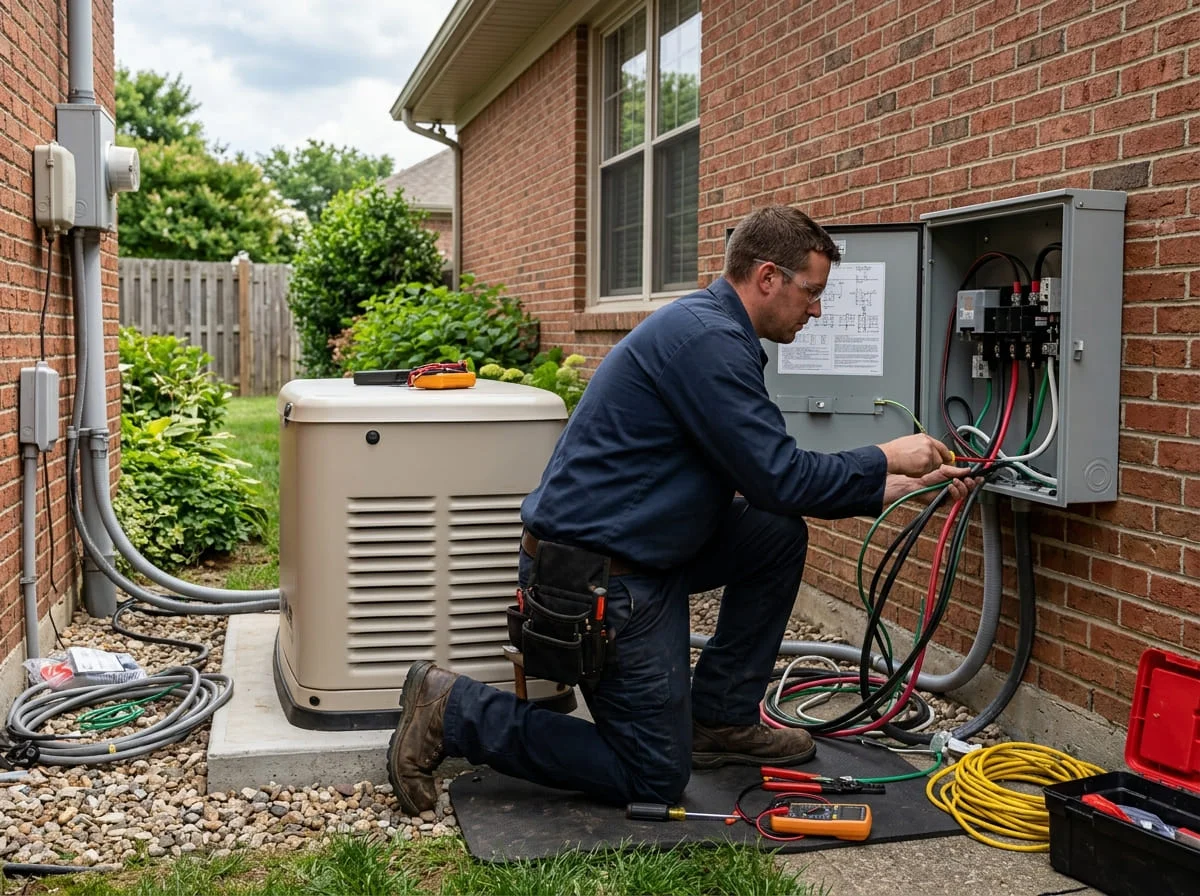
A generator hookup in Melbourne, FL runs $475 for a basic interlock kit up to $16,750 for a full whole-home standby system, and which option is realistic depends on a question this city's split housing stock makes more relevant than most: what kind of panel does the house actually have. A 1928 bungalow near downtown and a 2006 build west of I-95 both call about backup power, and they're often working from a completely different starting point.
Handyman Palm Bay FL assesses generator setups across Melbourne — the historic downtown blocks, Eau Gallie, the Riverview and Sherwood neighborhoods, the beachside approaches, and the newer subdivisions toward Wickham Road. Wiring a generator into the house is licensed electrical contractor work requiring a City of Melbourne permit and inspection, and a standby system's gas or propane line adds a licensed gas contractor with its own permit. We don't perform that licensed work ourselves — what we do is tell you honestly what your panel will support, size the generator to your actual load, and coordinate the trades who do the installation.
Generator Hookup Services We Coordinate in Melbourne
- Interlock kit installation — on panels with a UL-listed kit available for that brand and model
- Manual and automatic transfer switch installation — for panels without a listed interlock option or for whole-home standby systems
- 60-amp fuse service conversion — the prerequisite step for older downtown and Eau Gallie homes before any generator hookup is possible
- Residential load calculations — sizing the generator to what the house actually draws, not a guess based on square footage
- Natural gas and propane fuel assessment — checking what's actually available on your street before specifying a unit
- Power inlet box installation — a weatherproof exterior connection point for a portable generator
- Whole-home standby packages — generator, transfer switch, pad, and fuel line coordinated as one project
- Post-storm safety check — verifying an existing hookup wasn't compromised by flooding or a rushed installation before a prior storm
The Load Calculation Nobody Shows You — Applied to a Generator
The load calculation nobody shows you decides generator size the same way it decides panel size, and it's worth doing before you buy anything. A generator sized off a rule of thumb like "20 kW for a 2,500-square-foot house" routinely misses badly in either direction. The right approach totals what actually needs to run during an outage — HVAC, the water heater, the range, the dryer, the pool pump, and any car charger — against what you're willing to shed manually if the smallest, cheapest unit is the goal instead.
Where this trips people up in Melbourne is predictable.
The tech-corridor employment around the Harris and L3Harris campuses means a lot of home offices in this city, and homeowners planning a generator commonly assume the office setup drives the sizing. It doesn't. A workstation, three monitors, and networking equipment draws less than a hair dryer. The equipment that actually determines whether you need a 14 kW unit or a 22 kW unit is the same list every house has — air handler, water heater, range, dryer, pool pump — and getting that calculation done before ordering a generator is the difference between the right-sized unit and an oversized one you overpaid for.
Why a 60-Amp Fuse Service Can't Take a Generator Hookup
A 60-amp fuse service stops a generator hookup before it starts, which surprises homeowners in Melbourne's older neighborhoods who assume a generator is a simple add-on. An interlock kit requires a listed mechanism engineered for a specific breaker panel — a fuse box has no breaker to interlock with at all. A transfer switch is more flexible but still needs to tie into modern overcurrent protection on the load side, which a 60-amp fuse panel generally can't support alongside the house's existing demand.
This is the same fuse-service problem covered on our electrical panel upgrade page, and it means the sequence matters.
Downtown and Eau Gallie homes built in the 1920s through the 1950s on their original fuse service need that service converted to a modern breaker panel before a generator hookup is possible, not as an optional upgrade alongside it. Once that conversion is done, the generator hookup itself is no more complicated than on any newer Melbourne home, and homeowners who are already facing a fuse-service conversion for insurance reasons should plan the generator hookup into that same project rather than paying for two separate mobilizations.
Natural Gas or Propane — What's Actually Available in Melbourne
Natural gas or propane is a fuel decision Melbourne homeowners face more directly than some Brevard cities, because natural gas service exists here in pockets rather than citywide. Where a natural gas line already runs to the property, a standby generator ties into it directly and never needs refueling or a delivery schedule. Where it doesn't, which is most of the county outside a few served corridors, a propane tank is the standard alternative and sizes the same generators without limitation.
Checking availability is a five-minute call before it's a wasted quote.
A generator spec'd for natural gas without confirming the line exists at that address is a common and avoidable mistake, and it's one we check before recommending a fuel type rather than after a unit has been ordered. Propane tank placement has its own setback rules from the house and property line that a licensed installer coordinates with the pad location.
Salt Air on the Beachside Approaches
Salt air shortens a standby generator's enclosure life on Melbourne's eastern edge the same way it shortens an exterior panel's life, covered in more detail on our panel upgrade page. Homes on the beachside approaches and along the Eau Gallie riverfront sit close enough to the lagoon and the Atlantic that a steel enclosure corrodes on a visibly faster schedule than the same unit would inland.
Enclosure material is the fix, not maintenance.
An aluminum housing or a coated steel enclosure rated for coastal exposure costs more upfront than a standard unit but avoids the rust staining, stiff access panels, and premature enclosure failure that shows up on standard units within a few years this close to open water. Sealed conduit entries at every penetration matter just as much as the enclosure material itself, since a single unsealed entry point undoes the benefit of an otherwise corrosion-rated housing.
What the Job Actually Involves
A generator hookup in Melbourne follows a sequence worth knowing before the crew arrives. First, a load calculation determines the right generator size, and a panel check confirms whether an interlock kit is available or whether the panel needs a transfer switch — or, for the oldest fuse-service homes, a service conversion first. Second, the fuel source gets confirmed: natural gas line availability checked with the utility, or a propane tank sized and sited if natural gas isn't an option.
From there the trades split by scope.
Third, for a portable-generator setup, the licensed electrician pulls the permit, installs the interlock or transfer switch, and mounts a power inlet box on an exterior wall. Fourth, for a standby system, the pad gets poured, the gas or propane line gets run under its own permit, and the electrician sets the automatic transfer switch and lands the control wiring. Finally, the inspector signs off on each permit and the generator gets tested under an actual load before the job is considered complete.
Generator Hookup Pricing in Melbourne, FL
Interlock kit installation, panel-dependent: $475–$975.
Manual transfer switch, 6–10 circuits: $1,500–$2,650.
Power inlet box, added to an existing interlock or switch: $250–$500.
Whole-home standby system, 20–24 kW with automatic transfer switch: $9,750–$16,750.
Reinforced concrete pad with hurricane tie-downs: $1,000–$1,800.
Permit and inspection: $150–$400.
A 60-amp fuse service conversion, required before a generator hookup on older downtown and Eau Gallie homes, is priced on our electrical panel upgrade page. All pricing is confirmed in writing before any work begins, and the estimate is free. Call (877) 916-5930 or request a quote online — during hurricane season, jobs booked ahead of a storm get scheduling priority over jobs booked during one.
We coordinate generator hookups throughout Brevard County — including interlock and standby installation in Palm Bay.