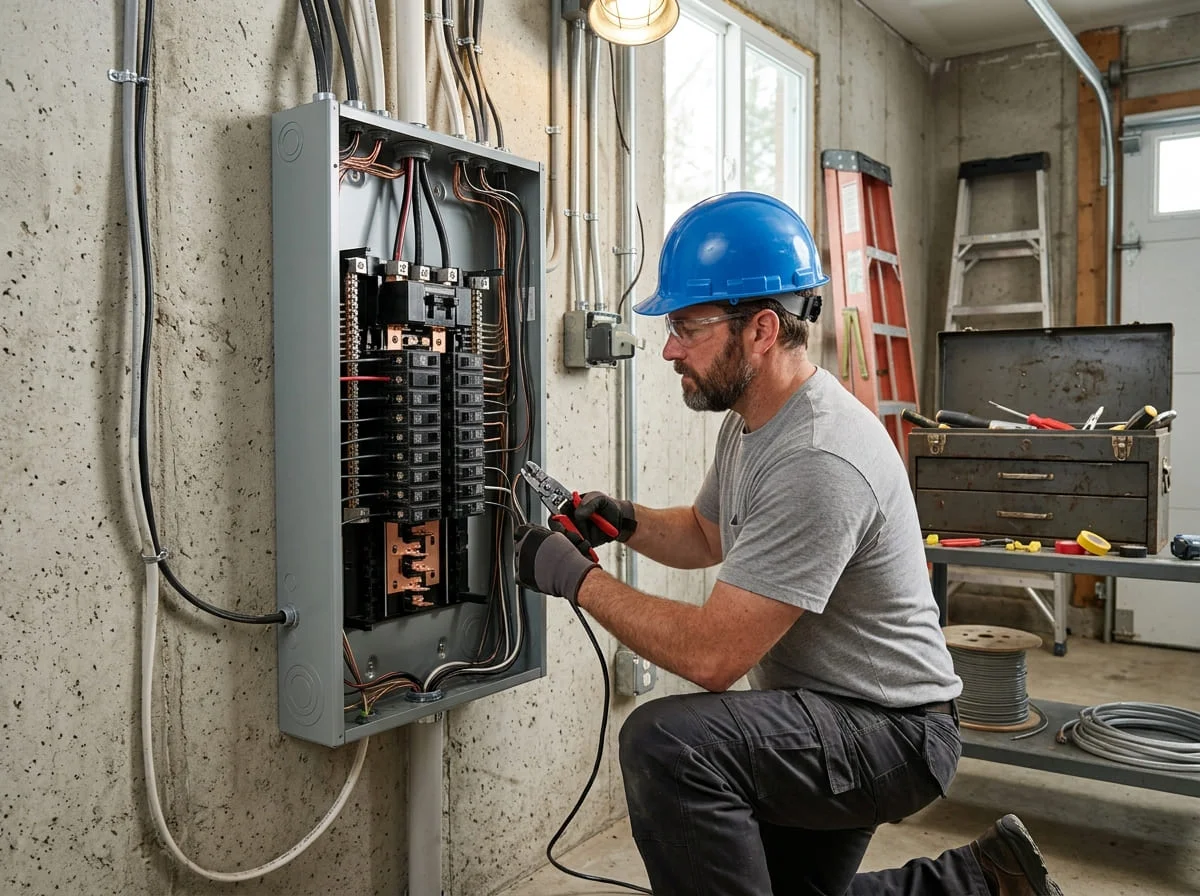
An electrical panel upgrade in Melbourne, FL runs $1,700–$4,400, and the number depends almost entirely on one question that gets asked backwards most of the time: does this house need a bigger service, or just a better panel? Melbourne makes that question harder than most Brevard cities because the housing stock splits so widely. A 1926 bungalow off New Haven Avenue and a 2004 four-bedroom west of I-95 are both Melbourne homes, and they arrive at a panel upgrade for opposite reasons.
Handyman Palm Bay FL assesses panels across Melbourne — the historic downtown blocks, Eau Gallie, the Riverview and Sherwood neighborhoods, the beachside approaches, and the newer subdivisions out toward Wickham Road and the interstate. Service changes are licensed electrical contractor work requiring a City of Melbourne permit, an inspection, and an FPL meter disconnect. We do not perform that portion ourselves and will say so plainly. What we do is run the assessment honestly, explain the load math in terms that let you check our reasoning, and coordinate the licensed electrician who pulls the permit.
Electrical Panel Services We Coordinate in Melbourne
- Residential load calculations — the arithmetic that decides whether you need 100, 150, or 200 amps
- 60-amp fuse service conversion — for the older downtown and Eau Gallie homes that never got updated
- Panel replacement at existing service size — when the panel is the problem and the service is adequate
- 200-amp service upgrades — meter, service entrance conductors, grounding, and panel together
- Flagged brand replacement — Federal Pacific, Zinsco, and Challenger panels named in insurance findings
- Dedicated circuit additions — home offices, workshops, and appliance circuits where the panel has room
- Subpanel installation — garages, additions, and converted spaces
- Panel schedule documentation — a legible, accurate circuit directory, which the code requires
The Load Calculation Nobody Shows You
A load calculation is the piece of a panel upgrade conversation that homeowners almost never get shown, and it is the only thing that separates a real recommendation from a guess. The method is not mysterious. An electrician totals the connected load in a house — the general lighting and receptacle load based on square footage, the fixed appliances, the largest of heating or cooling, and any dedicated loads — applies the demand factors the code allows because not everything runs at once, and compares the result against the service size.
Where Melbourne homes surprise people is which loads actually matter.
The tech corridor employment around the Harris and L3Harris campuses has filled this city with serious home offices, and homeowners routinely assume that a room with three monitors, a workstation, and networking gear is a heavy electrical load. It is not. That entire setup typically draws less than a single hair dryer. What actually consumes a Melbourne service is the equipment nobody thinks about: the air handler and compressor, the electric water heater, the range and oven, the dryer, the pool pump, and increasingly a car charger. Those are the loads that decide the answer. A homeowner convinced they need 200 amps because of a home office frequently needs a single dedicated circuit instead, at a tenth of the cost, and that is worth finding out before committing to a service change.
Downtown, Eau Gallie, and the 60-Amp Problem
The 60-amp service is the defining electrical problem in Melbourne's older neighborhoods. Homes built downtown and through Eau Gallie in the 1920s through the 1950s were served by fuse panels rated 60 amps, which was entirely adequate for a house with lighting, a refrigerator, a radio, and no air conditioning. Those houses now run central HVAC and a full complement of modern appliances on a service designed before any of it existed.
A fuse box also has a specific failure mode that a breaker panel does not.
When a circuit keeps blowing a 15-amp fuse, the fuse is doing its job and reporting a real overload. A breaker in that situation gets reset and the homeowner is annoyed. A fuse gets replaced — and because fuses are cheap, interchangeable, and sold on a rack by amperage, the replacement is very often a 20-amp or 30-amp fuse screwed into a socket protecting 14-gauge wire. That single substitution removes the protection entirely and leaves the wiring to act as the fuse instead. It is the most common dangerous condition we find in older Melbourne homes, and it is invisible until someone unscrews the fuse and reads the number stamped on it. Homes at this age frequently need attention to branch wiring alongside the service, particularly ungrounded two-wire circuits where GFCI protection on two-prong outlets is the affordable legal remedy.
What Insurance Carriers Look For in Melbourne
Insurance carriers looking at a Melbourne home focus on the electrical service more closely than most owners expect. A four-point inspection reports the panel brand, the service amperage, the wiring type, and any visible defects, and each of those can independently affect whether a policy is written. In a market where Florida carriers have narrowed sharply, a finding that would have been noted and ignored ten years ago now produces a decision.
Four findings drive most of the outcomes here.
First, a flagged panel brand — Federal Pacific, Zinsco, or Challenger — which is treated as a defect based on brand alone rather than on observed failure. Second, a 60-amp or smaller service, which many carriers will not write regardless of condition. Third, fuses rather than breakers, often grouped with the service size in the same finding. Fourth, cloth-insulated or knob-and-tube branch wiring, which is a wiring problem rather than a panel problem and is worth separating in your mind, because replacing the panel does not resolve it. That last distinction matters financially. A homeowner who spends $3,000 on a service upgrade to satisfy a carrier that actually flagged the branch wiring has solved the wrong problem, and the letter will come back. Read the finding carefully, and bring it to the estimate so the scope matches what is being asked.
Salt Air on the Beachside Approaches
Salt air shortens panel life measurably on Melbourne's eastern edge. Homes on the beachside approaches and along the Eau Gallie riverfront sit close enough to the Indian River Lagoon and the Atlantic that exterior meter and panel enclosures corrode on a schedule inland homes never see. The mechanism is straightforward — chloride-laden humidity condenses inside the enclosure overnight and works on every steel and aluminum surface it touches.
The signs are legible once you know what to look for.
Rust staining below the enclosure door, white or greenish deposits on the bus bar and breaker terminals, stiff breaker handles, and a door that no longer closes flush are all corrosion. None of them mean the panel failed today. All of them mean the connections inside are degrading, and a degrading connection generates heat under load. On a riverfront home where an exterior panel has sat for thirty years, corrosion alone justifies replacement independent of brand or capacity, and it is one of the few cases where an otherwise modern panel needs to come out early. Choosing an enclosure with a better corrosion rating and mounting it with proper weatherproofing at the conduit entries is the part of the specification worth paying attention to on this side of town.
Electrical Panel Upgrade Pricing in Melbourne, FL
Panel replacement, same service size: $1,700–$2,800.
100-amp to 200-amp full service upgrade: $2,400–$4,000.
60-amp fuse service conversion to modern breaker panel: $2,600–$4,400.
Federal Pacific, Zinsco, or Challenger replacement: $1,950–$3,300.
Residential load calculation: included with any panel estimate.
Permit and inspection: $150–$400.
Whole-home surge protector installed at the panel: $325–$550.
Dedicated 20-amp circuit added to an existing panel: $285–$495.
Older downtown and Eau Gallie homes generally sit at the higher end because the service entrance and grounding electrode system get replaced along with the panel rather than reused. All pricing is confirmed in writing before work begins, and the estimate is free. Call (877) 916-5930 or request a quote online to get scheduled. You can see the full range of what we handle in this city on our Melbourne handyman services page.
We assess panels throughout Brevard County — including Federal Pacific and Zinsco replacement in Palm Bay and service capacity work in Rockledge.