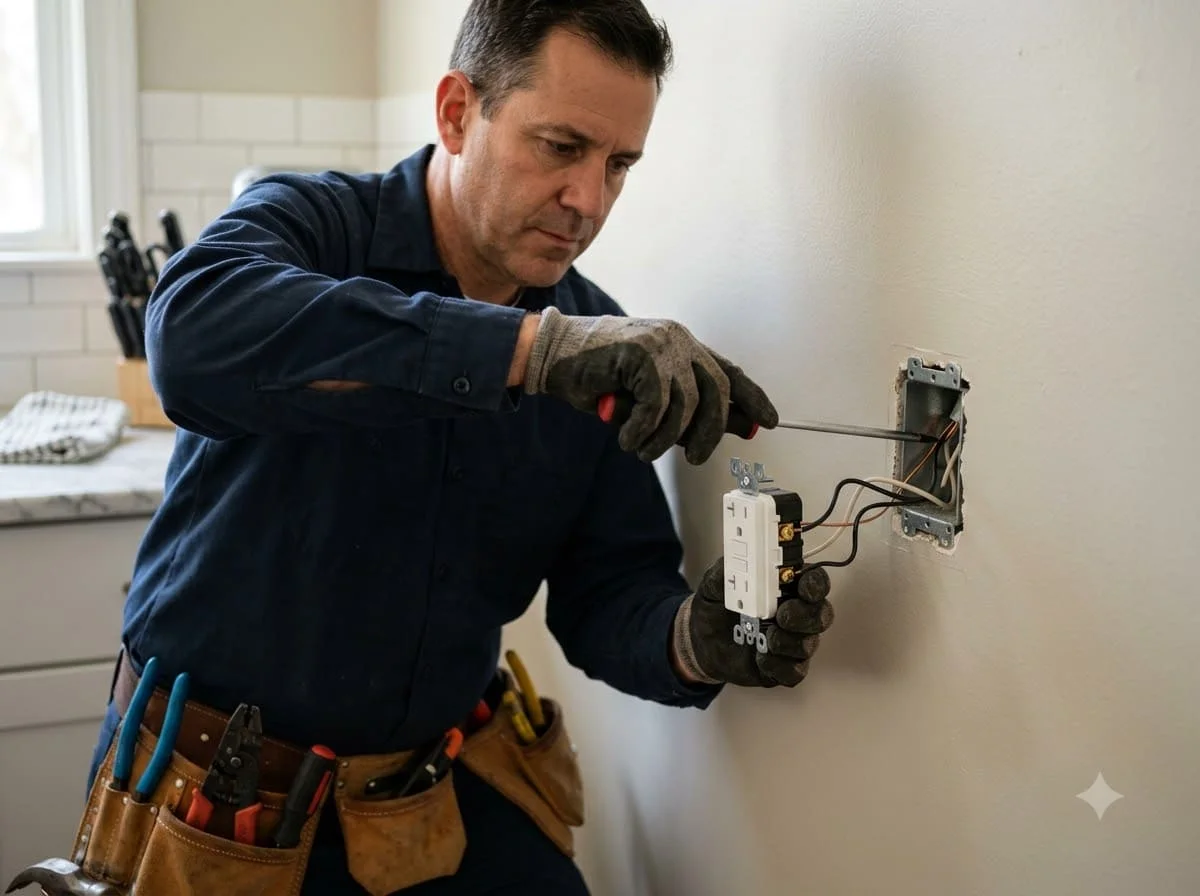
GFCI outlet installation in Palm Bay, FL runs $125–$225 per location, and a typical 1970s Port Malabar house is missing protection in five or six of them. The reason is chronology rather than negligence. Ground-fault protection entered the National Electrical Code one room at a time — outdoor and bathroom receptacles in 1975, garages in 1978, kitchen countertop receptacles near the sink in 1987, all countertop receptacles in 1996, and laundry areas later still. A house permitted in 1978 was fully compliant with a single protected receptacle in the bathroom, and if nobody has touched it since, that is still all it has.
Handyman Palm Bay FL installs, replaces, and troubleshoots ground-fault protection across the entire city — the Port Malabar street grid, Bayside Lakes, Palm Bay Point, Palm Bay Village, the newer subdivisions off Emerson Drive and Malabar Road, and the canal-front homes on the southeast side where salt air shortens the life of every outdoor device. We map your home against the locations current code protects, tell you plainly which gaps matter and which are cosmetic, and fix the underlying fault when a receptacle keeps tripping instead of selling you a replacement that will do the same thing. Where the wiring behind the wall is the real problem, we look at panel and circuit upgrades in the same visit.
Ground-Fault Protection Services We Provide in Palm Bay
- Whole-home GFCI audit — every location current code protects, checked against what your house actually has
- Standard-to-GFCI receptacle replacement — kitchens, bathrooms, garages, laundry areas, and outdoors
- Ungrounded circuit protection — two-prong outlets brought up to a safe, labeled, code-recognized standard
- GFCI circuit breakers — panel-level protection covering an entire circuit at once
- Weather-resistant outdoor receptacles — WR-rated devices with in-use bubble covers rated for Florida rain
- Nuisance trip diagnosis — finding the moisture, damaged cable, or failing appliance actually causing it
- End-of-life replacement — identifying pre-2015 devices with no self-test function
- Lanai, pool equipment, and dock receptacles — the wet-location circuits that matter most on the canals
Why Port Malabar Homes Have So Few Protected Outlets
Port Malabar homes have so few protected outlets because the code kept expanding after they were finished. General Development Corporation platted this street grid on a scale nothing else in Brevard County matched, and the houses that filled it through the 1970s and early 1980s were wired to the requirements of their permit year. Each later NEC cycle added rooms to the list — but a code edition applies to new work, not retroactively to a house that already exists. Nothing about your 1978 kitchen became illegal in 1996. It simply stopped matching what the code had learned about where people get shocked.
Florida's construction style narrows the list in a way that surprises people who moved here from the Northeast.
Current code requires protection in crawl spaces and basements, and Palm Bay's slab-on-grade CBS homes have neither, so two whole clauses fall away before we start. What's left is the list that actually applies here: kitchen countertops, bathrooms, the garage, the laundry area, outdoors, any receptacle within six feet of a sink, and any within six feet of a tub or shower. That last pair catches homeowners off guard constantly — the outlet on a wall six feet from the wet bar sink or the guest bath tub is covered by the same rule as the one right beside it. We count the locations, walk you through the list, and put the number in writing before anything gets replaced.
Protecting Two-Prong Outlets Without Rewiring the House
Protecting two-prong outlets without rewiring is entirely legitimate, and it rests on how the device actually works. A GFCI measures the current leaving on the hot conductor against the current returning on the neutral. When those two figures diverge by roughly 6 milliamps, something is leaking to earth — possibly through a person — and the device opens the circuit in a fraction of a second. An equipment grounding conductor plays no part in that comparison, which is why NEC 406.4(D)(2) permits a GFCI to replace a non-grounding receptacle on a two-wire circuit.
The labeling is not optional, and it is where most DIY retrofits fall down.
First, the GFCI itself and every outlet fed downstream from it must be marked "GFCI Protected" and "No Equipment Ground." Second, no ground wire may be run from the GFCI back to those downstream receptacles. Finally, the homeowner needs to understand what the upgrade does and does not deliver: you gain genuine shock protection and a usable three-prong outlet, but surge protectors and any equipment that relies on a true ground still have nothing to reference. We explain that distinction honestly rather than leaving you to discover it when a surge strip fails to do its job. If the ungrounded circuits run throughout the house, replacing failing receptacles in the same trip usually costs less than a second call-out.
Salt Air, Canals, and Outdoor Receptacles on the Southeast Side
Salt air and canal humidity destroy outdoor receptacles here faster than anywhere inland in Brevard County. Palm Bay's southeast quadrant is threaded with saltwater canals running to the Indian River Lagoon, and the homes along them carry exterior devices for boat lifts, dock lighting, pool pumps, and lanai outlets that sit in salt-laden air every day of the year. We routinely open weatherproof boxes on those streets to find green corrosion across the terminals and a GFCI that resets normally but no longer trips on the test button — a device that is, functionally, an ordinary outlet with a reassuring label on it.
Two hardware details make the difference between a five-year device and a fifteen-year one.
Outdoor locations need a weather-resistant receptacle — marked WR — paired with an in-use cover, the deep bubble type that stays closed over a plugged-in cord rather than the flat flip-lid that only seals when nothing is connected. A flip-lid cover on a canal-front lanai with a pump cord permanently plugged into it is an open box. Beyond the hardware, monthly testing matters more in this environment than the manufacturer's card suggests: press the test button, confirm power drops, then reset. A device made before June 29, 2015 predates the UL 943 self-test mandate entirely and will give you no warning whatsoever when its electronics quit. Exterior circuits are also the natural moment to handle landscape and security lighting, since that wiring needs the same protection.
What Florida Code Requires Right Now — and What Changes This December
Florida code currently sits on the 8th Edition (2023) Florida Building Code, which adopts the 2020 National Electrical Code. Under that edition, 210.8(A) covers all 125-volt through 250-volt receptacles on single-phase branch circuits rated 150 volts or less to ground, across eleven listed dwelling locations. The 2020 cycle widened the net noticeably — it took laundry areas from "within six feet of a sink" to the whole area, and it raised the ceiling from 125-volt 15- and 20-amp devices to 250 volts, which pulls in circuits people never associated with GFCIs before.
Two dates are worth having on your calendar if you own a Palm Bay home.
The 9th Edition (2026) Florida Building Code takes effect December 31, 2026, and the Florida Building Commission conducted its electrical review against the 2023 NEC — so permits pulled after that date fall under a newer set of rules than permits pulled today. Separately, the NEC's temporary exemption for listed outdoor HVAC equipment under 210.8(F) is written to expire September 1, 2026, which is directly relevant in a city where every house has a condenser sitting outside in the weather. Local building departments have the final word on how each provision is enforced on your specific permit, and we'll tell you when a job genuinely needs a permitted licensed electrician rather than taking work outside our scope. Ground-fault protection also pairs naturally with a smoke alarm coverage check, since both are gaps that older Palm Bay homes carry quietly for decades.
GFCI Outlet Installation Pricing in Palm Bay, FL
Standard receptacle replaced with a GFCI on an existing grounded circuit: $125–$195 per location.
Ungrounded two-wire circuit protected and labeled to 406.4(D)(2): $145–$225 per location.
GFCI circuit breaker supplied and installed at the panel: $185–$325.
Weather-resistant outdoor GFCI with in-use bubble cover: $165–$260.
Whole-home retrofit covering six to eight locations: $650–$1,200.
Intermittent or nuisance trip diagnosis: $95–$185.
New receptacle added where none currently exists: $225–$400 depending on the run.
All pricing is confirmed in writing before any work begins, and the estimate is free. Call (877) 916-5930 or request a quote online and we'll schedule you — most Palm Bay jobs go out same-day. You can see the full range of what we handle locally on our Palm Bay handyman services page.
We cover the same work across the county — including ground-fault protection in West Melbourne and GFCI troubleshooting in Melbourne.