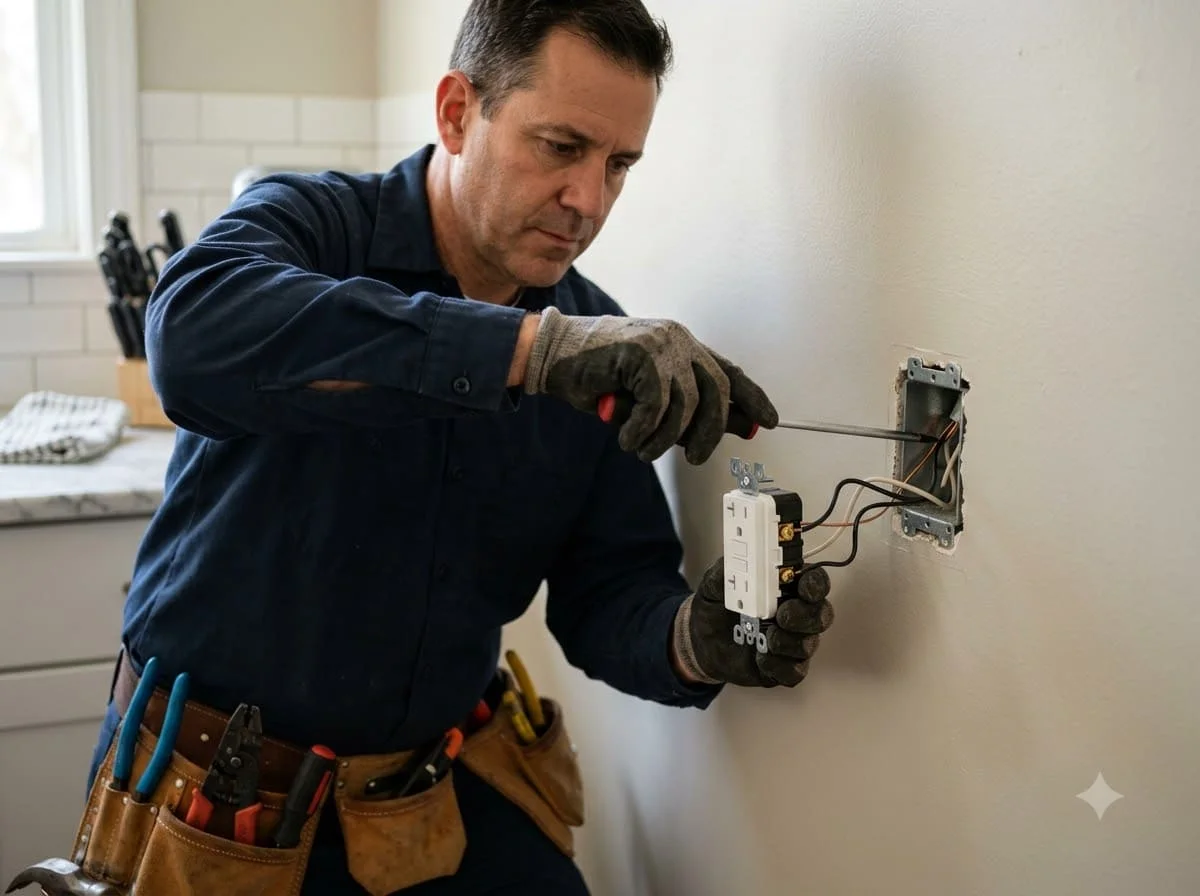
GFCI outlet installation in Cocoa, FL runs $120–$215 per location, and for the majority of homes in this city the job starts with an outlet that has only two slots in it. Cocoa's character lives in the historic Village, where houses built between the 1920s and 1950s were wired with two-conductor cable and no equipment ground — decades before ground-fault protection was invented, let alone required. A three-prong plug does not fit those receptacles. What fills that gap in a great many Cocoa houses is a hardware-store adapter, and that adapter is the most dangerous object in the room.
Handyman Palm Bay FL installs ground-fault protection across Cocoa — the Village blocks, the neighborhoods along Brevard Avenue and Dixon Boulevard, the substantial share of local housing that operates as rental property, and the newer homes running toward the Rockledge line. In houses of this age we inspect the existing wiring before adding anything to it, work carefully around plaster and original trim, and use the retrofit route the electrical code specifically provides for ungrounded circuits. It's the same care we bring to dimmer switch work and doorbell camera wiring in Cocoa's period homes.
Ground-Fault Services We Provide in Cocoa
- Two-prong outlet upgrades — ungrounded receptacles replaced with protected, correctly labeled devices
- Kitchen and bathroom protection — the highest-value starting point in a small historic home
- Rental property compliance — devices, testing, and the labeling inspectors actually check
- Pre-installation wiring inspection — conductor and box condition assessed before new devices go in
- GFCI circuit breakers — whole-circuit protection where receptacle boxes are too shallow
- Weather-resistant exterior devices — WR receptacles and in-use covers for porches and yards
- Laundry and utility area protection — locations the 2020 code cycle expanded
- Failed device replacement — units that reset but no longer trip on test
Two-Prong Outlets and the Legal Way to Fix Them
Two-prong outlets have a legal fix that costs a fraction of rewiring, and it exists because of how the protection works. A GFCI compares the current flowing out on the hot conductor with the current returning on the neutral. When those figures differ by roughly 6 milliamps, current is escaping the circuit — possibly through a person — and the device opens in a fraction of a second. That comparison never touches an equipment grounding conductor. This is why 406.4(D)(2) of the 2020 National Electrical Code — the edition Florida enforces today through the 8th Edition (2023) Florida Building Code — permits a GFCI to replace a non-grounding receptacle on a two-wire circuit. The 9th Edition takes effect December 31, 2026 and was reviewed against the 2023 NEC, so a permit pulled after that date is judged against a newer rule set than one pulled today.
The adapter most people use instead does the opposite of what they believe.
A cheater plug makes a grounded cord fit an ungrounded outlet by simply omitting the ground connection. Nothing is grounded afterward. If a fault develops inside an appliance, the metal housing can become energized and stay that way, because there is no path for fault current to trip the breaker — the circuit reads as perfectly normal until somebody completes it. A GFCI in that same location detects the escaping current and cuts power whether a ground exists or not. First we confirm the circuit is genuinely ungrounded rather than assuming it. Second we fit the device. Finally we apply the required markings, which is where most retrofits fall short.
Small Historic Kitchens and the Six-Foot Sink Rule
Small historic kitchens run into the six-foot sink rule in a way that larger modern kitchens don't. Under that same edition, 210.8(A) requires ground-fault protection for receptacles serving countertop surfaces, and separately for any receptacle installed within six feet of the top inside edge of a sink bowl. In a spacious 2005 kitchen those are two distinct sets of outlets. In a 1930s Cocoa Village kitchen measuring twelve feet across, six feet from the sink frequently covers the entire room.
Homeowners are routinely surprised by which outlets the measurement captures.
The receptacle on the far wall behind the kitchen table is not obviously a wet-location device, but if it sits within six feet of the sink bowl, the rule reaches it. The same applies to outlets around the bathroom sink and to anything within six feet of the outside edge of a tub or shower. We measure from the bowl rather than estimating, because the requirement is dimensional and these rooms are tight enough that a foot changes the answer. For most Village homes, protecting the kitchen and the bathroom together is the sensible first phase — it addresses the two rooms where water and electricity actually meet, at a cost that doesn't require financing, and the rest of the house can follow when it suits. Since alarm coverage is the other gap these houses carry quietly, a smoke alarm assessment in the same visit is usually worth the time.
Rental Properties, Labeling, and What Inspectors Check
Rental properties in Cocoa attract closer scrutiny of exactly this work, and the labeling is where compliant installations most often fail. A large share of the local housing stock is tenant-occupied, and where an inspection happens the reviewer is looking for three things. First, protection present in every location code requires. Second, devices that actually trip when the test button is pressed, since an installed device and a functioning one are not the same claim. Third, correct marking wherever a GFCI protects an ungrounded circuit.
That third item is a genuine code requirement rather than a paperwork formality.
NEC 406.4(D)(2) requires the device and every outlet fed downstream from it to be marked "GFCI Protected" and "No Equipment Ground," and it prohibits running an equipment grounding conductor from the GFCI to those downstream receptacles. The markings exist so that a future occupant or contractor knows the outlet offers shock protection but no ground reference — which matters the moment somebody plugs in a surge protector expecting it to work. We label every affected receptacle as part of the installation and leave the property owner a written record of which devices protect which outlets. For a landlord managing several Cocoa properties, that record is worth more than the labels themselves at renewal time. Older houses often want a wiring safety check and an electrical upgrade assessment alongside the retrofit, and we're straightforward about when that's warranted.
GFCI Outlet Installation Pricing in Cocoa, FL
Standard receptacle replaced with a GFCI on a grounded circuit: $120–$185 per location.
Ungrounded two-wire circuit protected and fully labeled to 406.4(D)(2): $140–$215 per location.
Kitchen and bathroom protected together — the usual first phase: $280–$450.
GFCI circuit breaker supplied and installed at the panel: $180–$310.
Weather-resistant exterior GFCI with in-use bubble cover: $160–$250.
Whole-property device test with written record for landlords: $85–$150.
Box extension where an original box is too shallow for a GFCI: add $35–$70 per location.
All pricing is confirmed in writing before any work starts, and estimates are free. Call (877) 916-5930 or request a quote online — we schedule most Cocoa addresses within a day or two. See the full range of what we handle locally on our Cocoa handyman services page, or bundle the trip with ceiling fan installation while we're already on site.
The same service runs down the county — riverfront and boathouse circuits in Rockledge and code retrofits in Palm Bay.