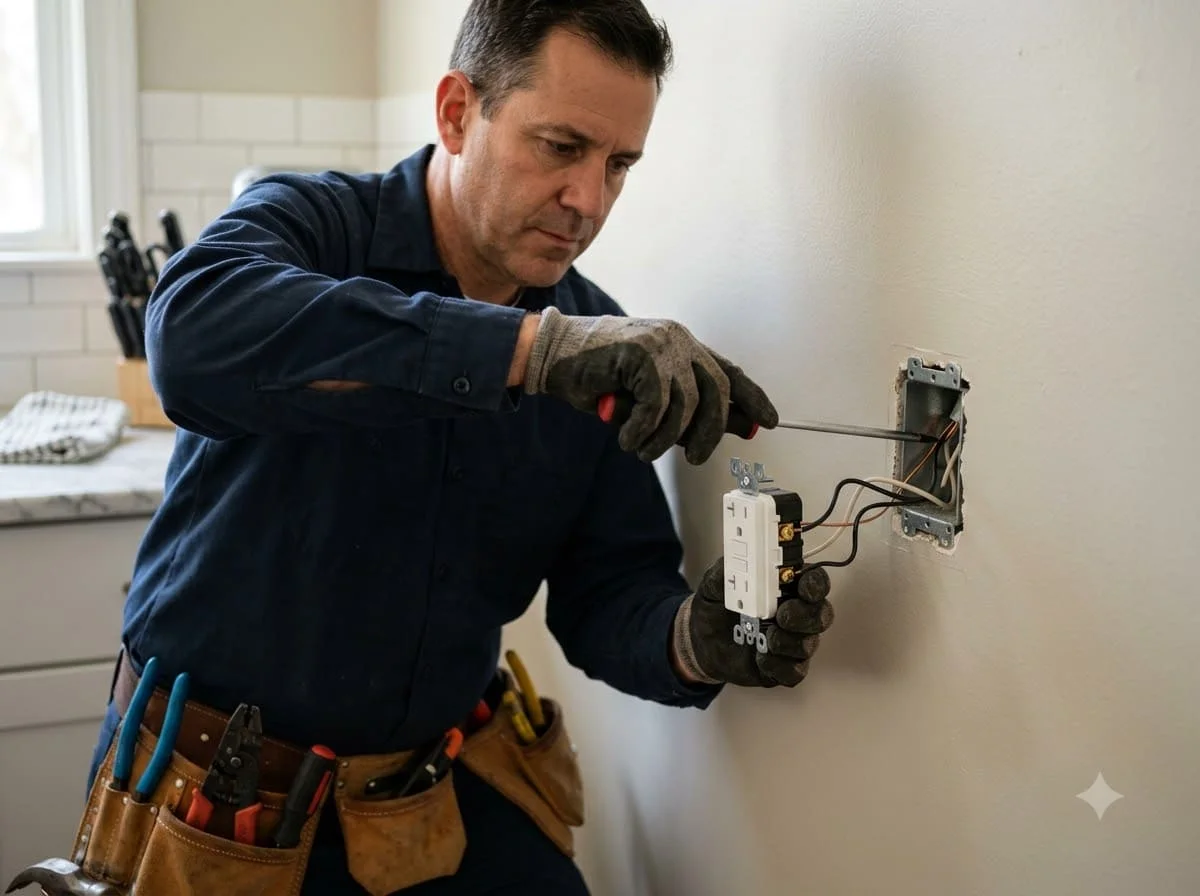
GFCI outlet installation in Rockledge, FL runs $135–$245 per location, and this is the one Brevard city where the code's boathouse clause is a routine part of the conversation rather than a footnote. Under the 2020 National Electrical Code — the edition Florida currently enforces through the 8th Edition (2023) Florida Building Code — 210.8(A) lists boathouses among the dwelling locations requiring ground-fault protection, right alongside bathrooms and garages. In most of Brevard County that line is theoretical. Along Rockledge Drive, where properties run down to the Indian River with docks and boathouses at the bottom of the lawn, it describes real buildings with real receptacles in them.
Handyman Palm Bay FL installs and replaces ground-fault protection throughout Rockledge — the riverfront estates on Rockledge Drive, the older central neighborhoods around Barton Boulevard, the mid-century homes off Fiske Boulevard, and the newer developments running north toward Viera. The two ends of that range need genuinely different work. A 1950s riverfront house often has no protection at all in rooms that now require it, while a 2010 Viera-area build has protection everywhere and needs its aging devices tested. We treat them as the different problems they are.
Ground-Fault Services We Provide in Rockledge
- Waterfront and boathouse receptacles — protected devices in corrosion-rated enclosures at the shoreline
- Whole-home coverage audit — every location current code protects, checked against what the house has
- Circuit mapping and labeling — identifying which device controls which downstream outlets in large homes
- Ungrounded circuit protection — two-prong outlets brought to a labeled, code-recognized standard
- Period-home device replacement — working inside existing boxes without disturbing plaster
- GFCI circuit breakers — panel-level protection where downstream chains have grown unwieldy
- Outdoor kitchen and pool equipment circuits — wet-location devices on estate exteriors
- Pre-2015 device replacement — units manufactured before self-test was required
Boathouses, Docks, and the Indian River Shoreline
Boathouses and the Indian River shoreline put receptacles in the harshest environment a Brevard County home offers. Salt-laden air moves across these properties constantly, and the structures at the water's edge get spray, sustained humidity, and none of the shelter the house itself provides. Corrosion attacks terminals, and moisture inside an enclosure raises leakage current directly — which is why waterfront devices trip and fail years before the ones on the same property's street side.
Getting this right is mostly a hardware and enclosure question rather than a wiring one.
First, the receptacle itself must be weather-resistant, marked WR, because a standard device's face and internals degrade quickly in this air. Second, the cover has to be the in-use bubble type that stays sealed over a connected cord — a flip-lid cover on a boat lift or dock light circuit that is permanently plugged in provides no protection from weather at all. Finally, the enclosure and fasteners need to be rated for a marine environment, since ordinary steel screws in a boathouse box are rust streaks within two seasons. We should also be clear about scope: 210.8(A) covers the boathouse, and dock and shoreline power installations carry further requirements beyond it. When a job crosses into that territory, we say so and point you to a licensed electrical contractor rather than working past the edge of what a handyman should touch in Florida.
Why One Tripped Device Kills Outlets in Three Rooms
One tripped device kills outlets in three rooms because of how downstream protection is wired. A GFCI has line terminals and load terminals, and anything connected to the load side is protected by that device — ordinary receptacles, with no test button and no visible indication of what governs them. It is an efficient and entirely correct way to protect a run of outlets with a single device. In a small house it is also easy to follow. In a large Rockledge home with additions built across different decades, those chains sprawl.
The practical result is a homeowner hunting for a reset button with no idea where it lives.
We find garage devices controlling exterior receptacles on two different elevations, a bathroom GFCI feeding an outlet in a hallway forty feet away, and — on properties where a boathouse or workshop was wired later — one device at the house governing outlets in an outbuilding. First we map what feeds what, testing each device and recording which receptacles drop. Second we label every downstream outlet so the next person to face a dead circuit isn't repeating the exercise. Third, where a chain has become genuinely unreasonable, we recommend a GFCI breaker at the panel, which protects the whole circuit from a single obvious location. Homes where the panel itself is undersized for that approach need an electrical upgrade looked at first, and we'll tell you if that's the case.
Working Inside Period Homes Without Damaging Plaster
Working inside period homes without damaging plaster is straightforward for device replacement and demanding for anything beyond it. Swapping a receptacle for a GFCI happens entirely within the existing box — cover plate off, device out, new device in, cover plate on. Nothing is cut and nothing new penetrates the wall. That is why protecting an older Rockledge Drive house is far less invasive than owners expect, and why we usually recommend doing it before any other electrical work.
Two complications turn up often enough in older houses to plan around.
The first is box depth. A GFCI has a deeper body than an ordinary receptacle, and the shallow metal boxes common in mid-century construction sometimes cannot take one safely without crowding the conductors. Where that happens the honest options are a box extension or a GFCI breaker at the panel — not forcing the device in. The second is the plaster itself, which grows brittle with age and can chip at the box edge when a painted-on cover plate is removed. We score the paint line before lifting a plate rather than pulling and hoping. Where these houses also have no equipment ground, 406.4(D)(2) lets a GFCI replace the non-grounding receptacle legally, provided it and every outlet downstream carry "GFCI Protected" and "No Equipment Ground" markings. Both provisions come from the edition in force today; the 9th Edition Florida Building Code arrives December 31, 2026 and was reviewed against the 2023 NEC, so anything permitted after that date is judged against a newer rule set. Since we're already working at ceiling and wall level, it's a practical moment to handle ceiling fan installation or a smoke alarm coverage check in the same visit.
GFCI Outlet Installation Pricing in Rockledge, FL
Standard receptacle replaced with a GFCI on a grounded circuit: $135–$210 per location.
Ungrounded two-wire circuit protected and labeled to 406.4(D)(2): $155–$245 per location.
GFCI circuit breaker supplied and installed at the panel: $190–$340.
Weather-resistant exterior GFCI with in-use bubble cover: $175–$285.
Boathouse or waterfront location with marine-rated hardware: $225–$350.
Whole-home circuit mapping and downstream labeling: $120–$220.
Box extension where an existing box is too shallow: add $35–$70 per location.
Every figure is confirmed in writing before work begins, and estimates are free. Call (877) 916-5930 or request a quote online to get on the schedule. More about the work we handle across the city is on our Rockledge handyman services page, and exterior circuits pair naturally with landscape and security lighting.
We work the surrounding cities on the same terms — two-prong outlet upgrades in Cocoa and GFCI trip diagnosis in Melbourne.