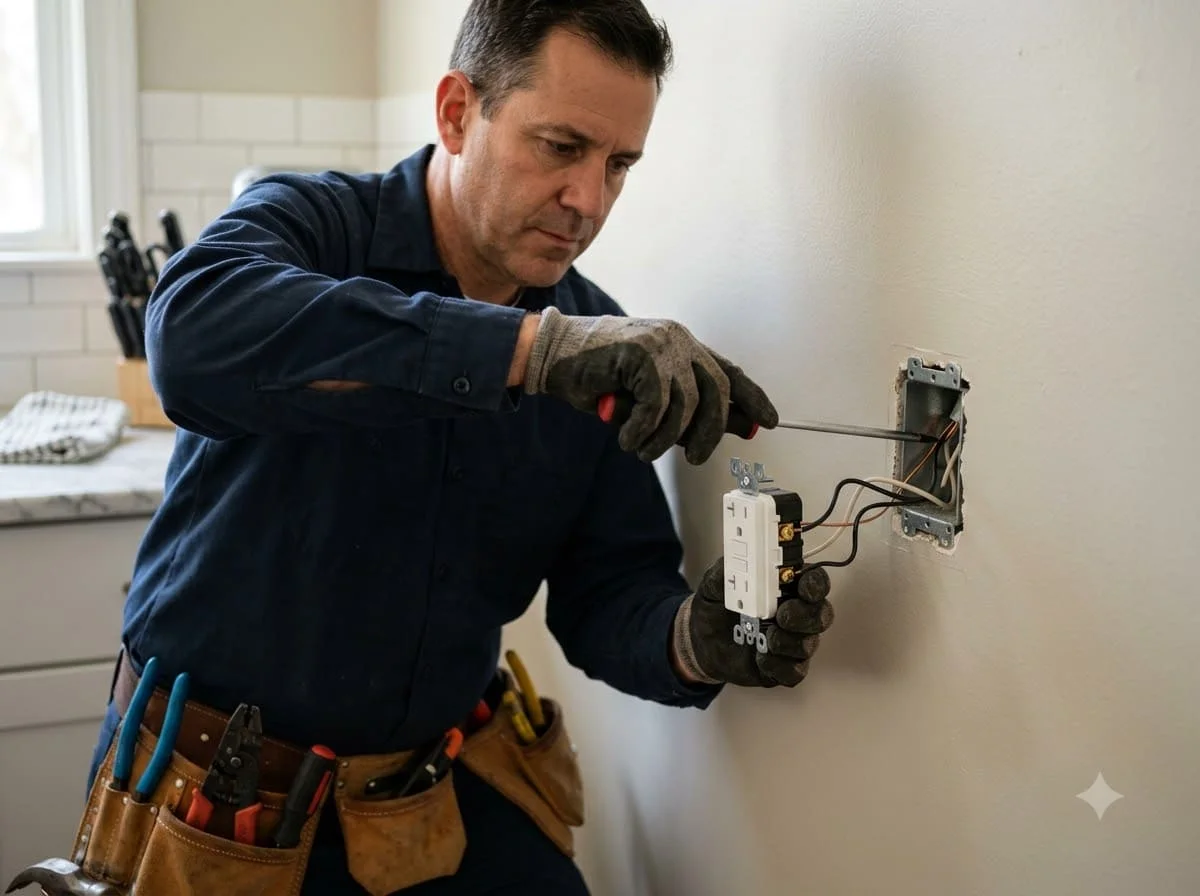
GFCI outlet installation in Melbourne, FL runs $135–$235 per location, and more than half the calls we take in this city are not installations at all — they are a device that keeps tripping and a homeowner who has already replaced it twice. A Class A GFCI is required to trip at 6 milliamps of leakage current and is not permitted to trip below 4. That narrow band is the entire diagnostic problem. When a circuit sits at 4.5 mA all day, the device is working exactly as designed, the wiring is not faulty, and swapping in a third receptacle changes nothing.
Handyman Palm Bay FL installs and troubleshoots ground-fault protection throughout Melbourne — Eau Gallie, the downtown grid off New Haven Avenue, the neighborhoods bordering the Indian River Lagoon, the established 1980s and 1990s subdivisions along the Palm Bay Road corridor, and the homes filled with engineers who work at Harris and want to understand the fault before they authorize the fix. We measure rather than guess, explain what the meter shows, and put the actual cause in front of you. Where an older Melbourne house has no equipment ground behind the walls at all, we protect the circuit legally without opening plaster, exactly as we do for dimmer switch work in the same houses.
Ground-Fault Protection Services We Provide in Melbourne
- Nuisance trip diagnosis — measuring actual leakage current instead of replacing parts in sequence
- Standard-to-GFCI replacement — kitchens, bathrooms, garages, laundry areas, and exterior walls
- Ungrounded circuit protection — the code-recognized retrofit for Eau Gallie and downtown two-wire wiring
- Dedicated circuits for home offices — separating leaky electronics from protected kitchen and bath circuits
- GFCI circuit breakers — whole-circuit protection where individual receptacles are hard to reach
- Weather-resistant exterior devices — WR-rated receptacles and in-use covers for lagoon-side humidity
- Pre-2015 device replacement — identifying units with no self-test capability
- Monthly test failures — devices that reset but no longer trip when tested
Why a Melbourne GFCI Trips With Nothing Obviously Wrong
A GFCI trips with nothing obviously wrong because leakage current accumulates quietly across everything sharing the circuit. The device is not looking for a short or an overload — it compares the current flowing out on the hot conductor against the current returning on the neutral, and any meaningful difference means some of it went somewhere else. Motors, heating elements, and the input filters inside modern electronics all pass a small amount to ground during entirely normal operation. Individually those figures are trivial. Added together on one branch circuit, they are not.
This is why the trip so often correlates with a specific combination rather than a specific appliance.
A refrigerator compressor might contribute half a milliamp, a coffee maker's heating element another fraction, a microwave more again — and the circuit crosses 6 mA only when several run at once. Homeowners reasonably conclude the GFCI is defective, because each appliance works fine on its own. The genuine faults we do find in Melbourne are usually a cable damaged inside a wall, a receptacle that has taken on moisture near an exterior door, or one appliance with a degraded heating element leaking far more than its share. Telling those apart requires a clamp meter and a methodical process of isolating loads, which is the part a parts-swap approach skips entirely.
Eau Gallie and Downtown: Older Wiring, Newer Requirements
Older wiring in Eau Gallie and downtown Melbourne meets newer requirements through a specific allowance in the code rather than through rewiring. A great many houses in these neighborhoods were built decades before equipment grounding was standard practice, and they still run two-wire cable with two-prong receptacles. NEC 406.4(D)(2) permits a GFCI to replace a non-grounding receptacle precisely because ground-fault detection never uses the ground conductor — the comparison happens between hot and neutral.
The labeling requirement carries real weight and is the step DIY retrofits skip.
First, the GFCI and every receptacle fed from it must be marked "GFCI Protected" and "No Equipment Ground." Second, no equipment grounding conductor may be run from the GFCI to those downstream outlets. Third, you should understand the limits of what you have bought: shock protection is genuine and complete, but surge protection is not, because a surge strip needs a real ground path to divert energy into and a labeled outlet does not provide one. For a homeowner running expensive equipment in a 1940s Eau Gallie bungalow, that distinction is worth knowing before the next thunderstorm rather than after. Where receptacles themselves are loose or scorched, we handle outlet repair on the same visit.
Home Offices, Lab Benches, and Shared Kitchen Circuits
Home offices and lab benches create a leakage problem that Melbourne sees more than most Florida cities. The engineering workforce around the Harris and L3Harris campuses has produced a lot of houses with a serious workspace in them — a rack of network gear, a UPS, multiple workstations, test equipment, sometimes a small server. Switch-mode power supplies use input filters that intentionally pass current to ground, commonly on the order of half a milliamp to a milliamp per device, and that is by design rather than by fault.
Eight devices at 0.75 mA each is 6 mA, which is the trip threshold with nothing else running.
The answer is not to strip protection out of rooms where code requires it. First we measure what the equipment is actually drawing to ground, because published figures and real behavior differ. Second we look at what else shares that circuit, since a home office wired off a bedroom circuit that also feeds a bathroom receptacle is a common and awkward find. Finally we split the load — a dedicated circuit for the rack, or redistributing the workspace so protected locations aren't carrying equipment leakage on top of their own. Aquariums and chest freezers in Melbourne garages produce the identical symptom for the identical reason. If the panel has no room left for another breaker, that becomes an electrical upgrade conversation rather than a receptacle one, and we'll say so plainly.
What Florida Enforces Today and What Arrives in December
Florida enforces the 8th Edition (2023) Florida Building Code today, which adopts the 2020 National Electrical Code. Under 210.8(A), protection is required for all 125-volt through 250-volt receptacles on single-phase branch circuits rated 150 volts or less to ground, across eleven listed dwelling locations — bathrooms, garages and grade-level accessory buildings, outdoors, crawl spaces, basements, kitchen countertop receptacles, anything within six feet of a sink, boathouses, anything within six feet of a tub or shower, laundry areas, and indoor damp or wet locations.
The 9th Edition (2026) Florida Building Code takes effect December 31, 2026.
The Florida Building Commission conducted its electrical review for that edition against the 2023 NEC, so a permit pulled in January falls under different rules than one pulled this month. There is also a date worth noting for anyone with a variable-speed condenser outside: the NEC's temporary exemption for listed outdoor HVAC equipment under 210.8(F) is written to expire September 1, 2026. Your local building department is the authority on how any of this applies to your specific permit, and when a job needs a licensed electrical contractor rather than a handyman, we tell you that up front instead of taking it on. Melbourne homeowners adding exterior devices often pair the work with video doorbell wiring while we're already at the front of the house.
GFCI Outlet Installation Pricing in Melbourne, FL
Standard receptacle replaced with a GFCI on a grounded circuit: $135–$205 per location.
Ungrounded two-wire circuit protected and labeled to 406.4(D)(2): $150–$235 per location.
GFCI circuit breaker supplied and installed at the panel: $190–$335.
Weather-resistant outdoor GFCI with in-use bubble cover: $170–$270.
Whole-home retrofit covering six to eight locations: $700–$1,250.
Leakage measurement and intermittent trip diagnosis: $95–$185.
New dedicated circuit for a home office or workshop: $350–$700 depending on the run and panel capacity.
Every figure is confirmed in writing before work starts, and the estimate costs nothing. Call (877) 916-5930 or request a free quote — we cover all of Melbourne and reach most addresses same-day. More about what we handle across the city is on our Melbourne handyman services page.
The same service runs throughout Brevard County — see GFCI replacement in West Melbourne or waterfront circuit protection in Rockledge.