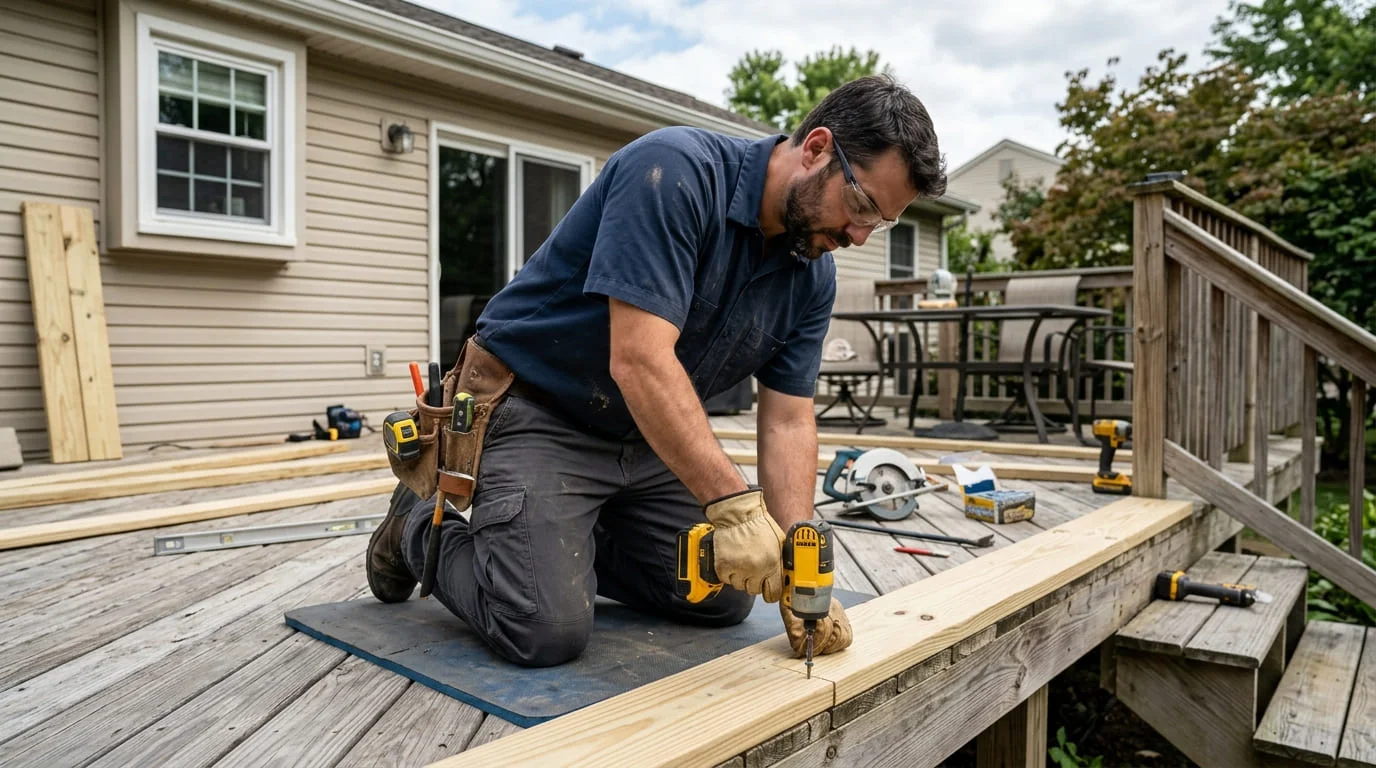
No outdoor structure takes more punishment in Palm Bay than a wood deck. Eleven months of UV exposure, daily summer rain, year-round humidity, and Brevard County's active termite population work on deck wood from every angle simultaneously. A deck that was solid five years ago can develop soft spots, popping boards, and wobbly railings well before its expected lifespan — especially if it hasn't been sealed regularly. Deck repair in Palm Bay is about catching problems at the board level before they become structural problems at the frame level, where the cost multiplies significantly.
Deck Repair Services in Palm Bay
- Rotted board replacement — removing and replacing individual deck boards with pressure-treated or composite material
- Railing repair and replacement — securing loose rails, replacing broken balusters, rebuilding sections that fail code
- Post replacement — replacing rotted or damaged structural posts with pressure-treated lumber set in proper footings
- Joist sistering — adding a new joist alongside a damaged one to restore structural capacity without full replacement
- Ledger board inspection and repair — the ledger attaches your deck to the house; failure here is a safety issue
- Fastener replacement — backing out nails re-driven, corroded screws replaced with stainless steel or coated deck screws
- Deck sealing and staining — cleaning and applying penetrating stain or sealer to extend the life of your existing deck
- Composite deck repair — replacing damaged Trex and similar composite boards, re-securing loose sections
What Destroys Palm Bay Decks
The ledger board is the most critical and most overlooked part of any deck attached to a Palm Bay home. It's the board that connects the deck structure to the house framing, and it's also one of the first places water intrudes — particularly when flashing was improperly installed or has failed. A compromised ledger board is a structural failure waiting to happen. We inspect ledger boards on every deck repair visit and won't ignore a problem there even if you only called about a loose railing.
Subterranean termites are active across all of Brevard County and will find pressure-treated wood that's been wet-cycled and has lost its chemical protection at the surface. Ground contact and areas where wood holds moisture — post bases, joist ends, areas under planters — are the entry points. Regular inspection and prompt replacement of compromised members is the only effective defense short of full composite replacement.
Signs Your Deck Needs Repair Now
Deck problems in Palm Bay rarely announce themselves loudly until they become safety issues — most start as small, easy-to-miss signs that are worth checking for at least once a year, ideally before hurricane season. A deck surface that feels noticeably springy or bouncy underfoot in one area, compared to firm everywhere else, usually means a joist beneath that spot has begun to rot or has lost its connection to the beam. Popped or backed-out fasteners — screw or nail heads sitting proud of the board surface — are often the first visible sign that the wood around them has started to deteriorate and lost its grip on the fastener. Gaps between deck boards that have widened noticeably compared to when the deck was built can indicate boards drying and shrinking excessively, sometimes from sun exposure on boards that were installed too wet. A railing that wobbles when pushed, even slightly, should never be dismissed — railings are a fall-prevention safety feature, and a wobbly railing means either the post connection or the post itself has weakened. Any separation, gap, or staining where the deck framing meets the house wall (the ledger board) is the most serious sign on this list and warrants prompt inspection.
Our Deck Repair Process
Deck repair always starts at the structure and works outward to the surface — fixing a board on top of a failing joist just relocates the problem.
- Step 1 — Inspect the ledger board: since this connects the deck to the house and is the most safety-critical component, it's checked first for separation, water staining, or soft wood, regardless of what the original complaint was about
- Step 2 — Probe posts and joists: structural members are probed with an awl or screwdriver at ground contact points and joist ends, where moisture collects and rot starts — wood that's soft to a half-inch or more of probing depth has lost structural value at that point
- Step 3 — Check railings and guardrails: every post, baluster, and rail connection is tested for movement, since loose railings are a common injury cause and an easy fix relative to the risk
- Step 4 — Assess decking boards: individual boards are checked for cracking, cupping, soft spots, and fastener condition
- Step 5 — Repair structure first: any compromised joists, posts, or ledger issues are addressed before cosmetic board replacement — sistering joists, replacing posts with proper footings, and re-securing or replacing the ledger as needed
- Step 6 — Replace boards and refinish: damaged decking boards are replaced, fasteners are upgraded to stainless or coated deck screws, and the repaired area is sealed to match the existing deck's finish schedule
Wood vs. Composite Decking for Palm Bay
When deck boards need replacement, homeowners often face a choice between matching the existing pressure-treated pine or upgrading to composite for the repaired section. Pressure-treated pine is the lowest upfront cost and matches existing decking seamlessly, but it requires sealing every 1–2 years in Palm Bay's UV and humidity to reach its full 10–15 year lifespan — and a newly replaced board will weather differently than surrounding boards until it's been sealed and aged for a season or two. Composite decking — materials like Trex, TimberTech, and similar — costs more per board but lasts 25–30 years with essentially no sealing or staining required, and it doesn't splinter, crack, or attract the wood-boring insects that are active throughout Brevard County. A common approach for partial deck repairs is replacing damaged boards with composite while keeping the existing pressure-treated frame — composite boards attach to standard PT framing with the same fastening methods, so the structural frame doesn't need to match the decking material. This gives homeowners a path to gradually transition a deck to lower-maintenance composite over successive repairs rather than all at once.
Deck Railing and Guardrail Code Requirements in Florida
Florida's building code requires a guardrail on any deck surface that's more than 30 inches above the ground or floor below — a threshold that catches most raised decks in Palm Bay, including many pool decks and second-story additions. The code specifies a minimum railing height of 36 inches for residential decks, and baluster spacing must be such that a 4-inch sphere cannot pass through — a rule aimed at preventing young children from slipping through or getting their heads caught between balusters. This matters for repairs because older decks built before these requirements were adopted, or built without permits, sometimes have railings that don't meet current spacing or height standards. When we repair a railing, we'll point out if the existing configuration doesn't meet current code — replacing a single broken baluster to match non-compliant spacing perpetuates a safety gap, while bringing the repaired section up to current spacing (even if the rest of the railing isn't changed) is a meaningful safety improvement for a relatively small cost difference.
Deck Repair Pricing in Palm Bay
Board replacement: $15–$35 per linear foot. Railing repair: $45–$95 per linear foot. Post replacement: $250–$500. Joist sistering: $200–$400 per joist. Deck sealing (clean and seal): $1–$3 per sq ft. Written estimate after inspection.