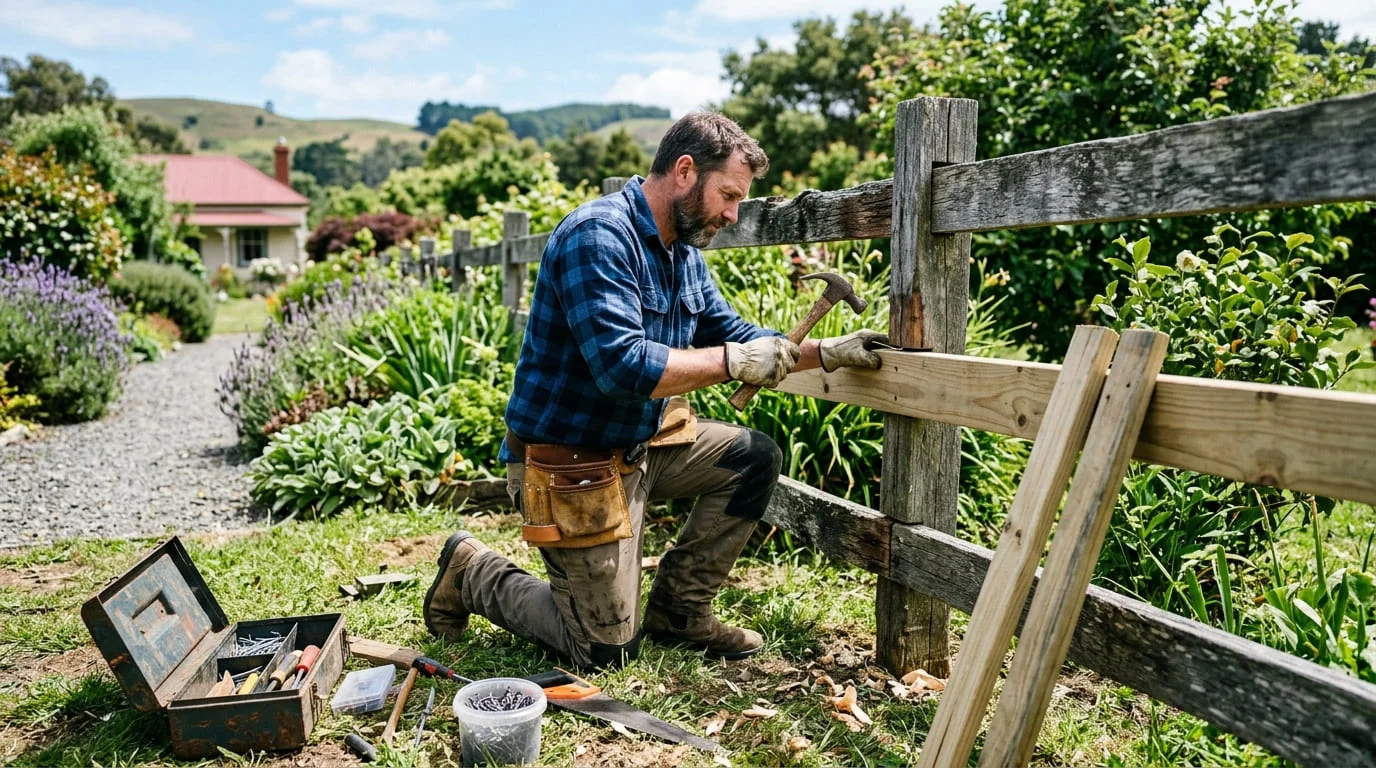
Palm Bay's storm season and year-round humidity are a fence's worst enemies. A summer thunderstorm can push over a section with a rotted post that looked fine from above. Humidity cycles rot wood at ground level while the above-grade sections appear solid. And salt air from the Indian River Lagoon corrodes metal hardware faster than inland areas. Fence repair in Palm Bay requires understanding which part of the fence is actually failing — surface boards are replaceable for a fraction of the cost of posts, and posts are far cheaper to fix than entire sections.
Fence Repair Services in Palm Bay
- Board and picket replacement — individual wood boards replaced with pressure-treated material to match existing fence
- Post replacement and reset — removing rotted or broken posts and setting new ones with proper drainage and concrete footings
- Leaning post repair — straightening and resetting posts that have shifted in Palm Bay's clay-heavy soil
- Gate repair — realigning sagging gates, replacing hinges, adjusting or replacing latches and closers
- Section rebuild — rebuilding damaged sections after storm damage or vehicle impact
- Vinyl fence repair — replacing cracked panels and resetting posts in vinyl privacy fence systems
- Chain link repair — patching damaged mesh, replacing bent top rails, resetting posts
- Fence staining and sealing — applying penetrating stain to wood fencing after repair to extend its service life
Storm Damage and Fence Repair in Palm Bay
Palm Bay's hurricane season runs June through November, and tropical storms and squalls cause fence damage every year. The pattern is consistent: sections with rotted posts fall, while sections with solid posts survive. The repair approach is to replace the failed posts and boards without rebuilding what's still sound. A full fence replacement is rarely necessary after a storm — targeted post and section repair gets the fence back to full function at a fraction of the cost.
HOA compliance is a consideration in many Palm Bay neighborhoods — Bayside Lakes communities in particular have specific requirements about fence height, material, and appearance. We're familiar with the common requirements and can ensure repairs meet your HOA's standards to avoid violation notices.
Diagnosing Fence Damage: Post, Board, or Hardware?
Most fence problems fall into one of three categories, and the repair cost varies enormously depending on which one it is — so a quick diagnosis before calling for repair helps set expectations. Individual board damage (cracking, splitting, or a board that's come loose from the rail) is the cheapest fix and usually doesn't affect the rest of the fence. Post problems are the costly category — a post that wiggles when pushed, has visibly rotted at the soil line, or has snapped below grade after a storm requires excavation and resetting, and one bad post can make an otherwise-solid section of fence lean or sag. Hardware problems — sagging gates, broken latches, hinges pulling out of posts — are usually quick fixes that dramatically improve how a fence functions day to day, even if the fence itself looks fine.
- Push test on posts — grip the post near the top and push side to side; any movement at the base indicates a loose or rotted post
- Check the soil line — probe the post with a screwdriver right at ground level; wood that's soft or crumbles indicates rot has started even if the post above ground looks fine
- Look for consistent lean direction — multiple posts leaning the same direction after a storm usually means wind load on the fence panels pushed against under-set posts
- Listen for hardware sounds — gates that scrape, squeak, or require lifting to latch are almost always a hinge or post-plumb issue, not a gate problem
Our Fence Repair Process
Repairing a fence properly means fixing the root cause, not just the visible symptom — replacing a few boards on a fence with a failing post just means those new boards fall down with the next storm.
- Step 1 — Walk the full fence line: we check every post for movement and every section for board condition, not just the area you called about, since storm damage often affects more than the obvious spot
- Step 2 — Probe questionable posts: any post that shows movement gets probed at the soil line to determine whether it can be reset or needs full replacement
- Step 3 — Excavate and replace failed posts: rotted or broken posts are dug out completely — leaving a broken post stub in the ground is a common shortcut that causes the new post to fail at the same depth within a couple of years
- Step 4 — Set new posts with drainage in mind: we add gravel at the base of the post hole before concrete so water draining down the post doesn't pool against the wood — a key detail in preventing the same failure from recurring
- Step 5 — Replace boards and hardware: damaged boards are replaced with material matched to the existing fence, and all hardware is checked and replaced if corroded
- Step 6 — Final alignment check: gates are tested for swing and latch, and the full repaired section is checked for level and plumb against the rest of the fence
Fence Materials Compared for Palm Bay's Climate
Vinyl fencing has become the dominant choice in newer Palm Bay developments because it genuinely performs well here — it doesn't rot, doesn't need painting or staining, resists fading reasonably well with UV-stabilized material, and the posts (when set correctly) outlast wood posts significantly since there's no organic material for soil moisture to attack. The tradeoff is repair cost: a cracked vinyl panel typically needs full panel replacement rather than a board-by-board fix, and matching an older vinyl color exactly can be difficult if the manufacturer has discontinued that shade. Aluminum fencing — common for pool enclosures and decorative perimeter fencing — never rusts (unlike steel) and holds paint or powder coat finishes well, making it a strong choice near the coast. Pressure-treated pine remains popular for its lower upfront cost and the classic look many homeowners want, but it requires resealing every 2–3 years in Palm Bay's UV and humidity to get anywhere near its full lifespan — skipping this maintenance is the single biggest reason wood fences fail early. Chain link with a vinyl coating resists the rust that bare galvanized chain link develops within a few years near the Indian River Lagoon, at a relatively low cost.
Fence Height, Setbacks, and Florida Wind Considerations
Palm Bay's fence regulations limit residential fence height to 6 feet in side and rear yards and typically lower in front yards, and fences must be set back from property lines according to your specific zoning — it's worth confirming exact setbacks before any new section is built, since repairs that involve resetting posts in a new location can trigger these requirements even when a full permit isn't needed. Florida's wind exposure also affects fence construction more than most homeowners realize: taller privacy fences act like sails during tropical storms, and post depth and spacing matter for wind resistance, not just appearance. Posts set at the standard 24-inch depth with proper concrete footings handle typical Florida storms; fences in more exposed locations — open lots near canals or with no windbreak from neighboring structures — benefit from posts set deeper or spaced more closely than the minimum. When we replace storm-damaged posts, we factor in the fence's exposure and set replacements to hold up better than the originals did.
Fence Repair Pricing in Palm Bay
Board replacement: $8–$20 per board. Post replacement: $175–$350 per post. Gate repair: $125–$275. Section rebuild (6–8 ft): $350–$700. Assessment included with any repair.