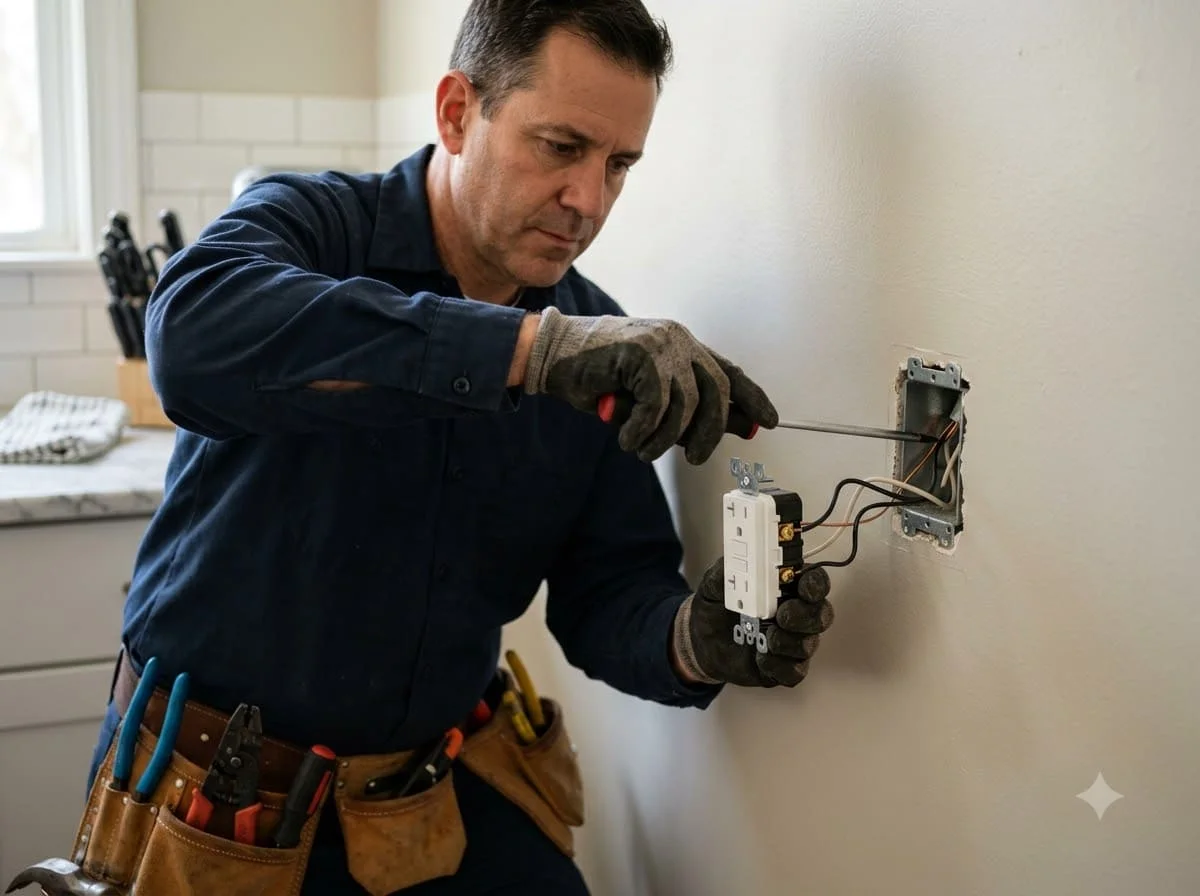
GFCI outlet installation in West Melbourne, FL costs $125–$195 per location, and in this city the work is usually replacement rather than first-time protection. West Melbourne's housing stock is comparatively young — the subdivisions off Minton Road, Hollywood Boulevard, and Norfolk Parkway filled in through the 2000s, and those homes were built when kitchen, bathroom, garage, and exterior protection was already standard. The devices went in correctly on day one. Twenty-something years later, they are quietly the oldest safety component in the house.
Handyman Palm Bay FL tests, replaces, and adds ground-fault protection across West Melbourne — the newer construction along Heritage Oaks and Sawgrass, the established streets closer to the Melbourne line, the HOA communities where exterior hardware has to match the trim, and the homes on well systems out toward the western edge of the city. Our most common job here is not installing anything new. It is walking the house with a tester, showing homeowners which of their original devices no longer trip, and replacing the ones that have failed without ever announcing it.
Ground-Fault Services We Provide in West Melbourne
- Whole-house device testing — every GFCI in the home checked and the results written down
- Original device replacement — pre-2015 units with no self-test capability swapped for current models
- Coverage gap retrofits — the laundry and appliance locations the 2020 code cycle added
- Weather-resistant exterior devices — WR receptacles and in-use covers matched to HOA trim colors
- Stucco-over-foam mounting — exterior boxes anchored properly through foam to structure
- GFCI circuit breakers — panel-level protection for circuits with awkward receptacle access
- Pool, spa, and lanai receptacles — wet-location devices on screened enclosures and pool decks
- Nuisance trip diagnosis — measuring leakage before replacing anything
The Protection in Your 2004 Home Is Now the Oldest Part of It
The protection in a 2004 home is now its oldest safety component because ground-fault devices age in a way the rest of the house doesn't. A GFCI is not a piece of passive hardware like a light switch. It contains a current transformer, a solid-state sensing circuit, and a mechanical relay, and all three degrade under two decades of Florida heat cycling and humidity. Ten to fifteen years is a realistic service life. A device installed when the house was framed is well past it.
What makes this genuinely dangerous is the absence of any warning.
Underwriters Laboratories did not require auto-monitoring in GFCIs until UL 943 made it mandatory for devices manufactured after June 29, 2015. Anything older has no mechanism to check its own protection, no indicator that reports a failure, and no behavior change a homeowner would notice. It powers the hair dryer, accepts a reset, and looks identical to a working device. Current models self-test periodically and respond to an internal fault by denying power or tripping repeatedly — they force the issue. A West Melbourne home built in 2004 and never touched since is almost certainly running devices from the era before any of that existed. Press the test button on every one: if the power to the outlet does not drop, the device is not protecting anyone.
What the 2020 Code Cycle Added That Your Home Doesn't Have
The 2020 code cycle added coverage that homes built in the 2000s were never required to include. Florida currently enforces the 8th Edition (2023) Florida Building Code, which adopts the 2020 National Electrical Code, and that edition widened 210.8(A) in ways that matter to newer construction specifically — because these houses already had the obvious locations covered and the changes land on the less obvious ones.
Three expansions are worth knowing about in a home of this vintage.
First, laundry areas: earlier editions protected receptacles within six feet of a laundry sink, and the 2020 cycle extended it to the laundry area as a whole. Second, the voltage ceiling rose from 125-volt 15- and 20-amp receptacles to all receptacles from 125 through 250 volts on single-phase circuits rated 150 volts or less to ground, which pulls in circuits nobody previously associated with ground-fault protection. Third, dishwashers moved to 422.5 and now require protection on the outlet supplying them whether that outlet is a receptacle or a hardwired connection. None of this makes your house illegal — code applies as of the permit year, and a 2004 home is compliant with 2004. It does describe the gap between what your home has and what two decades of code development concluded people need. A device sweep pairs naturally with a smoke alarm coverage check, since both are quiet aging problems in houses this age.
Exterior Devices, Stucco Walls, and the September 2026 HVAC Date
Exterior devices on West Melbourne's stucco-over-foam walls need mounting that reaches past the foam to something structural. A great many homes here were built with a rigid foam layer under the stucco finish, and an exterior box anchored into that layer alone will work loose within a few seasons of thermal movement and driving rain — taking its weather seal with it. We anchor through to framing or block, seal the penetration properly, and fit an in-use bubble cover rather than the flat flip-lid that only seals when nothing is plugged in. On a pool pump or landscape lighting cord that stays connected year-round, a flip-lid is an open box.
One date belongs on the calendar of anyone here with a high-efficiency air conditioner.
The 2020 NEC's 210.8(F) extends ground-fault protection to outdoor outlets serving dwelling equipment, and outdoor HVAC units turned out to be poorly compatible with it — variable-speed and inverter-driven condensers, exactly the type installed across West Melbourne's newer builds, generated widespread nuisance tripping because their drive electronics pass leakage current by design. The industry response was a temporary exemption for listed outdoor HVACR equipment, and that exemption is written to expire September 1, 2026. What it means for a homeowner is practical rather than alarming: if you are replacing a condenser around that date, the protection question is worth raising with your HVAC contractor and your building department before the equipment is ordered. Exterior circuit work is also the sensible moment to handle landscape and security lighting, since it needs the same protected circuit.
GFCI Outlet Installation Pricing in West Melbourne, FL
Aged GFCI replaced on an existing grounded circuit: $125–$195 per location.
Whole-house replacement sweep, six to nine original devices: $650–$1,300.
GFCI circuit breaker supplied and installed at the panel: $185–$325.
Weather-resistant exterior GFCI with in-use bubble cover: $165–$265.
Stucco-over-foam exterior mounting and resealing: add $20–$45 per location.
Whole-home test and written device inventory: $85–$140.
New protected receptacle added where none exists: $225–$400 depending on the run.
All pricing is confirmed in writing before work begins and estimates are free. Call (877) 916-5930 or request a quote online — most West Melbourne addresses are scheduled same-day. See the wider range of what we cover locally on our West Melbourne handyman services page, or bundle the visit with dimmer switch installation while we're already working the circuits.
We handle the same work in neighboring cities too — outlet protection in Palm Bay and nuisance trip diagnosis in Melbourne.