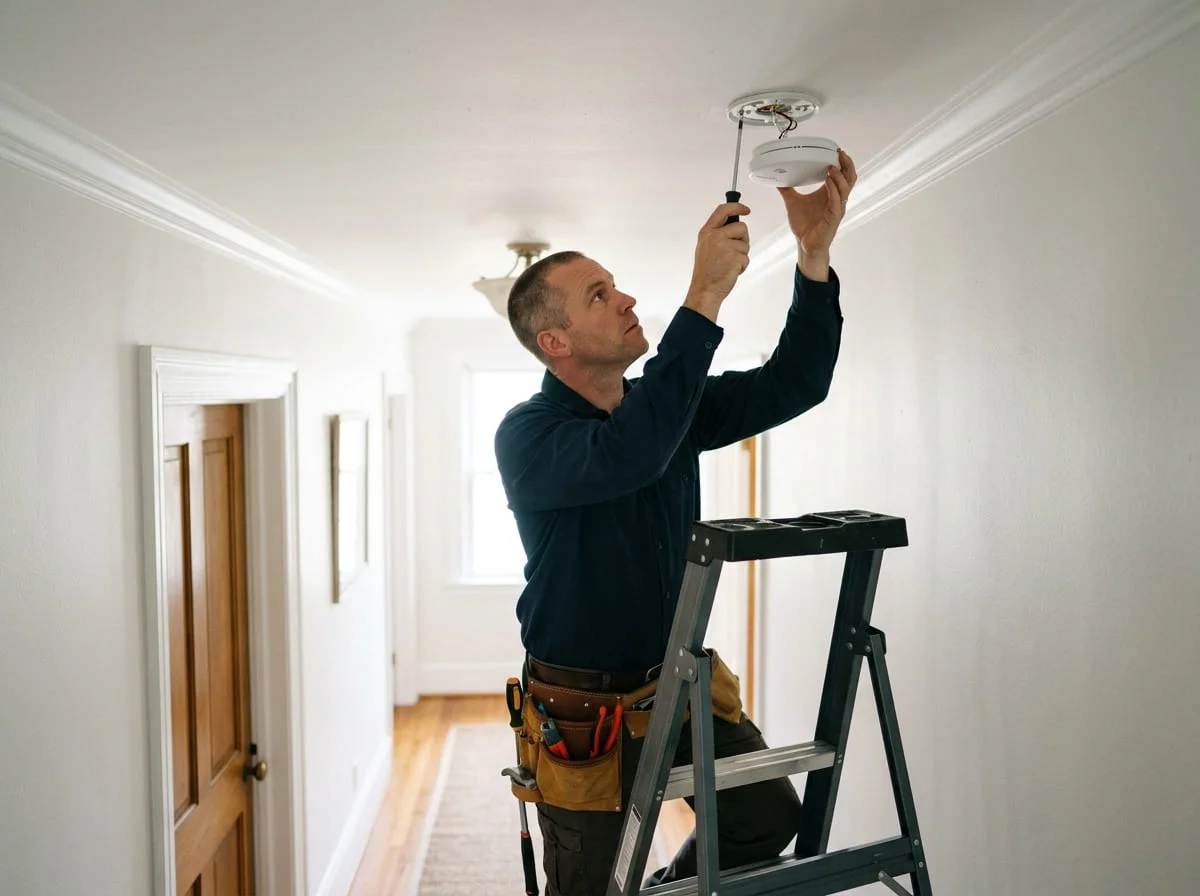
Whole-house smoke alarm replacement in West Melbourne, FL runs $400–$800 for a typical six-to-eight-alarm home, and it is by far the most common alarm job in this city. West Melbourne's problem is the opposite of Palm Bay's. Homes here are newer — largely 2000s and later tract construction — so they were built correctly from day one with hardwired, interconnected alarms in every bedroom. Those alarms are now fifteen to twenty years old, well past the 10-year service life NFPA 72 assigns them, and they are all failing at once because they were all installed in the same week.
Handyman Palm Bay FL replaces and reconfigures smoke alarm systems throughout West Melbourne — the subdivisions off Norfolk Parkway and Minton Road, the newer builds along Hollywood Boulevard, and the established neighborhoods around Field Manor and Heritage Oaks. We replace whole interconnected sets so they actually talk to each other, handle the vaulted great-room and two-story foyer placements these floor plans are full of, and stop the 3am chirp permanently rather than silencing one unit and waiting for the next.
Smoke Alarm Services We Provide in West Melbourne
- Whole-house hardwired replacement — every interconnected alarm swapped as a matched set in one visit
- End-of-life diagnosis — reading manufacture dates off the back of every unit in the house
- Interconnect compatibility checks — confirming new units will trigger each other on the existing traveler wire
- Vaulted & tray ceiling placement — great-room and two-story foyer installs to NFPA 72 slope rules
- Chirp diagnosis — separating a dying backup battery from a genuine end-of-life fault
- Combination smoke & CO alarms — for the attached garages standard in these floor plans
- Coverage gap checks — verifying bedroom, hallway, and per-level counts against current standards
- Nuisance alarm relocation — moving units clear of kitchen plumes and HVAC supply vents
Why the Whole House Starts Chirping the Same Month
The whole house starts chirping the same month because the whole house was built the same month. West Melbourne grew in concentrated tract phases, and a builder wired and mounted every alarm in a home within days of each other, all from the same case of identical units. A decade and a half later those alarms reach end-of-life as a group. What feels like a run of bad luck is really just a synchronized clock finishing its count.
The 3am timing has a real explanation too, and it isn't malice.
Household temperature reaches its lowest point in the early morning hours, and cold drops battery voltage just enough to cross the low-battery threshold — so an alarm that stayed quiet all day announces itself when the house is coldest and everyone is asleep. Replacing the one that woke you buys a few weeks before its neighbor does the same thing. First we pull each unit and read the manufacture date off the back, second we confirm whether current models still interconnect with what's on the wire, and finally we quote the honest comparison between a whole-house set and picking them off one at a time. On a home where every alarm dates to the same build, the matched set is almost always both cheaper and safer.
Vaulted Great Rooms and Two-Story Foyers
Vaulted great rooms and two-story foyers are the signature of West Melbourne's 2000s floor plans, and they change where an alarm belongs. Smoke stratifies and collects under the highest point of a sloped ceiling, so a unit mounted partway down the slope sits below the layer it's meant to sample and responds late. NFPA 72 addresses this directly: on tray or coffered ceilings, alarms go on the highest portion, or on the sloped section within 12 inches vertically down from the highest point.
There is one spot on a vaulted ceiling to deliberately avoid.
The corner where the peak meets the wall holds a pocket of dead air that smoke moves around rather than into, and an alarm tucked into that corner is measurably slower than the same unit a foot away. Two-story foyers raise a second issue — reaching them safely takes a tall ladder and a stable setup over a stairwell, which is genuinely the reason a lot of homeowners leave a chirping foyer alarm chirping for months. We carry the ladder and quote those positions separately so the price is transparent. It's the same access problem we solve on high-foyer chandelier installs in these homes.
Reading the Date, Not Waiting for the Chirp
Reading the date is the only reliable way to know where your alarms stand, and it takes about a minute per unit. Twist the alarm off its mounting plate and look at the rear housing — every listed alarm carries a date of manufacture printed there. NFPA 72 sets the service life at 10 years from that date, not from installation day, which on a new-build home can be a year or more later. A West Melbourne house finished between 2004 and 2014 with original alarms is past due whether or not anything has started beeping.
Waiting for the chirp is the mistake, because sensors fail quietly.
A low-battery chirp tells you about a battery. It tells you nothing about a photoelectric or ionization sensor that has spent fifteen Florida summers accumulating dust and losing sensitivity, and there is no sound an alarm makes to announce that. A silent alarm and a working alarm are not the same object. We check dates across the whole house during any alarm visit, hand you the numbers, and let you decide with facts rather than guesswork. While we're there we also verify coverage against current standards — even correctly built homes sometimes have a converted den or bonus room now used for sleeping with no alarm inside it. See everything we cover locally on our West Melbourne handyman services page.
Smoke Detector Installation Pricing in West Melbourne, FL
Whole-house hardwired replacement, six to eight alarms including units: $400–$800.
Individual hardwired alarm replaced on existing wiring: $75–$125 per unit.
Combination smoke and carbon monoxide alarm: $85–$150.
Vaulted great-room or two-story foyer placement: add $25–$50.
10-year sealed-battery alarm supplied and mounted: $45–$75 each.
New 14/3 cable run to hardwire an alarm where none exists: $150–$300 per location.
All pricing is confirmed in writing before any work begins. Call (877) 916-5930 for a free estimate. Because a whole-house alarm swap already has us on a ladder in every room, it pairs well with ceiling fan installation or dimmer switch upgrades in the same visit.