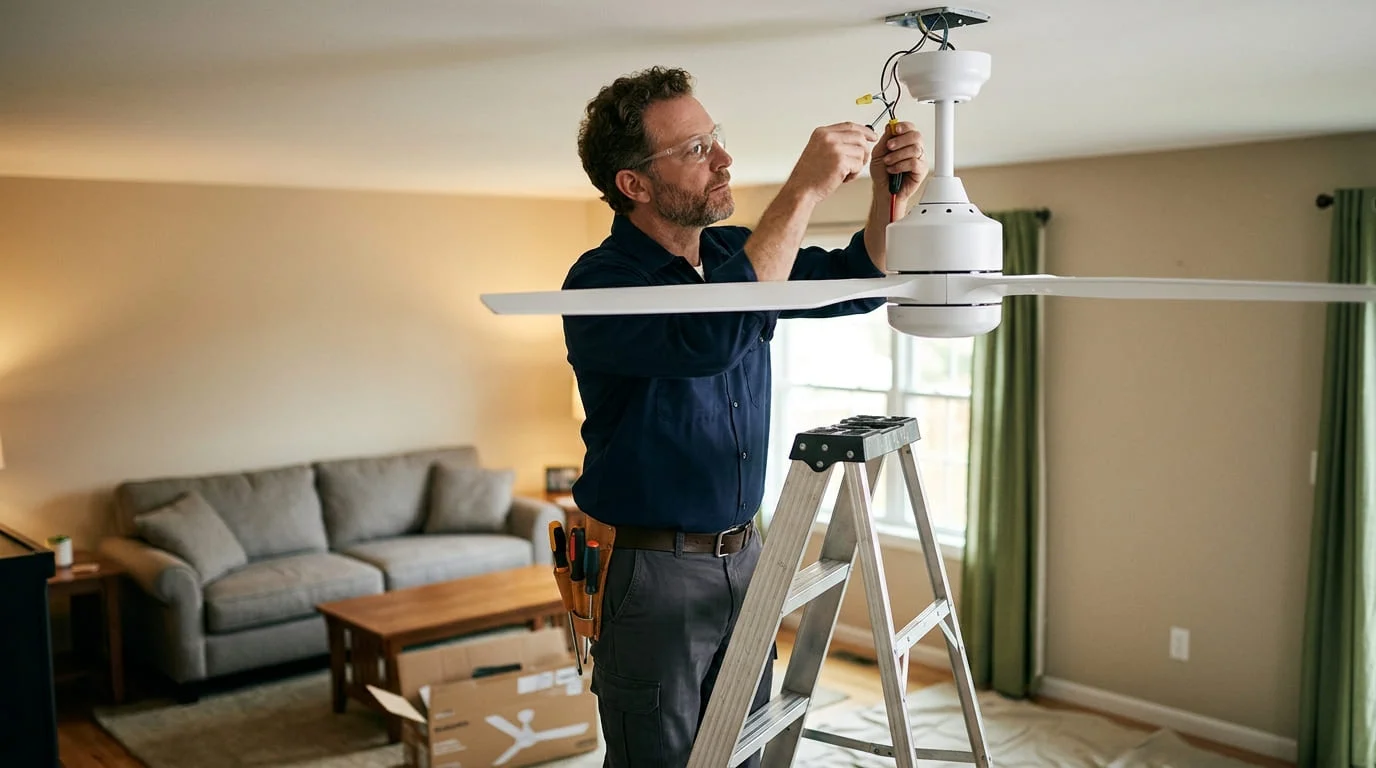
In a city where air conditioning runs ten months a year, a ceiling fan is one of the most cost-effective upgrades a Palm Bay homeowner can make. A properly sized fan running counterclockwise in summer creates a wind-chill effect that lets you raise the thermostat 4°F without any perceived comfort loss — and because a ceiling fan costs only pennies per hour to run compared to an AC compressor, the savings compound quickly in Brevard County's climate. Ceiling fan installation in Palm Bay done correctly means the right fan matched to the room's square footage and ceiling height, a box rated for the fan's dynamic load, and wiring connected cleanly and to current Florida code.
Handyman Palm Bay FL installs, replaces, and wires ceiling fans throughout Palm Bay — Port Malabar, Bayside Lakes, Palm Bay Point, Palm Bay Village, Bimini Bay, Highland Shores, Courtyards at Sandy Pines Preserve, and all surrounding Brevard County communities. Whether you're replacing a builder-grade fan that's been wobbling for 20 years, installing your first fan in a bedroom that's only ever had a light fixture, or adding an outdoor damp-rated fan to your screened lanai, we handle the full job in a single visit.
Ceiling Fan Services We Provide in Palm Bay
- New ceiling fan installation — hanging customer-supplied or contractor-supplied fans on existing fan-rated boxes, complete with all wiring connections, blade balancing, and test operation
- Ceiling fan replacement — removing an old or failing fan and installing a new one, including disposal of the old unit and cleaning up the ceiling area
- Fan-rated box upgrade — swapping a standard light fixture box for a fan-rated pancake box or expandable brace rated for the fan's weight and motion load
- New wiring runs — fishing a new circuit from a panel or nearby junction to a ceiling location that currently has no wiring at all
- Outdoor and lanai fan installation — damp-rated and wet-rated fan installation for screened porches, covered patios, and semi-exposed outdoor spaces common in Palm Bay homes
- Wall control and remote receiver installation — adding a separate wall switch for fan speed and light control, or wiring a remote receiver inside the fan canopy
- Smart fan switch installation — upgrading to smart-home compatible controls (Google Home, Amazon Alexa, Apple HomeKit) for fans with compatible receiver modules
- Fan balancing and wobble correction — diagnosing and correcting wobbling fans caused by blade weight imbalance, loose mounting hardware, or a misaligned mounting bracket
CBS Ceilings and Concrete Mounting — What Makes Palm Bay Fan Installs Different
The majority of Palm Bay's housing stock — particularly the thousands of homes in Port Malabar built between the 1960s and 1990s — uses concrete block structure (CBS) construction. In a wood-frame home, ceiling fans are anchored into a joist or an expandable fan brace that spans two joists. In CBS construction with poured concrete or concrete-decking ceilings, that approach doesn't apply. You're anchoring into concrete, which requires masonry anchors, a hammer drill, and the correct anchor type for the fan's weight and dynamic pull-out load.
A standard screw or plastic toggle that works fine in drywall will fail in concrete — either immediately under torque or progressively as fan vibration loosens the anchor over time. We bring a hammer drill and properly rated masonry anchors on every CBS ceiling fan installation in Palm Bay. We also verify that the wiring exits the ceiling in a way that's properly protected inside the fan canopy — in many older Port Malabar homes, wiring runs through flexible conduit in the block cavity, and the conduit termination at the ceiling point needs to align correctly with the fan's mounting bracket.
For Palm Bay homes with wood-frame or light steel stud ceilings — found in some newer construction and additions — we use a stud finder to locate joists and lag into solid framing with appropriate hardware. Either way, the result is a securely anchored fan that doesn't wobble, doesn't loosen over time, and doesn't create the kind of ceiling damage that follows a poorly anchored installation.
Installing a Ceiling Fan Where Only a Light Fixture Exists
This is the single most common scenario we see for ceiling fan installations in Palm Bay: a homeowner wants a fan in a room that's only ever had a light fixture. The fixture box in the ceiling is almost never fan-rated — it was installed for a static load (a lamp or chandelier) and isn't structurally adequate for the weight and motion of a spinning fan. Installing a ceiling fan on an underated light box is one of the most common causes of fan wobble and, in the worst cases, fan ceiling collapses.
The fix is straightforward: we remove the existing light box and install a fan-rated pancake box anchored to the joist, or — in rooms where the joists don't align with the desired fan center — an expandable fan brace that spans two joists and positions the box exactly where you want the fan. Once the box is right, the fan installation proceeds normally.
If the existing circuit isn't wired for separate fan and light control (common in older Palm Bay homes where a single switch controls everything), we can add a remote receiver inside the fan canopy — a small module that gives you independent speed and light control via a handheld remote or wall-mounted transmitter without pulling any additional wiring. This is the cleanest solution for rooms where rerouting a new wire to a second switch location would require significant drywall or ceiling work.
Outdoor Ceiling Fans for Palm Bay Lanais and Screened Porches
Outdoor ceiling fans are one of the most popular additions to Palm Bay homes. Screened lanais and covered back patios are a defining feature of Brevard County residential living, and a ceiling fan on a lanai makes an enormous difference in how usable that space is during the summer months. The key specification for outdoor fans is the UL wet or damp rating — this isn't just a marketing designation, it determines whether the motor windings, blade hardware, and canopy materials are designed to withstand moisture exposure.
For typical enclosed screened lanais, a damp-rated fan handles the condensation and high humidity air without issues. For covered patios that aren't fully screened, where rain can blow in at an angle, a wet-rated fan is the right call — it's built to handle direct water spray without rusting or shorting. In Palm Bay neighborhoods near Turkey Creek, Bimini Bay, and properties adjacent to the Indian River watershed, salt-adjacent air accelerates corrosion on metal components, making a proper outdoor rating even more important than it is farther inland.
We discuss the right rating for your specific outdoor space during the estimate and won't install an indoor-rated fan in an outdoor application regardless of what the homeowner has already purchased — it's a liability we won't take on.
Ceiling Fan Sizing Guide for Palm Bay Homes
Fan sizing is one of the most commonly overlooked aspects of ceiling fan installation, and it directly affects how well the fan performs. The rule of thumb: rooms up to 75 sq ft need a 29–36 inch fan; rooms 76–144 sq ft need a 36–42 inch fan; rooms 145–225 sq ft need a 44–50 inch fan; rooms over 225 sq ft — common in Palm Bay's open-plan great rooms and Florida rooms — need a 52–60 inch fan or multiple fans. An undersized fan in a large room runs harder, moves less air than needed, and fails sooner than a properly sized unit.
Ceiling height matters equally. Standard 8-foot ceilings are best served by a flush-mount (hugger) fan, keeping blade clearance above the recommended 7 feet from the floor. Vaulted or cathedral ceilings — found in many of Palm Bay's larger Bayside Lakes homes and newer Port Malabar construction — need a downrod of appropriate length to bring the fan to an effective operating height. A fan mounted 14 feet in the air in a vaulted room mostly circulates air near the ceiling, not at occupant level where it actually matters.
If you're unsure about sizing for your specific rooms, we'll walk through it during the estimate. We measure the rooms, assess the ceiling height, and give you a recommendation — including specific fan models at different price points — before any work starts.
Ceiling Fan Installation Pricing in Palm Bay
Installation on existing fan-rated box (fan supplied by homeowner): $150–$225.
Fan-rated box upgrade or expandable brace installation: add $75–$125.
New ceiling fan with light kit (fan supplied by Handyman Palm Bay FL): $250–$425 total.
New wiring run from panel or nearby circuit to ceiling with no existing wiring: $350–$600.
Outdoor lanai fan installation — damp or wet rated (customer-supplied fan): $175–$250.
Remote receiver or smart switch installation: $85–$150.
Fan wobble diagnosis and balancing: $75–$125.
All pricing is provided in writing before any work begins. Call (877) 916-5930 for a free estimate, or ask about bundling ceiling fan installation with outlet work, light fixture installation, or TV mounting in the same visit to save on the trip charge.