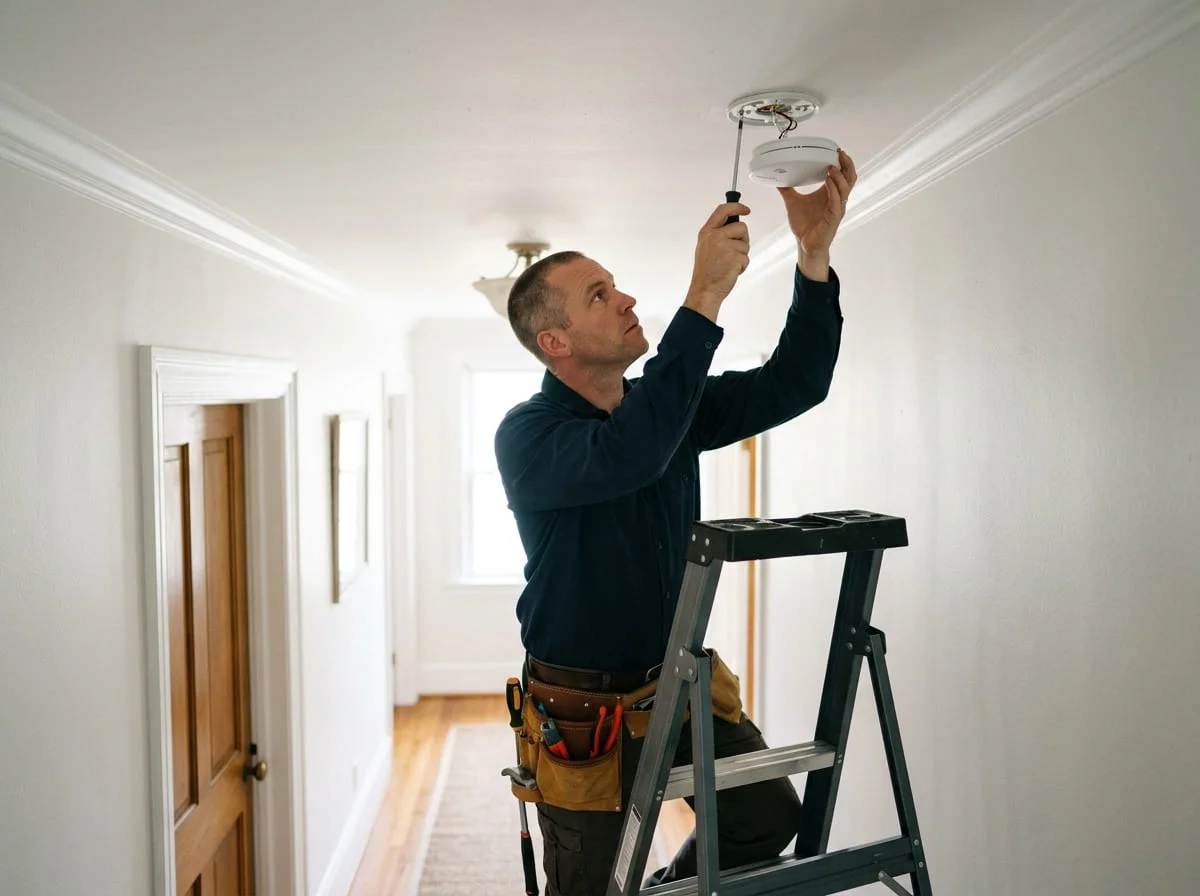
Smoke detector installation in Palm Bay, FL runs $45–$125 per alarm, and the typical older Palm Bay home needs five or six of them rather than the one it currently has. That gap is the whole story here. Most of the city's Port Malabar housing stock went up in the 1970s and early 1980s, when a single battery-powered alarm in the hallway outside the bedrooms satisfied the code of the day. Modern standards ask for an alarm inside every sleeping room, one outside each separate sleeping area, and at least one on every level — which means a three-bedroom house built in 1978 is running at roughly a fifth of the coverage it should have.
Handyman Palm Bay FL installs, replaces, and interconnects smoke alarms across the whole city — Port Malabar, Bayside Lakes, Palm Bay Point, Palm Bay Village, the newer subdivisions off Emerson Drive and Malabar Road, and the canal-front homes on the southeast side. We count your sleeping areas and levels against current placement rules, add the alarms that are missing, replace units that have quietly aged past their service life, and fix the placement mistakes that make alarms chirp until somebody disables them. Where running new cable through a slab-on-grade home makes no sense, Florida law gives us a legitimate alternative — and we use it.
Smoke Alarm Services We Provide in Palm Bay
- Whole-home coverage assessment — counting bedrooms, sleeping areas, and levels against current placement standards
- Hardwired alarm replacement — swapping aged 120V units on existing wiring, backup batteries included
- New hardwired alarm circuits — running 14/3 interconnect cable to bedrooms that never had an alarm
- 10-year sealed battery alarms — the Florida-code retrofit route for homes where rewiring isn't practical
- Wireless interconnect — battery alarms that all sound together without a single wire pulled
- Combination smoke & CO alarms — for homes with an attached garage or any fuel-burning appliance
- Nuisance alarm relocation — moving units away from bathroom steam, kitchen plumes, and HVAC supply vents
- End-of-life replacement — identifying alarms past the 10-year mark from their date of manufacture
Why Port Malabar Homes Are Under-Protected
Port Malabar homes are under-protected for a simple, structural reason: they were built to a code that asked for far less. When Palm Bay's big 1970s and early-1980s expansion filled in the Port Malabar street grid, a builder met the requirement with one battery alarm in the hall and nothing else. Bedrooms went without. Garages and second sleeping areas went without. Nobody did anything wrong at the time, but a house that has never been updated is carrying 1978's fire protection into 2026.
The count that matters today is bedrooms plus hallways plus levels.
An alarm belongs inside each sleeping room, outside each separate sleeping area, and on every floor of the home. Run that arithmetic on a standard three-bedroom Palm Bay ranch and you land at five or six alarms against the one that's actually mounted. We walk the house, mark the missing locations, and give you the count in plain numbers before any work starts — so the decision is yours to make with real information rather than a vague sense that you should probably have more of them. Homes with aging wiring behind the walls sometimes want an electrical upgrade looked at in the same visit.
Adding Bedroom Alarms Without Rewiring the House
Adding bedroom alarms without rewiring is where Florida law works in a Palm Bay homeowner's favor. Florida Statute 553.883 allows one-family and two-family dwellings and townhomes undergoing a repair or a Level 1 alteration to use smoke alarms powered by 10-year nonremovable, nonreplaceable batteries instead of retrofitting the home with alarms wired into its electrical system. That single provision is the difference between a straightforward afternoon and a project that involves cutting drywall in every bedroom.
It matters more here than in most Florida cities because of how Palm Bay was built.
These are slab-on-grade CBS homes, so there is no crawlspace and no basement to work from, and the attic run to an interior bedroom often means opening ceilings. First we check whether an attic path actually exists, second we price the hardwired route honestly if it does, and finally we compare it against sealed-battery units on wireless interconnect. Wireless interconnect is the part people miss — those battery alarms still trigger each other, so an alarm in the back bedroom sounds the whole house exactly as hardwired units would. You keep the safety behavior and skip the demolition.
Placement, Humidity, and Storm-Season Reliability
Placement is what separates an alarm that protects you from one you eventually rip off the ceiling. Florida's humidity punishes careless positioning: an alarm mounted just outside a bathroom door catches the steam plume every single morning, and NFPA 72 keeps alarms at least 10 feet from a permanent cooking appliance, with even nuisance-resistant units needing 6 feet. We also keep units clear of HVAC supply vents and ceiling fan wash, both of which push smoke away from the sensor and delay the alarm.
Storm season adds a second reliability question that Brevard County homeowners feel directly.
Hardwired alarms carry a battery backup so an outage doesn't strip a home of protection, and sealed 10-year units run independently of the grid altogether. What we find on service calls is the backup battery nobody has touched since the house was bought — a hardwired alarm with a dead backup is fully decorative the moment the power drops, which in Palm Bay is exactly when a generator, candles, and a running fridge on an extension cord all arrive at once. We test every backup during installation and replace the ones already gone. Alarms also age out: NFPA 72 puts a 10-year life on the unit itself, measured from the date of manufacture printed on the back, not from the day it was installed.
Smoke Detector Installation Pricing in Palm Bay, FL
Hardwired alarm replaced on existing working wiring: $75–$125 per unit.
10-year sealed-battery alarm supplied and mounted: $45–$75 each.
Wireless interconnected battery alarm: $65–$110 per unit.
New 14/3 cable run to hardwire an alarm where none exists: $150–$300 per location.
Whole-house hardwired replacement, six to eight alarms: $400–$800.
Combination smoke and carbon monoxide alarm: $85–$150.
Vaulted or two-story stairwell placement: add $25–$50.
All pricing is confirmed in writing before any work begins. Call (877) 916-5930 for a free estimate. Because alarm work usually means we're already on a ladder at your ceilings, we can handle it in the same visit as ceiling fan installation or light fixture installation. See everything we cover locally on our Palm Bay handyman services page.