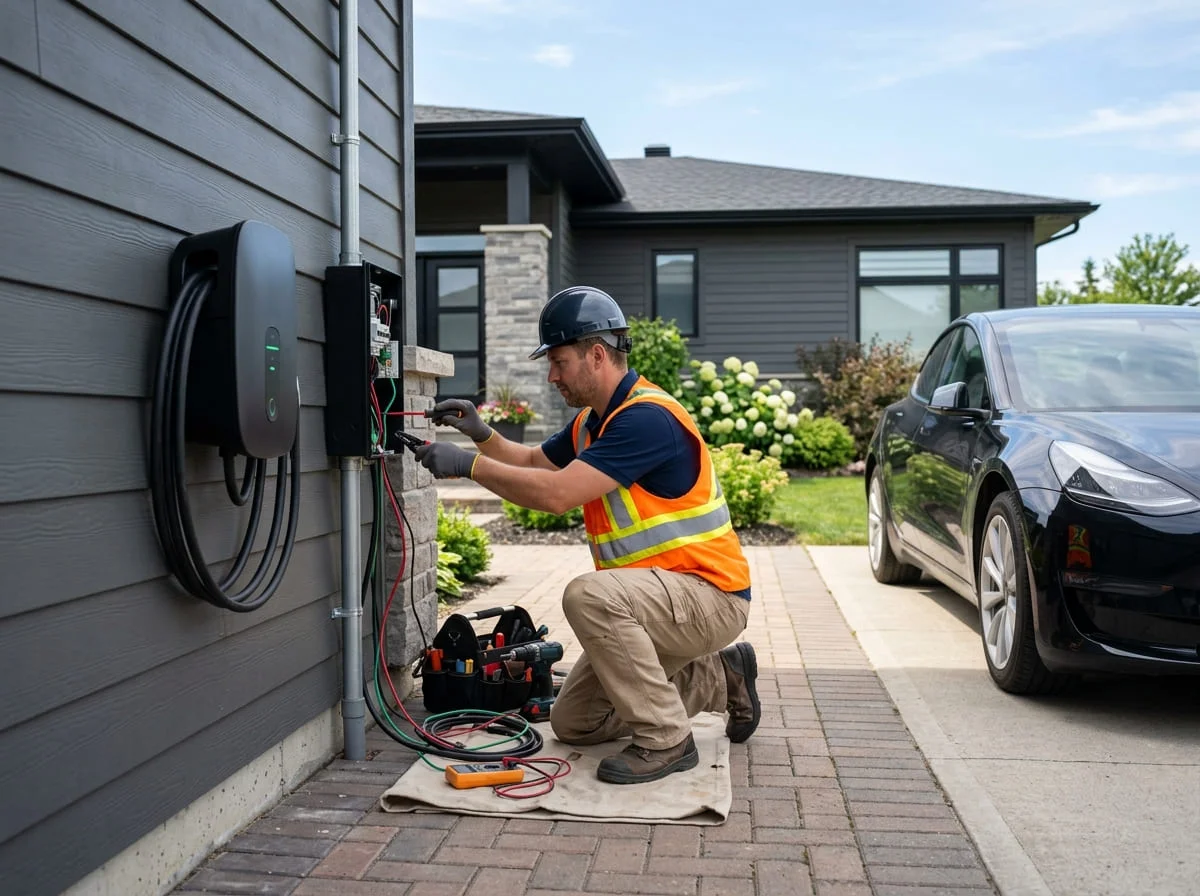
Palm Bay is a commuter town. Thousands of residents drive daily to the Melbourne tech corridor, up I-95, or out to Orlando — and more of those commutes are happening in electric vehicles every year. Charging on a standard 120-volt garage outlet adds only 3 to 5 miles of range per hour, which isn't enough to reliably refill a daily driver overnight. A Level 2 (240-volt) home charger adds 25 to 40 miles per hour, filling most EVs from near-empty to full while you sleep. But installing one correctly is real electrical work: a dedicated circuit, a permit, a load calculation, and code-compliant mounting — not a weekend plug-in job.
Handyman Palm Bay FL installs home EV charging stations throughout Palm Bay — Port Malabar, Bayside Lakes, Palm Bay Point, Palm Bay Village, Bimini Bay, Highland Shores, Courtyards at Sandy Pines Preserve, and the surrounding Brevard County communities. Tesla Wall Connectors, hardwired universal chargers, and NEMA 14-50 outlets — we handle the panel assessment, the circuit, the mounting, the permit, and the inspection so your setup is safe, legal, and built to last in Florida's climate.
EV Charger Services We Provide in Palm Bay
- Level 2 charger installation — dedicated 240-volt circuit, correctly sized breaker, and hardwired charger mounted and tested on an interior or exterior wall
- Tesla Wall Connector installation — mounted, wired, and commissioned, including Wi-Fi setup and power-sharing configuration for two-vehicle households
- NEMA 14-50 outlet installation — a GFCI-protected 240-volt receptacle for plug-in chargers, wired to current code
- Panel load calculation — an NEC-compliant assessment of your existing service to confirm it can carry a charging circuit before anything is ordered
- Panel upgrades and sub-panels — service upgrades or a dedicated sub-panel when an older Port Malabar home doesn't have spare capacity
- Load-management installation — smart devices that let a charger share capacity with your range or dryer, avoiding a full panel upgrade
- Outdoor and CBS-wall mounting — weatherproof, masonry-anchored installation for driveway and detached-garage charging
- Permit and inspection handling — we pull the City of Palm Bay / Brevard County electrical permit and see the job through final inspection
The Panel Is the Whole Job — Palm Bay's Older Service Sizes
The single biggest factor in an EV charger install isn't the charger — it's your electrical panel. A Level 2 charger is one of the largest continuous loads you can add to a home, and it has to be added to a panel that can actually carry it. The bulk of Palm Bay's housing, especially the Port Malabar homes built from the 1960s through the 1990s, was wired long before anyone imagined charging a car at home. Many still run on 100-amp or 150-amp service that's already carrying a central AC, an electric water heater, a range, and a dryer.
Before we quote a job, we open the panel and run a proper load calculation to the National Electrical Code. If there's headroom, adding a 240-volt circuit is straightforward. If there isn't, we lay out your real options honestly: a full service upgrade to 200 amps, a dedicated sub-panel, or a smart load-management device that lets the charger automatically back off when the dryer or oven is running.
One Palm Bay-specific safety note: some older homes here still have Federal Pacific Stab-Lok or Zinsco panels, which are known to fail to trip properly and are widely considered a fire hazard. If we find one while assessing your home for a charger, we'll flag it — adding a heavy new load to a panel that can't reliably protect its circuits is exactly the wrong move, and it's the kind of thing an honest local contractor tells you before, not after.
Hardwired vs. Plug-In — What Makes Sense for a Palm Bay Garage
Both hardwired chargers and plug-in units on a NEMA 14-50 outlet are legitimate, and we install both. The right choice depends on your car, your home, and how long you plan to stay. A hardwired unit can deliver 48 amps or more for faster charging, has no exposed plug to corrode in Palm Bay's humid, salt-influenced air, and is the better call for anything mounted on an exterior wall. A plug-in setup is a little cheaper, lets you take the charger with you if you move, and is capped around 40 amps — plenty for overnight charging of most vehicles.
There's one detail that surprises homeowners: under the current code, a NEMA 14-50 receptacle installed for EV charging has to be GFCI-protected, which means a specific breaker and correct wiring. Done wrong, it either nuisance-trips constantly or isn't protected at all. We wire it right the first time.
We also think about placement. Detached-garage and driveway charging is common in Palm Bay, and the distance from your panel to where the car parks drives both the cost and the conduit route. During the estimate we walk that path with you — through the attic, along the exterior wall, or underground — and pick the cleanest, most durable option rather than the fastest one for us.
Outdoor Charging on Palm Bay's Concrete Block Homes
A large share of Palm Bay homes are concrete block (CBS) construction, and many charge in a driveway or carport rather than an enclosed garage. Mounting a charger outdoors here means anchoring into block with a hammer drill and properly rated masonry anchors, selecting an outdoor-rated (NEMA 3R or 4) charger, and sealing every wall penetration against wind-driven rain — the kind that arrives sideways during a summer afternoon storm or a tropical system.
Florida's UV and salt-laced air are hard on outdoor hardware, so we use corrosion-resistant fasteners and, where the layout allows, position the unit out of direct west-facing afternoon sun to reduce heat stress on the electronics. The circuit runs in weatherproof conduit rated for exterior use.
We treat the enclosure and its seals as part of the job, not an afterthought — a charger that's technically wired correctly but slowly taking on moisture through a poorly sealed knockout will fail years early. Getting the weatherproofing right is what separates an install that lasts a decade from one that fails after the second rainy season.
EV Charger Installation Pricing in Palm Bay, FL
Standard Level 2 install — charger within ~15 ft of the panel, adequate capacity: $450–$850.
Longer conduit run (detached garage or far side of the house): add $150–$500.
NEMA 14-50 outlet on a new GFCI-protected 240V circuit: $400–$750.
Load-management device or dedicated sub-panel (near-capacity panels): $650–$1,400.
Full 200-amp panel/service upgrade (when required): $1,800–$3,500, quoted after the load calculation.
Electrical permit and inspection: included in the written quote.
All pricing is provided in writing before any work begins. Call (877) 916-5930 for a free estimate. Because an EV charger often reveals a panel that's near its limit, we frequently handle it alongside electrical panel upgrades or the same dedicated-circuit work we do for appliance wiring. Prefer a plug-in charger? See our outlet installation service, or view everything we cover locally on our Palm Bay handyman services page.