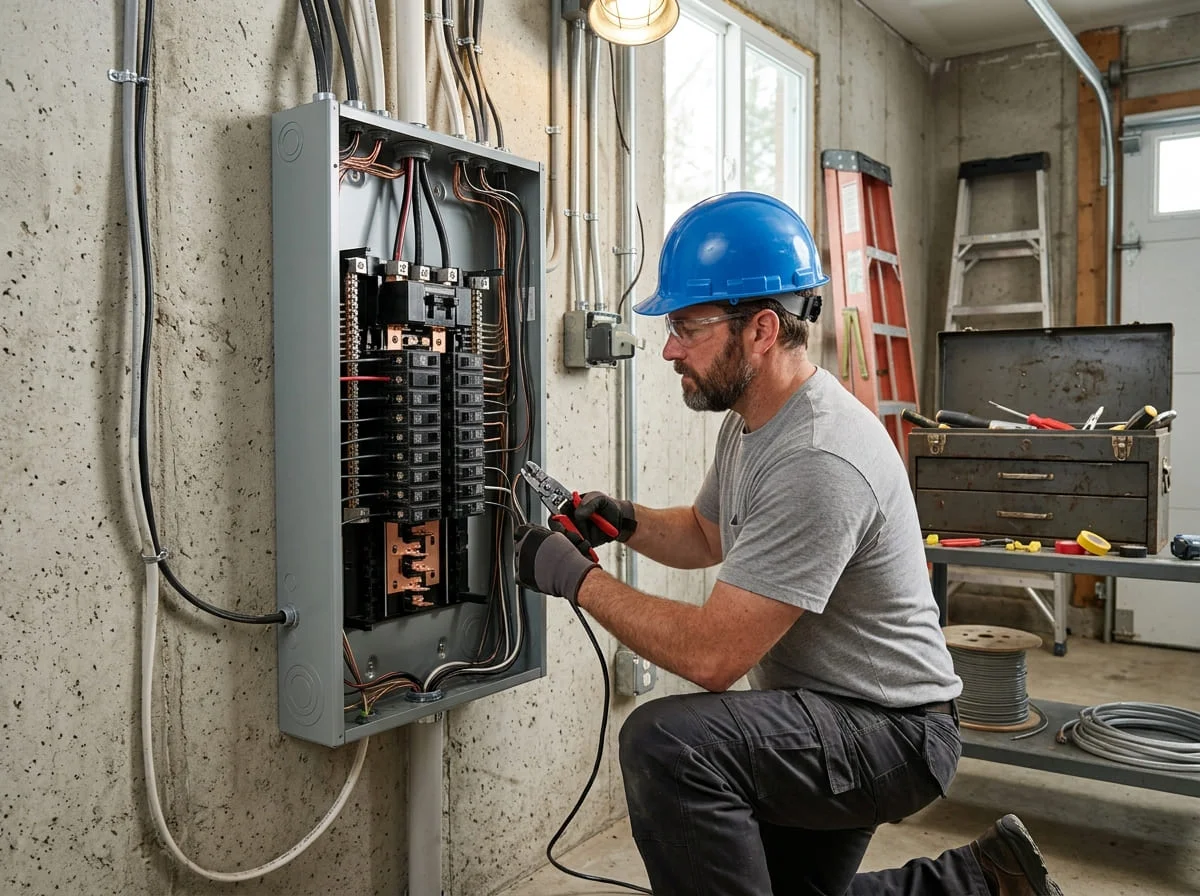
An electrical panel upgrade in West Melbourne, FL costs $900–$3,700, and the low end of that range exists because most homes in this city do not actually need a new panel. West Melbourne's housing stock is dominated by construction from roughly 2000 onward, which means the panels here are modern brands, correctly installed, on 200-amp service, sitting in dry garages. They are not dangerous. They are full — and a full panel and a failing panel are entirely different problems with entirely different price tags.
Handyman Palm Bay FL assesses panels across West Melbourne — the subdivisions off Minton Road and Norfolk Parkway, the newer developments along Hollywood Boulevard, the communities near the Field of Dreams complex, and the established streets closer to the Melbourne line. Service changes require a permit, an inspection, and an FPL meter disconnect, and are performed by a licensed electrical contractor rather than by us. Our job on this side of Brevard is more often to tell you that the $3,000 quote you received solves a problem you do not have.
Electrical Panel Services We Coordinate in West Melbourne
- Breaker space assessment — reading the panel label to determine what it will legitimately accept
- Subpanel installation — the usual answer to a full panel, at roughly half the cost of replacement
- Listed tandem breaker fitting — adding circuits within the panel's own rating where the label permits
- EV charger load calculations — determining whether a Level 2 charger fits the existing service
- Load management device installation — avoiding a service upgrade by scheduling large loads
- Panel replacement — where corrosion, overheating, or a recalled breaker line genuinely requires it
- 150-amp to 200-amp service upgrades — for the smaller services in early-2000s builds
- Circuit directory correction — accurate labeling, which the code requires and builders rarely completed properly
Full Is Not the Same as Failing
A full panel and a failing panel produce the same phone call and require completely different work. West Melbourne homeowners usually discover the problem the same way: an electrician quoting a new circuit for a car charger, a pool heater, a workshop, or a lanai kitchen looks at the panel, finds no open positions, and quotes a replacement. That quote may be correct. More often it skips two cheaper options that would have solved the same problem.
The distinction comes down to what is actually exhausted.
If the service is 200 amps and a load calculation shows the house drawing well under that, the electricity is available — there is simply no physical spot to connect another breaker. That is a hardware limitation, not an electrical one. If the calculation shows the house genuinely approaching the service rating, then capacity is the constraint and more breaker positions would only let you overload a service that is already stretched. These two situations look identical from the garage floor and are told apart by arithmetic. Any quote for a panel replacement in a home this age should be accompanied by the load calculation that justifies it, and it is entirely reasonable to ask for one before signing.
The Subpanel Route Most Quotes Skip
A subpanel solves the most common West Melbourne panel problem for considerably less than a replacement. The concept is simple. A feeder breaker in the main panel supplies a smaller second panel mounted nearby — typically on the same garage wall or in a utility space — and new circuits land there instead. The main panel gives up one or two positions and gains eight to twelve in exchange.
Three things make this the right call in houses of this vintage.
First, the existing panel is genuinely fine, so replacing it spends money to end up with equivalent equipment. Second, a subpanel requires no FPL disconnect and no all-day outage, because the work happens entirely downstream of the main breaker — the power interruption is measured in minutes rather than hours. Third, it leaves substantially more expansion room than a same-size replacement panel would, which matters in a house that has already outgrown its original circuit count once and will likely do it again. The cases where a subpanel is the wrong answer are specific and honest ones: when the main panel itself is damaged, when the service size is the real constraint, or when there is nowhere to mount the second enclosure that meets working clearance requirements. Where the reason for the new circuit is a car charger, the sizing conversation belongs with the Level 2 charger installation rather than being handled separately.
What Working Clearance Means for a Garage Panel
Working clearance is the requirement that most affects West Melbourne homeowners, and almost nobody knows about it until an inspector mentions it. Under the 2020 National Electrical Code, which Florida enforces today through the 8th Edition (2023) Florida Building Code, 110.26 requires clear working space in front of an electrical panel measuring at least 30 inches wide, 36 inches deep, and 6 feet 7 inches high. That space must stay clear — it is not a construction-day requirement that expires once the inspector leaves.
In a two-car garage that has been lived in for twenty years, this is almost always a conflict.
The wall where the builder put the panel is the same wall that accumulated a workbench, a set of storage shelves, a chest freezer, or the bikes. We regularly find panels behind a shelving unit that has to be unloaded before the door will open. The requirement exists for a practical reason: someone working on an energized panel needs room to step back, and someone needs to be able to reach the main breaker in an emergency without moving furniture first. Florida moves to the 9th Edition Building Code on December 31, 2026, reviewed against the 2023 NEC, so work permitted after that date follows a newer edition. Before scheduling any panel work, clear that space — an inspector who cannot access the panel will not sign off, and rescheduling around an FPL meter appointment is the expensive kind of delay.
Stucco, Conduit, and Exterior Work on Newer Builds
Exterior work on a West Melbourne home runs into stucco-over-foam construction, which changes how a service upgrade gets executed. Homes built here through the 2000s commonly use a foam board layer under the stucco finish, and that assembly does not behave like the concrete block found in older Brevard neighborhoods. Anchoring conduit, a meter can, or a disconnect to it requires fasteners that reach actual structure rather than biting into foam and finish coat.
Two failure modes follow from getting this wrong.
First, mechanical: a heavy enclosure fastened only into foam works loose over years of thermal cycling and load, and the mounting sags. Second, and more damaging, moisture: every penetration through a stucco-over-foam wall is a potential water path, and an unsealed conduit entry lets rain track behind the finish where nobody sees it until staining appears indoors. Proper execution means locating framing or block behind the assembly, using appropriate fasteners, and sealing every penetration with a compatible sealant rather than whatever is in the truck. This is one of the reasons a service upgrade costs more than a straight interior panel swap in this city, and it is worth confirming that a quote accounts for it. Panels showing corrosion at exterior penetrations often signal water intrusion that needs separate attention — the same detailing logic applies to our weatherproofing and sealing work.
Electrical Panel Upgrade Pricing in West Melbourne, FL
Subpanel installed to add breaker space: $900–$1,750.
Listed tandem breakers fitted within panel rating: $145–$320.
Panel replacement, same 200-amp service: $1,700–$2,750.
150-amp to 200-amp service upgrade: $2,300–$3,700.
Load calculation for an EV charger or pool heater: included with any panel estimate.
Load management device to avoid a service upgrade: $425–$850.
Permit and inspection: $150–$400.
Whole-home surge protector installed at the panel: $325–$550.
Most West Melbourne homes land in the first two lines rather than the middle of this list, and we would rather quote the cheaper correct job than the expensive one. All pricing is confirmed in writing before work begins, and the estimate is free. Call (877) 916-5930 or request a quote online to get scheduled. You can see the full range of what we handle here on our West Melbourne handyman services page.
We assess panels across Brevard County — including older service conversions in Cocoa and load calculations in Melbourne.