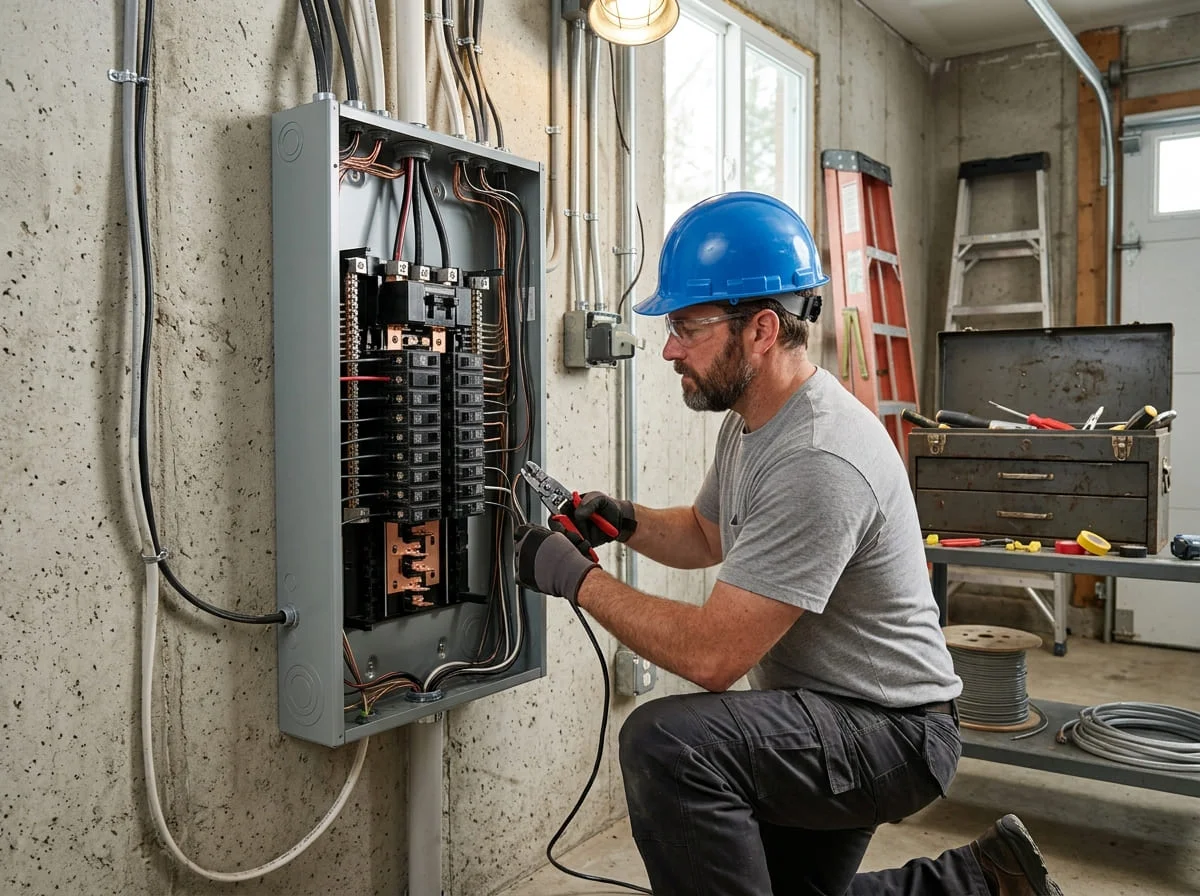
An electrical panel upgrade in Palm Bay, FL costs $1,650–$3,900 depending on whether you are replacing the panel alone or changing the service size with it, and in this city the job is driven by insurance far more often than by a flickering light. Brevard County carriers have spent the last several years tightening what they will write, and the panel brand on the wall of a 1970s Port Malabar home is one of the first things a four-point inspection reports back. Thousands of houses here were built inside the window when two now-notorious brands were standard equipment.
Handyman Palm Bay FL assesses panels across the Port Malabar street grid, Bayside Lakes, Palm Bay Point, Palm Bay Village, the newer subdivisions off Emerson Drive and Malabar Road, and the canal-front streets on the southeast side. A service change is licensed electrical contractor work that requires a City of Palm Bay permit, an inspection, and an FPL meter disconnect — we do not pretend otherwise, and we do not do that part ourselves. What we do is tell you honestly what you have, whether it is a safety problem or simply a capacity problem, what it should cost in this market, and then coordinate the licensed electrician who pulls the permit and performs the work.
Electrical Panel Services We Coordinate in Palm Bay
- Panel identification and assessment — reading the label, the breakers, and the bus for the specific failure patterns each brand has
- Federal Pacific and Zinsco replacement — the two brands Florida underwriters name most often in non-renewal letters
- 100-amp to 200-amp service upgrades — meter can, service entrance conductors, grounding electrode system, and panel as one coordinated change
- Fuse box to breaker panel conversion — for the oldest homes on the west side of the grid
- Four-point inspection support — figuring out what your carrier actually flagged and what will satisfy it
- Subpanel installation — garages, workshops, additions, and detached structures
- Whole-home surge protection — panel-mounted devices sized for Florida's lightning season
- Circuit directory correction — an accurate, legible panel schedule, which the code requires and almost no older panel has
Federal Pacific and Zinsco — Why Palm Bay Has So Many
Federal Pacific and Zinsco panels are common in Palm Bay because of when the city was built. The Port Malabar development boom put tens of thousands of homes on the ground through the 1960s, 1970s, and early 1980s, which is precisely the period when both brands were being installed as standard equipment nationwide. This is not a story about corner-cutting builders. These panels were listed, approved, and ordinary at the time. The problems became clear later.
What went wrong with each brand is different, and worth understanding before you spend three thousand dollars.
Federal Pacific Stab-Lok breakers have a documented tendency not to trip when they should. A breaker exists to open the circuit when current exceeds its rating, and independent testing found Stab-Lok units failing that test at rates far above what any listing would tolerate. A breaker that does not trip does not announce itself — the circuit simply keeps carrying current it was never meant to carry, and the failure shows up as heat inside a wall. Zinsco's problem is mechanical and different. Its breakers connect to an aluminum bus bar that corrodes and deforms, and a breaker can end up welded to the bus so that the handle moves while the connection never opens. In both cases the panel looks entirely normal from the outside, which is exactly why insurance carriers treat the brand as the finding rather than waiting for evidence of failure.
The Insurance Letter Is Usually What Starts This
The insurance letter is what brings most Palm Bay homeowners to a panel upgrade, not a symptom in the house. Florida's homeowners insurance market has repriced and retrenched hard, and carriers still writing here have narrowed their appetite. A four-point inspection — required on most older homes at renewal or at sale — reports on roof, plumbing, HVAC, and electrical, and the electrical section names the panel brand and the service size directly.
A flagged panel generally produces one of three outcomes.
First, a straight non-renewal, leaving you shopping a market where comparable coverage may cost considerably more. Second, a conditional renewal that requires replacement within a stated window, often thirty to ninety days. Third, and increasingly common, a refusal to quote at all during a purchase — which stalls a closing and puts the cost on the negotiating table between buyer and seller. If you are selling a Port Malabar home with an original panel, expect this to surface during the buyer's inspection, and know that handling it in advance is usually cheaper than handling it under deadline with a closing date pressing. Bring the letter to the estimate. The specific wording tells us whether the carrier wants the brand gone, wants a larger service, or wants something else entirely that a panel swap will not fix.
Salt Air, Slab Homes, and Where Your Panel Actually Lives
Where your panel lives in a Palm Bay house changes what fails and what the job costs. These homes are slab-on-grade concrete block with no basement and no crawl space, so the panel is almost never in a conditioned utility room the way it would be up north. It is on an exterior wall, frequently in a combination meter-main enclosure that houses the utility meter and the main breaker in one box, or inside the garage on the wall backing up to the meter.
That exterior mounting is why corrosion drives so many replacements here.
An enclosure on the outside of a house within a few miles of the Indian River Lagoon spends decades in salt-laden humidity. The failure is visible if you know to look: rust blooming at the bottom edge of the can, chalky white deposits on the bus, breaker handles that have gone stiff, and in bad cases a door that no longer seats. On the southeast canal streets this runs noticeably worse than it does inland off Minton Road. A corroded enclosure is a replacement condition on its own merits, independent of brand, because the connections inside it are no longer reliable. Combination meter-main enclosures also raise the cost of the job compared with a simple interior panel swap, since replacing one means coordinating with FPL on the meter side rather than working entirely on the customer side of the connection. Homes on those same streets often need matching attention to outdoor receptacles, which is where ground-fault protection for exterior circuits belongs in the same conversation.
Capacity Versus Safety — Two Different Problems
Capacity and safety are two separate reasons to replace a panel, and confusing them leads to money spent in the wrong place. A safety problem is the panel itself: a brand with a known failure mode, a damaged or corroded bus, evidence of overheating, double-tapped breakers, or an enclosure that no longer protects what is inside it. A capacity problem is arithmetic: the house now draws more than the service was built to deliver.
Palm Bay houses hit the capacity wall in a predictable order.
A 1978 Port Malabar home was designed around a modest air conditioner, an electric range, a water heater, and lighting. Since then the same house has likely gained a higher-capacity heat pump, a pool pump on the lanai side, a garage refrigerator or freezer, and a laundry pair that draws more than the original. Add a Level 2 car charger and the calculation usually breaks — which is why an EV charger installation is the single most common trigger for a service upgrade in this city right now. A charger pulling 40 amps continuously is roughly equivalent to adding a second air conditioner that runs all night. Under the 2020 National Electrical Code, which Florida enforces today through the 8th Edition (2023) Florida Building Code, 230.79 sets 100 amps as the minimum service for a one-family dwelling, so a 100-amp service is not automatically illegal or unsafe — it is simply the floor, and many houses have grown past it. Florida moves to the 9th Edition on December 31, 2026, reviewed against the 2023 NEC, so work permitted after that date is judged against a newer rule set. The honest version of this conversation involves a load calculation rather than a sales pitch, and if your numbers come back fine, adding circuits to a healthy panel is the cheaper and correct answer.
What the Job Actually Involves
A panel upgrade in Palm Bay follows a sequence that is worth knowing before the day arrives. First, a licensed electrical contractor pulls a permit with the City of Palm Bay building department and schedules the FPL disconnect. Second, on the day of work, FPL pulls the meter and the house goes dark, typically early in the morning. Third, the old panel comes out, the new enclosure is mounted, and every branch circuit is landed on a new breaker and labeled properly as it goes.
The parts homeowners do not expect are usually the grounding and the clearances.
Fourth, the grounding electrode system gets brought up to current requirements — this often means new ground rods and a proper bonding connection to the metallic water piping, and on older homes it is frequently the largest hidden portion of the work. Fifth, the inspector visits and signs off. Finally, FPL resets the meter and power returns. One requirement that surprises people is working clearance: the code requires a clear space in front of the panel roughly 30 inches wide, 36 inches deep, and 6 feet 7 inches high, which means the shelving, storage cabinet, or closet that grew around the garage panel over twenty years has to come out and stay out. Where a service change reveals branch circuits that also need attention, that scope belongs with our electrical upgrade work rather than being quietly folded into the panel price.
Electrical Panel Upgrade Pricing in Palm Bay, FL
Panel replacement, same 200-amp service: $1,650–$2,700.
100-amp to 200-amp full service upgrade: $2,300–$3,900.
Federal Pacific or Zinsco replacement: $1,900–$3,200.
Fuse box to breaker panel conversion: $2,400–$4,100.
Combination meter-main enclosure replacement: add $600–$1,300.
Permit and inspection: $150–$400.
Whole-home surge protector installed at the panel: $325–$550.
Subpanel for a garage, workshop, or addition: $850–$1,700.
Corroded exterior enclosures, long service runs, and grounding electrode work push jobs toward the upper end of each range, and a load calculation is what settles which range you are actually in. All pricing is confirmed in writing before any work begins, and the estimate is free. Call (877) 916-5930 or request a quote online, and if you are working against a carrier deadline, say so when you call — those get scheduled first. You can see the wider range of what we handle locally on our Palm Bay Point handyman services page.
We assess panels across Brevard County — including service capacity in West Melbourne and panel replacement in Melbourne.