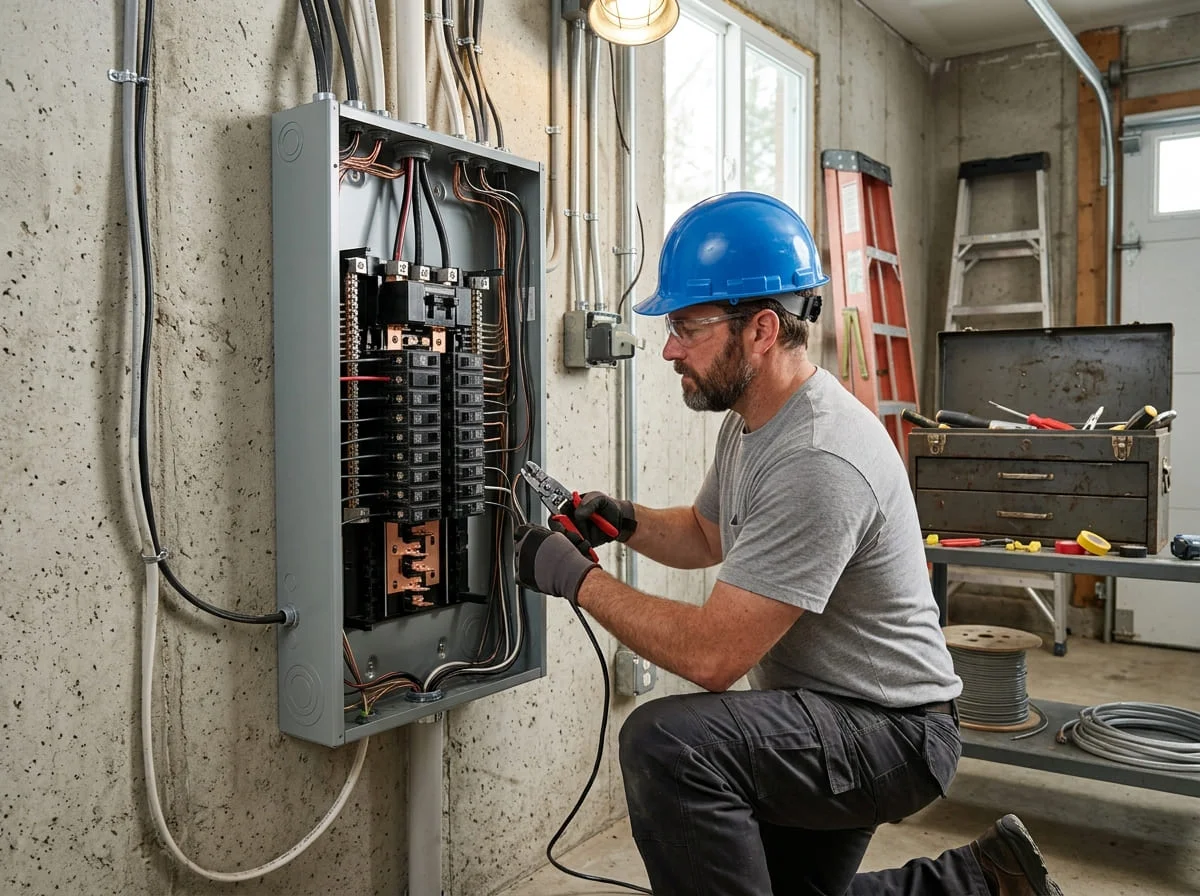
An electrical panel upgrade in Cocoa, FL costs $1,700–$4,500, and on a house built in 1935 the panel is only one component of a question that deserves a fuller answer. Cocoa Village holds some of the oldest continuously occupied housing stock in Brevard County, and in a home of that age the service equipment and the wiring behind the walls were installed decades apart by different people to different standards. Replacing the panel alone can leave the actual hazard completely untouched.
Handyman Palm Bay FL assesses electrical systems throughout Cocoa — the historic Village blocks, the neighborhoods along Brevard Avenue and Delannoy, the mid-century streets west toward Clearlake Road, and the rental properties scattered through all of them. A service change is licensed electrical contractor work requiring a City of Cocoa permit, an inspection, and an FPL disconnect, and that portion is coordinated rather than performed by us. What we do here is give you the whole picture rather than a quote for the one part that happens to be easiest to sell.
Electrical Services We Coordinate in Cocoa
- Whole-system assessment — service, panel, and branch wiring evaluated together rather than in isolation
- 60-amp fuse service conversion — the defining upgrade for pre-1955 Village homes
- Knob-and-tube and cloth wiring identification — finding what is actually behind the walls before quoting
- Panel replacement — flagged brands, corroded enclosures, and undersized services
- Four-point inspection interpretation — separating panel findings from wiring findings
- Rental property compliance work — meeting landlord policy requirements documented properly
- GFCI protection for ungrounded circuits — legal shock protection without rewiring
- Grounding electrode system upgrades — frequently the largest hidden portion of an older-home service change
What Is Actually Behind the Walls
Behind the walls of a pre-war Cocoa Village home is usually a layered history rather than a single wiring system. A house built in the 1920s or 1930s started with knob-and-tube. Somewhere in the 1950s a portion was replaced or extended with early cloth-sheathed cable. In the 1970s a kitchen remodel added modern grounded circuits. Each layer is still in service, and the panel out front protects all of them equally without knowing the difference.
Three distinct problems live in those layers, and only one is a panel problem.
First, embrittlement: the rubber and cloth insulation used before modern thermoplastics hardens and cracks with age and heat, and conductors that flex during work can shed insulation entirely at the point where they enter a box. Second, absence of grounding: two-wire circuits have no equipment grounding conductor, which is why every receptacle in an untouched room is a two-prong outlet. Third, buried knob-and-tube: these conductors were designed to dissipate heat in open air, and when a later owner blew attic insulation over them, that assumption failed. A new panel changes none of this. It is still frequently worth doing — but it should be quoted as one line in a plan rather than presented as the solution. Rooms with two-prong outlets are addressed affordably through ground-fault protection on ungrounded circuits, which provides real shock protection without opening walls.
The 60-Amp Fuse Service and Why It Has to Go
A 60-amp fuse service is the most common finding in older Cocoa homes and the one most likely to force action. Sixty amps was standard for a house with lighting, a refrigerator, and little else. Those homes now carry central air conditioning, an electric range, a water heater, a dryer, and a kitchen full of appliances, and the arithmetic stopped working decades ago.
The fuse itself creates a hazard that a breaker does not.
Fuses are consumable, cheap, and sold by amperage on the same rack, which makes substitution effortless. A circuit that repeatedly blows a 15-amp fuse is reporting a genuine overload, and the correct response is to find out why. The common response is to buy a 20-amp or 30-amp fuse because it stops the inconvenience. That single act removes the protection from a circuit wired with 14-gauge conductors and leaves the wire itself as the only limiting element, which means it heats until something gives. In an eighty-year-old house with brittle insulation, that is a meaningful fire risk hidden inside a wall. Under the 2020 National Electrical Code, which Florida enforces today through the 8th Edition (2023) Florida Building Code, 230.79 establishes 100 amps as the minimum service for a one-family dwelling, so a 60-amp service is well below what any new installation would be permitted at. Florida moves to the 9th Edition on December 31, 2026, reviewed against the 2023 NEC, so work permitted after that date is judged against a newer edition.
Rental Properties and What Underwriters Ask
Rental properties in Cocoa face closer electrical scrutiny than owner-occupied homes, and the Village has a substantial number of them. Landlord policies are underwritten differently, and carriers writing investment property in Brevard County have narrowed their appetite alongside the rest of the Florida market. A four-point inspection on a rental gets read carefully.
The findings that drive decisions come in a predictable set.
First, fuses rather than circuit breakers, which is frequently disqualifying on its own. Second, a service under 100 amps. Third, a flagged panel brand such as Federal Pacific or Zinsco. Fourth, active knob-and-tube or deteriorated cloth wiring, which many carriers treat as an outright refusal rather than a condition. The financially important point for an owner is that these are four separate findings with four separate remedies, and the panel replacement only addresses the first three. A landlord who spends $3,000 upgrading the service to satisfy a letter that flagged knob-and-tube has bought a better panel and an unchanged policy decision. Read the inspection report line by line, and where a finding is ambiguous, ask the carrier what specifically satisfies it before scheduling any work. Documentation of permitted, inspected work is what closes these files, so the permit is not optional paperwork — it is the deliverable.
Working on Historic Homes Without Wrecking Them
Historic Cocoa homes require a different working method than a 2005 tract house, and the difference shows up in the finish work. These houses commonly have lath-and-plaster walls and ceilings, original heart pine or oak trim, plaster crown details, and framing at dimensions that no longer match anything sold today. A service change means new conductors entering the building and a new grounding electrode system, and both involve opening things up.
Plaster behaves nothing like drywall when you cut into it.
Plaster is keyed through wood lath — the wet material was pushed through the gaps and mushroomed behind them, and those keys are what hold the wall together. A fast cut with an aggressive blade vibrates the lath and breaks keys well beyond the cut line, which is why a small opening in a plaster wall can produce a crack a foot away three days later. The method that avoids it is slower and deliberate: score the surface first, cut with minimal vibration, support the lath on both sides of the opening, and expect the patch to be plaster-compatible rather than a drywall scrap taped in. Routing new service conductors along an exterior wall or through a closet rather than through a plastered interior wall avoids much of this entirely, and on a historic home that routing decision is worth more than it costs. Where openings are unavoidable, the finish work belongs with our wall repair and texture matching rather than being left as a patch someone else has to solve.
Electrical Panel Upgrade Pricing in Cocoa, FL
Panel replacement, same service size: $1,700–$2,850.
60-amp fuse service converted to 200-amp breaker panel: $2,600–$4,500.
100-amp to 200-amp service upgrade: $2,350–$3,900.
Federal Pacific or Zinsco replacement: $1,950–$3,300.
Whole-system assessment with written findings: $185–$325.
Grounding electrode system upgrade on an older home: $425–$900.
Permit and inspection: $150–$400.
Whole-home surge protector installed at the panel: $325–$550.
Village homes generally land at the top of each range because nothing gets reused — the service entrance, meter, panel, and grounding are all replaced together on a house this age. All pricing is confirmed in writing before work begins, and the estimate is free. Call (877) 916-5930 or request a quote online to get scheduled. You can see the full range of what we handle locally on our Cocoa handyman services page.
We assess panels across Brevard County — including large-property distribution work in Rockledge and subpanel solutions in West Melbourne.