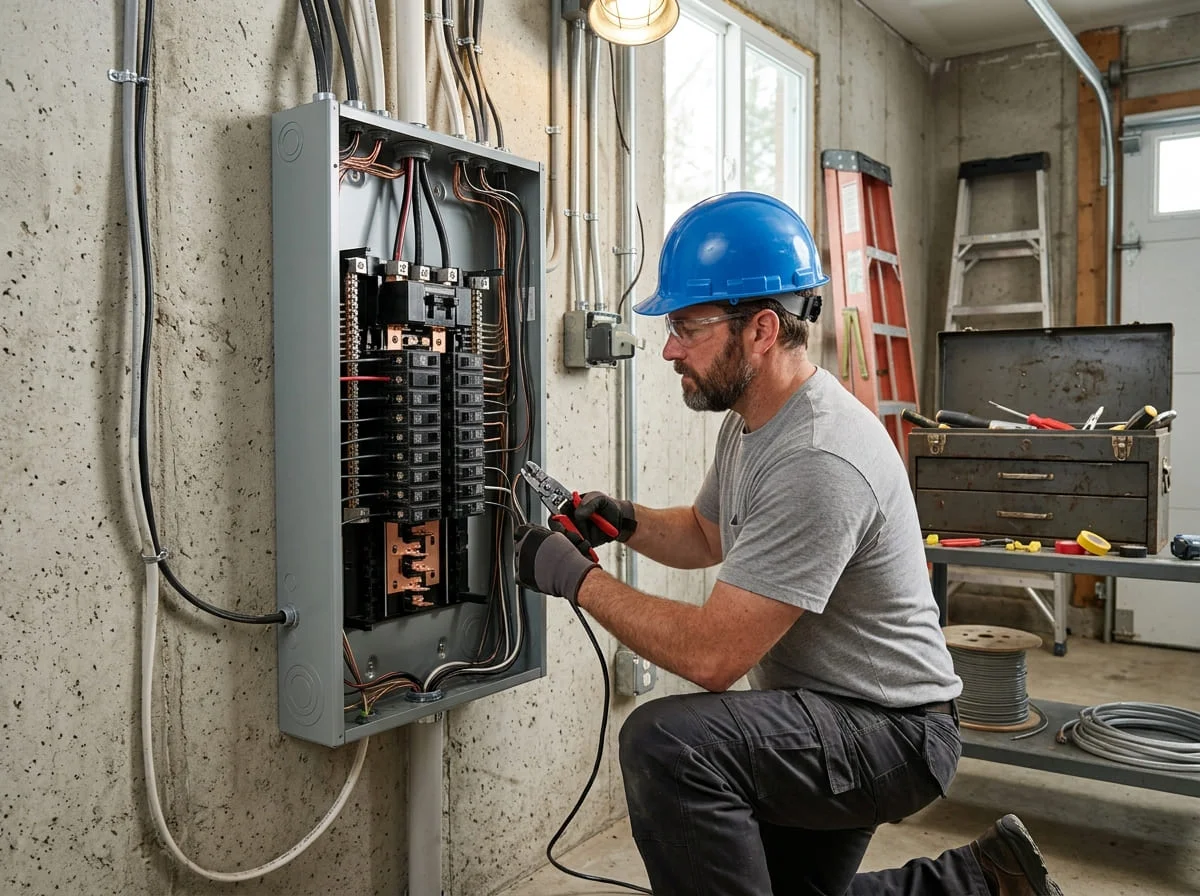
An electrical panel upgrade in Rockledge, FL runs $1,400–$7,500, a range wider than any other city in Brevard County, and the reason is that Rockledge asks a different question than its neighbors. Here the problem is frequently not how many amps arrive at the house but how they get distributed once they do. A 4,000-square-foot riverfront home on Rockledge Drive with a detached garage and a dock has an electrical layout that a single panel by the front door was never designed to serve well.
Handyman Palm Bay FL assesses panels throughout Rockledge — the historic riverfront properties along Rockledge Drive, the mid-century neighborhoods off Barton Boulevard, the established streets near Cocoa Village's southern edge, and the newer Viera-area developments to the west. Service changes and feeder work are licensed electrical contractor jobs requiring a permit, an inspection, and an FPL disconnect, and we coordinate rather than perform that portion. On larger properties, the assessment matters more than usual, because the wrong diagnosis here is an expensive one.
Electrical Panel Services We Coordinate in Rockledge
- Whole-property distribution assessment — mapping what feeds what before recommending anything
- Subpanel installation for large homes — placing capacity near the loads instead of extending long runs
- Detached structure feeders — garages, guest houses, workshops, and dock structures
- 320-amp service upgrades — dual-panel services for properties whose load calculation genuinely exceeds 200 amps
- Voltage drop diagnosis — measuring under load rather than guessing from symptoms
- Panel replacement — mid-century originals, corroded enclosures, and flagged brands
- Marine-rated enclosures and hardware — for riverfront and dock-adjacent installations
- Circuit mapping and directory documentation — essential in homes with three or more panels
Distance Is the Rockledge Variable
Distance is what makes Rockledge electrical work different from the rest of Brevard County. Voltage drop is a function of conductor length, conductor size, and the current being carried, and it does not care how large your main breaker is. A 200-amp service delivers 240 volts at the panel regardless. What arrives at a receptacle 95 feet away on 14-gauge wire is measurably less, and under load it drops further.
The symptoms get misdiagnosed as capacity problems constantly.
A homeowner notices that lights in the far wing dim when the well pump or a compressor starts, that a window unit at the end of the house struggles, or that a workshop tool bogs down in a detached garage but runs fine indoors. The intuitive conclusion is that the house needs more power, and a service upgrade gets quoted. It does not fix the problem, because the constraint was never the service — it was the run. The correct answers are different and usually cheaper: increase the conductor size on the affected circuits, or place a subpanel closer to that end of the house so every branch circuit downstream starts from a shorter distance. A voltage measurement taken at the far end under actual load settles this in a few minutes, and it should be taken before anyone quotes a service change on a large property.
Rockledge Drive Homes and Multi-Panel Properties
Rockledge Drive properties frequently carry three or more panels accumulated across decades, and nobody has a map of them. A 1955 riverfront house gets an addition in 1978 with its own subpanel. A detached garage gets fed in 1991. A pool and lanai project in 2006 adds another. Each was permitted and correct in its era, and collectively they form a distribution system nobody designed.
The practical consequences show up in three ways.
First, nobody knows which panel controls what, so a tripped breaker turns into a twenty-minute search across three enclosures in two buildings. Second, older subpanels are frequently wired with the neutral and ground bonded together — correct practice for a main panel, incorrect for a subpanel fed from one, and a genuine safety issue that inspections catch. Third, the original main panel is often the oldest and weakest link feeding everything else, so upgrading it improves the whole property while replacing a downstream subpanel improves almost nothing. Before spending money on a property like this, the useful first step is a mapping session: every panel opened, every circuit identified and traced, and a legible directory produced for each. That work is inexpensive relative to the property and frequently changes what gets recommended. Homes of this era on this street also tend to need attention to their exterior receptacles, where ground-fault protection near water is both required and genuinely load-bearing for safety.
Docks, Boathouses, and Detached Structures
Detached structures on Rockledge's riverfront properties carry requirements that surprise homeowners expecting a simple wire run. Feeding a garage, guest house, workshop, or boathouse is a feeder-and-subpanel job, not an extended branch circuit. The structure generally needs its own disconnecting means so power can be killed at the building itself, and it needs a grounding electrode system established there rather than relying on the one at the house.
The Indian River adds a second layer to all of it.
Anything within reach of the water needs ground-fault protection, and anything mounted outdoors in this environment needs corrosion-rated enclosures, stainless or coated hardware, and properly sealed conduit entries. Standard indoor-grade equipment installed near the lagoon has a short and unhappy life — the same salt-laden humidity that eats exterior panel enclosures elsewhere in the county works considerably harder a hundred feet from open water. Underground feeders need burial at the required depth in appropriate conduit, which on a mature riverfront lot means trenching around live oak root systems that predate the house. That trenching is frequently the largest single variable in the price, and it is the reason two superficially identical dock jobs on the same street can quote three thousand dollars apart. An honest estimate walks the route before putting a number on it.
Mid-Century Panels and the Viera Contrast
Mid-century Rockledge homes and newer Viera houses need almost opposite things, which is worth stating plainly because the same service name covers both. Homes built through the 1950s and 1960s off Barton Boulevard and in the older riverfront blocks often still have their original service, sized for a house without central air conditioning and without any of the appliances that followed. Those are genuine replacement candidates on capacity grounds alone, before considering brand or condition.
Viera-area homes sit at the other end entirely.
Built largely from the late 1990s onward, they have modern 200-amp service, contemporary panels, and correct installation. Replacement is rarely warranted. What these homes benefit from is an assessment before a major addition — a pool heater, a car charger, a summer kitchen — and an accurate circuit directory, since builder labeling in production housing tends toward optimistic shorthand that stops matching reality after the first renovation. Under the 2020 National Electrical Code that Florida enforces through the 8th Edition (2023) Florida Building Code, 408.4 requires circuits to be legibly identified as to purpose, which is a requirement almost every twenty-year-old panel in this county fails. Florida adopts the 9th Edition on December 31, 2026, reviewed against the 2023 NEC. Correcting a directory costs very little and pays back the first time something trips at an inconvenient hour.
Electrical Panel Upgrade Pricing in Rockledge, FL
Panel replacement, same service size: $1,750–$2,900.
100-amp to 200-amp service upgrade: $2,400–$4,100.
320-amp service with dual 200-amp panels: $4,200–$7,500.
Subpanel inside the main structure: $950–$1,850.
Detached structure feeder and subpanel, including trenching: $1,400–$3,200.
Voltage drop diagnosis and load measurement: $165–$285.
Whole-property circuit mapping and directory documentation: $285–$625.
Permit and inspection: $150–$400.
Trench length, live oak root systems, and marine-rated hardware are what move a detached structure job within its range, so those get walked and measured before we quote rather than after. All pricing is confirmed in writing before work begins, and the estimate is free. Call (877) 916-5930 or request a quote online to get scheduled. You can see the full range of what we handle locally on our Rockledge handyman services page.
We assess panels throughout Brevard County — including historic service conversions in Cocoa and insurance-driven replacements in Palm Bay.