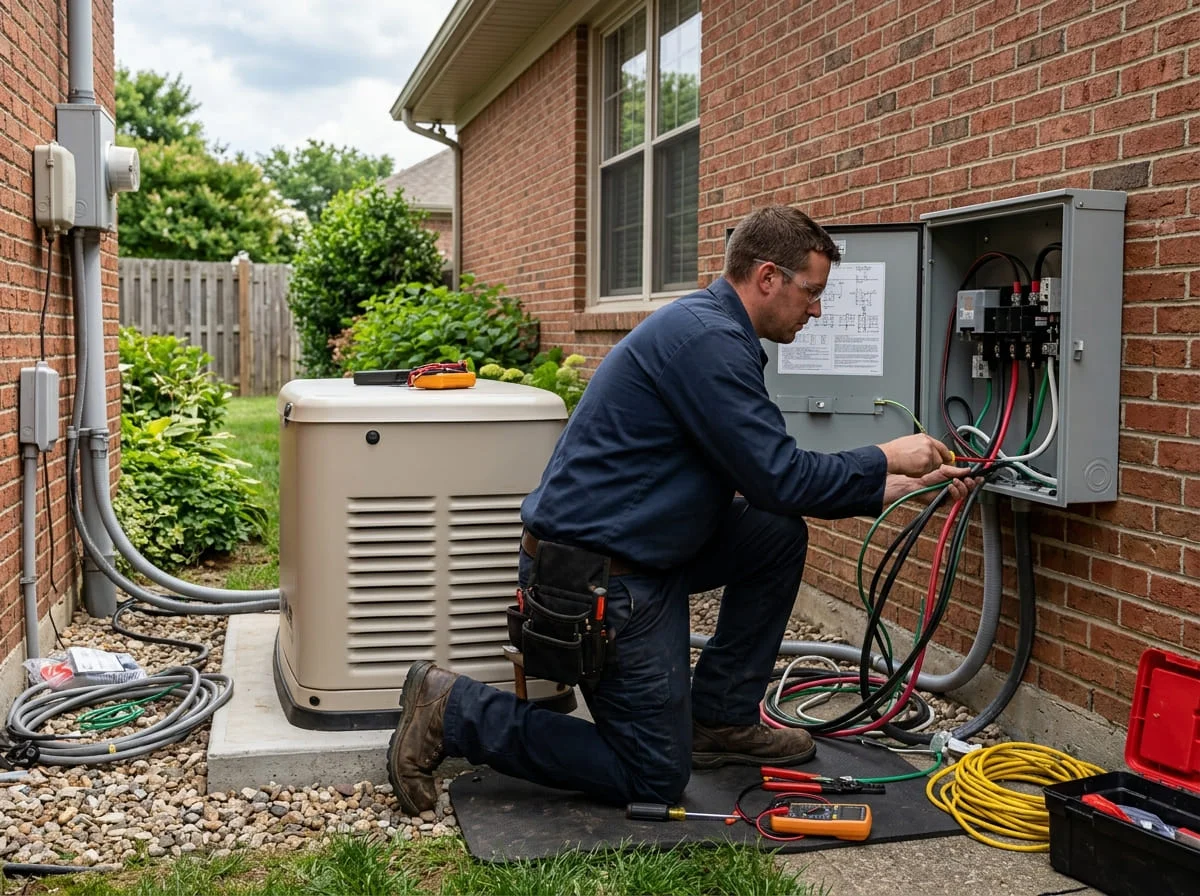
A generator hookup in West Melbourne, FL costs $450–$16,000 depending on whether you want a portable-generator interlock or a full whole-home standby system, and the panel itself is rarely what complicates the job here. West Melbourne's housing stock is dominated by construction from roughly 2000 onward, which means most panels are modern brands in good condition — the questions that actually decide the project are HOA approval, garage clearance, and exterior mounting, not whether a listed interlock kit exists for your panel.
Handyman Palm Bay FL assesses generator hookups across West Melbourne — the subdivisions off Minton Road and Norfolk Parkway, the newer developments along Hollywood Boulevard, the communities near the Field of Dreams complex, and the established streets closer to the Melbourne line. Wiring a generator into the house is licensed electrical contractor work requiring a permit and inspection, and a standby system's gas or propane line adds a licensed gas contractor with a separate permit. We tell you plainly what your setup needs and coordinate the licensed trades who do the work.
Generator Hookup Services We Coordinate in West Melbourne
- Interlock kit installation — straightforward on the modern panels common in this city's post-2000 housing
- Manual and automatic transfer switch installation — for portable-generator backup or whole-home standby systems
- HOA submission support — documentation for the exterior approval most standby installations require
- Garage clearance assessment — checking whether stored items block the required working space at the panel
- Power inlet box installation — properly anchored into stucco-over-foam exterior walls
- Whole-home standby packages — generator, transfer switch, pad, and fuel line as one coordinated project
- Load calculation for combined EV charger and generator loads — sizing both together rather than as separate afterthoughts
- Post-storm safety check — verifying a rushed pre-storm installation was done correctly
Interlock Kits Are the Easy Part Here
Interlock kits are the easy part of a West Melbourne generator hookup, which is the opposite of how the conversation goes in older Brevard neighborhoods. A UL-listed interlock kit exists for most Square D, Eaton, GE, and Siemens panels installed in the last two decades, and that covers the overwhelming majority of what's on the wall in this city's post-2000 housing stock. There's no Federal Pacific or Zinsco problem to work around here the way there is in older Port Malabar or Cocoa homes.
That doesn't mean there's nothing to check.
A licensed electrician still confirms the exact panel model against the interlock manufacturer's approved list before ordering hardware, since a generic universal interlock is a code problem waiting to surface at inspection. What it does mean is that the panel is rarely the bottleneck on the timeline or the budget here — the HOA approval process and the garage clearance requirement, covered next, are the parts of the project that actually take planning.
HOA Approval — the Real Bottleneck for a Standby System
HOA approval is the step that actually slows down a whole-home standby installation in West Melbourne, more often than the electrical work itself. Most HOAs here govern visible exterior changes, and a standby generator with its pad, enclosure, and often a propane tank is exactly that kind of visible change — unlike a straight interior panel swap, which usually falls outside HOA review entirely.
Submitting early avoids the expensive version of this problem.
Some covenants specify screening requirements, minimum setbacks from the property line, or restrictions on which side of the house equipment can be visible from. A generator ordered and scheduled before that approval comes back risks a stop-work request after the pad is poured, which costs real money to relocate. We recommend submitting HOA paperwork before finalizing the placement, not after, and we can provide the documentation most associations ask for as part of the estimate.
Working Clearance at the Panel and the Generator Pad
Working clearance affects a generator hookup the same way it affects a standalone panel job, and it's the requirement most West Melbourne homeowners don't know about until an inspector mentions it. Under the 2020 National Electrical Code, which Florida enforces today through the 8th Edition (2023) Florida Building Code, NEC 110.26 requires a clear working space in front of an electrical panel of roughly 30 inches wide, 36 inches deep, and 6 feet 7 inches high — a space an interlock kit or transfer switch installation needs access to just as much as any other panel work.
In a two-car garage lived in for twenty years, that space is almost always occupied.
A workbench, storage shelving, or a chest freezer commonly ends up against the same wall the builder put the panel on, and all of it has to come out before an electrician can legally work there or before an inspector will sign off. The standby generator's own pad carries a similar clearance requirement — roughly 18 inches behind it to a wall and 3 feet in front and to the sides for service access — which factors into where on the property it can actually go. Florida moves to the 9th Edition Building Code on December 31, 2026, reviewed against the 2023 NEC, so work permitted after that date follows the newer edition.
Stucco-Over-Foam and Where the Inlet Box Actually Mounts
Stucco-over-foam construction changes how a power inlet box, disconnect, or generator pad anchor gets installed on a West Melbourne home built through the 2000s. That wall assembly uses a foam board layer under the stucco finish, and it does not hold a fastener the way concrete block does — anything mounted through it needs to reach actual framing or block behind the assembly, not just bite into foam and finish coat.
Getting it wrong produces two separate failures.
Mechanically, a heavy enclosure fastened only into foam works loose over years of thermal cycling. More seriously, every unsealed penetration through a stucco-over-foam wall is a water path that can track behind the finish for months before staining shows up indoors. A licensed installer locates solid backing before drilling and seals every penetration with a compatible sealant, which is standard practice but worth confirming is included in any quote you receive.
What the Job Actually Involves
A generator hookup in West Melbourne follows a straightforward sequence given the panel situation here. First, a load calculation confirms generator size and whether an interlock, transfer switch, or standby system fits the goal, and the panel gets checked against the interlock manufacturer's listed models. Second, if a standby system is planned, HOA documentation gets submitted before the pad location is finalized.
From there the installation itself moves quickly.
Third, the licensed electrician pulls the permit, clears and confirms working space at the panel, and installs the interlock or transfer switch along with a properly anchored power inlet box. Fourth, for a standby system, the pad is poured, the gas or propane line is run under its own permit, and the automatic transfer switch and control wiring get set. Finally, the inspector signs off and the generator is tested under load before the job is complete.
Generator Hookup Pricing in West Melbourne, FL
Interlock kit installation: $450–$900.
Manual transfer switch, 6–10 circuits: $1,400–$2,500.
Power inlet box, added to an existing interlock or switch: $250–$475.
Whole-home standby system, 20–24 kW with automatic transfer switch: $9,500–$16,000.
Reinforced concrete pad with hurricane tie-downs: $1,000–$1,700.
Permit and inspection: $150–$400.
Most West Melbourne homes land toward the lower end of each range because the panel and service size rarely need attention first. All pricing is confirmed in writing before any work begins, and the estimate is free. Call (877) 916-5930 or request a quote online to get scheduled.
We coordinate generator hookups throughout Brevard County — including standby installation in Melbourne and interlock kits in Palm Bay.