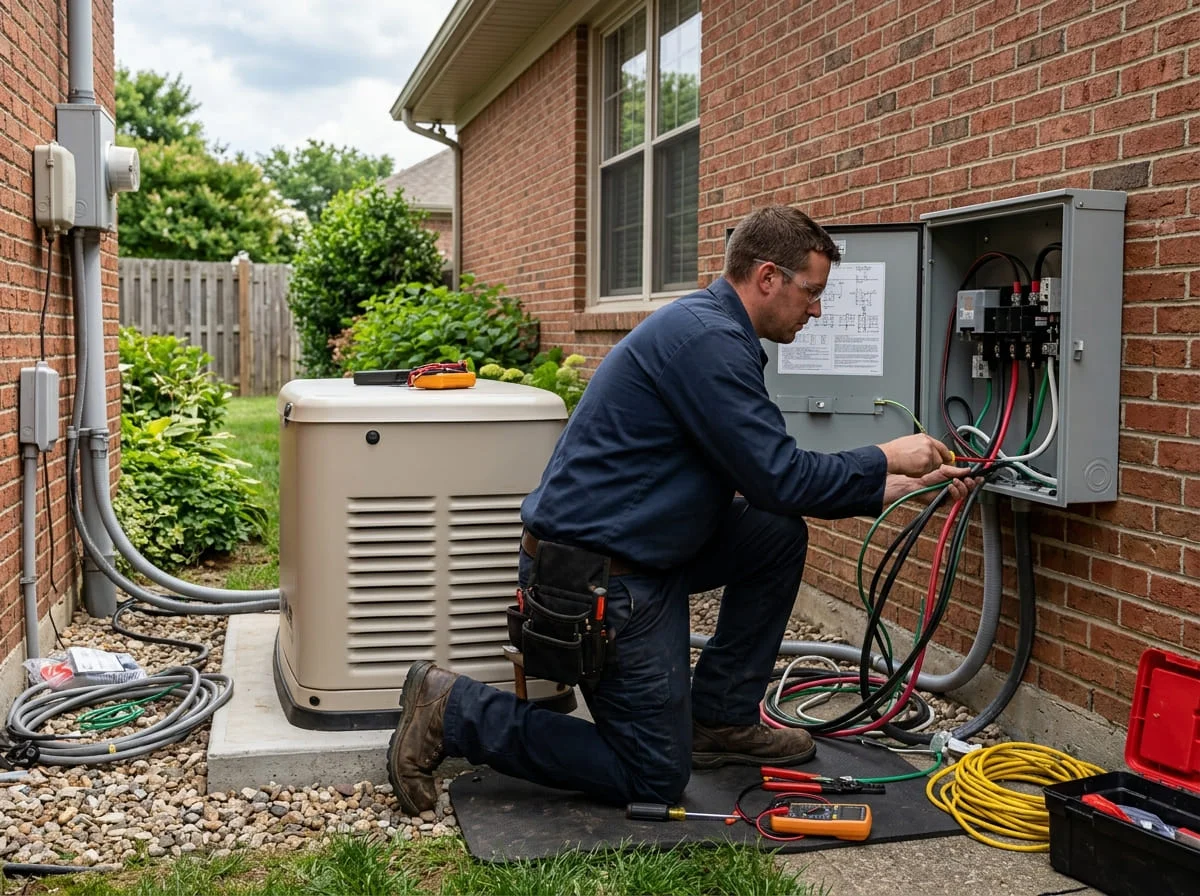
A generator hookup in Palm Bay, FL runs $450 for a basic interlock kit up to $16,500 for a full whole-home standby system, and the right answer for your house depends more on your electrical panel and how long you're willing to go without power than on budget alone. Brevard County loses grid power for hours at a time in an ordinary summer storm and for days at a time after a direct hurricane hit, and a generator that isn't wired in safely is either useless when the power actually goes out or dangerous enough to hurt someone in your own house.
Handyman Palm Bay FL assesses panels and generator setups across Port Malabar, Bayside Lakes, the canal-front streets on the southeast side, and the newer construction off Malabar Road and Emerson Drive. Wiring a generator into the house — an interlock kit, a manual or automatic transfer switch, a power inlet box, or a full standby package — is licensed electrical work that requires a City of Palm Bay permit and inspection, and a standby system with a gas or propane line adds a licensed gas contractor and often a structural sign-off on the pad. We don't blur those lines. What we do is tell you honestly which option fits your panel and your budget, size the job correctly, and coordinate the licensed trades who pull the permits and do the work.
Generator Hookup Services We Coordinate in Palm Bay
- Interlock kit installation — a mechanical device that locks out the main breaker so only the generator or the utility can feed the panel, never both
- Manual transfer switch installation — a dedicated 6–10 circuit sub-panel for running the essentials on a portable generator
- Automatic transfer switch installation — for whole-home standby systems that start and switch over on their own within seconds of an outage
- Power inlet box installation — the weatherproof exterior plug that lets you connect a portable generator without running an extension cord through a window
- Whole-home standby generator packages — natural gas or propane units sized to your panel's actual load, with the pad, gas line, and transfer switch coordinated as one project
- Panel compatibility assessment — checking whether your specific panel brand and model has a UL-listed interlock kit before you buy one online
- Load calculation — sizing the generator to what your house will actually draw during an outage, not a guess
- Post-storm safety check — verifying an existing hookup wasn't compromised by flooding, corrosion, or a rushed pre-storm installation
Interlock Kit or Transfer Switch — What Your Panel Allows
Interlock kit or transfer switch is a question your panel answers, not one you get to pick freely. An interlock kit is a metal plate or sliding mechanism that makes it physically impossible to switch on the main breaker and the generator breaker at the same time, and it only exists as a UL-listed part for specific panel brands and models. Under the 2020 National Electrical Code, which Florida enforces today through the 8th Edition (2023) Florida Building Code, NEC 702.5 and 702.11 require exactly that kind of listed, interlocked disconnecting means before a power inlet can feed the panel — this is why a generic universal interlock bought online is a code problem waiting to be found at inspection, not a shortcut.
Listed interlock kits exist for most Square D, Eaton, GE, and Siemens panels manufactured in the last few decades.
They do not exist for Federal Pacific or Zinsco equipment, which is common enough in Palm Bay's older Port Malabar homes that it comes up on a real share of the generator calls we take. If your panel is one of those two brands, the honest options are a standalone transfer switch that bypasses the main breaker question entirely, or a panel replacement first — and if you're already facing an insurance non-renewal over that same panel, as covered on our electrical panel upgrade page, the generator hookup is a reason to make that call now rather than twice.
Why Palm Bay Homeowners Are Wiring In Backup Power Now
Wiring in backup power now, rather than after the next storm, is what most Palm Bay callers wish they had done sooner. Brevard County sits on the part of the Florida coast that takes tropical systems seriously every summer and fall, and a grid built to handle ordinary afternoon thunderstorms strains hard under a named storm's wind and rain. Multi-day outages are not a hypothetical here — they're a planning assumption for anyone who has lived through more than one hurricane season in this county.
The homes most exposed to a bad outage share a few traits.
Slab-on-grade CBS construction means no basement generator room and no crawl space to hide the wiring run, so the interlock, transfer switch, or standby unit has to be planned around an exterior wall or a garage. Canal-front and southeast-side properties near the Indian River Lagoon deal with salt air that corrodes an outdoor generator enclosure faster than it would inland, which is a real factor in choosing hardware, not a sales detail. And a growing number of Palm Bay households now run a well pump, a second refrigerator, or medical equipment that makes a multi-day outage more than an inconvenience.
Portable Generator Safety — What the Interlock Actually Prevents
Portable generator safety is the entire reason the interlock and transfer switch requirements exist, and the risk is not abstract. Two failures account for nearly every generator-related injury after a Florida storm: backfeeding power into the house wiring through a regular outlet, which can electrocute a utility lineman working on what should be a dead line, and running a generator too close to the house, which lets carbon monoxide drift back in through a window, door, or vent. Florida Statute 553.885 already requires a carbon monoxide alarm in homes with an attached garage or a fuel-burning appliance — the same logic applies directly to a generator running feet from your bedroom window, and it's worth pairing a hookup with the combination smoke and CO alarm most older Port Malabar homes are still missing.
An interlock kit or transfer switch removes the backfeeding risk mechanically rather than relying on a homeowner to remember a rule during a stressful outage. That is the entire value of the hardware, and it's why a generic extension cord run through a cracked window is not a substitute for it.
Placement, Salt Air, and the Palm Bay Lot
Placement on a Palm Bay lot has to account for openings you might not think to count. A generator, portable or standby, needs a minimum 5-foot clearance from any window, door, dryer vent, soffit vent, or fresh-air intake, measured to the nearest edge of the opening — and on a house with a screened lanai, the lanai's screen counts as an opening for this measurement, which catches homeowners who assume the enclosed porch is a buffer rather than an open-air space. Standby units add their own clearance rules: roughly 18 inches behind to a noncombustible wall and 3 feet in front and to both sides for service access.
Salt air changes the hardware decision as much as the placement.
A standby unit's steel or aluminum enclosure on a canal-front or southeast-side lot near the lagoon corrodes faster than the same unit would inland off Minton Road, which is why enclosure material and coating matter more here than the spec sheet suggests. A concrete pad with hurricane tie-downs — required for any permanently installed unit in Florida's wind zones — also has to sit above expected flood staging on lower-lying lots, which a licensed installer checks against the flood zone map before pouring anything.
What the Job Actually Involves
A generator hookup in Palm Bay follows a sequence worth knowing before the crew arrives. First, a load calculation determines what you actually need to power — the whole house, or a defined set of essential circuits — which decides whether an interlock, a transfer switch, or a full standby system is the right scope. Second, the panel gets checked against the listed-kit requirement described above, ruling in or out the interlock option before you spend money on the wrong hardware.
From there the trades split by scope.
Third, for a portable-generator setup, the licensed electrician pulls a permit, installs the interlock or transfer switch, and adds a power inlet box on an exterior wall so no extension cord ever has to cross a window sill. Fourth, for a standby system, the pad gets poured with hurricane tie-downs, a licensed gas contractor runs the propane or natural gas line and pulls its own permit, and the electrician sets the automatic transfer switch and lands the generator's control wiring. Finally, the inspector signs off on each permit before the system is considered complete, and the generator gets a startup test under load, not just a key-turn.
Generator Hookup Pricing in Palm Bay, FL
Interlock kit installation, panel-dependent: $450–$950.
Manual transfer switch, 6–10 circuits: $1,450–$2,600.
Power inlet box, added to an existing interlock or switch: $250–$500.
Whole-home standby system, 20–24 kW with automatic transfer switch: $9,500–$16,500.
Reinforced concrete pad with hurricane tie-downs: $1,000–$1,800.
Permit and inspection: $150–$400.
A panel that needs replacement before a generator hookup will add the cost covered on our electrical panel upgrade page, and a home that hasn't been checked for adequate service size before adding a standby unit should start with that assessment rather than the generator quote. All pricing is confirmed in writing before any work begins, and the estimate is free. Call (877) 916-5930 or request a quote online — during hurricane season, say so when you call, since generator jobs booked ahead of a storm get priority over jobs booked during one.
We coordinate generator hookups throughout Brevard County — including HOA-cleared installs in West Melbourne and standby systems for larger properties in Rockledge.