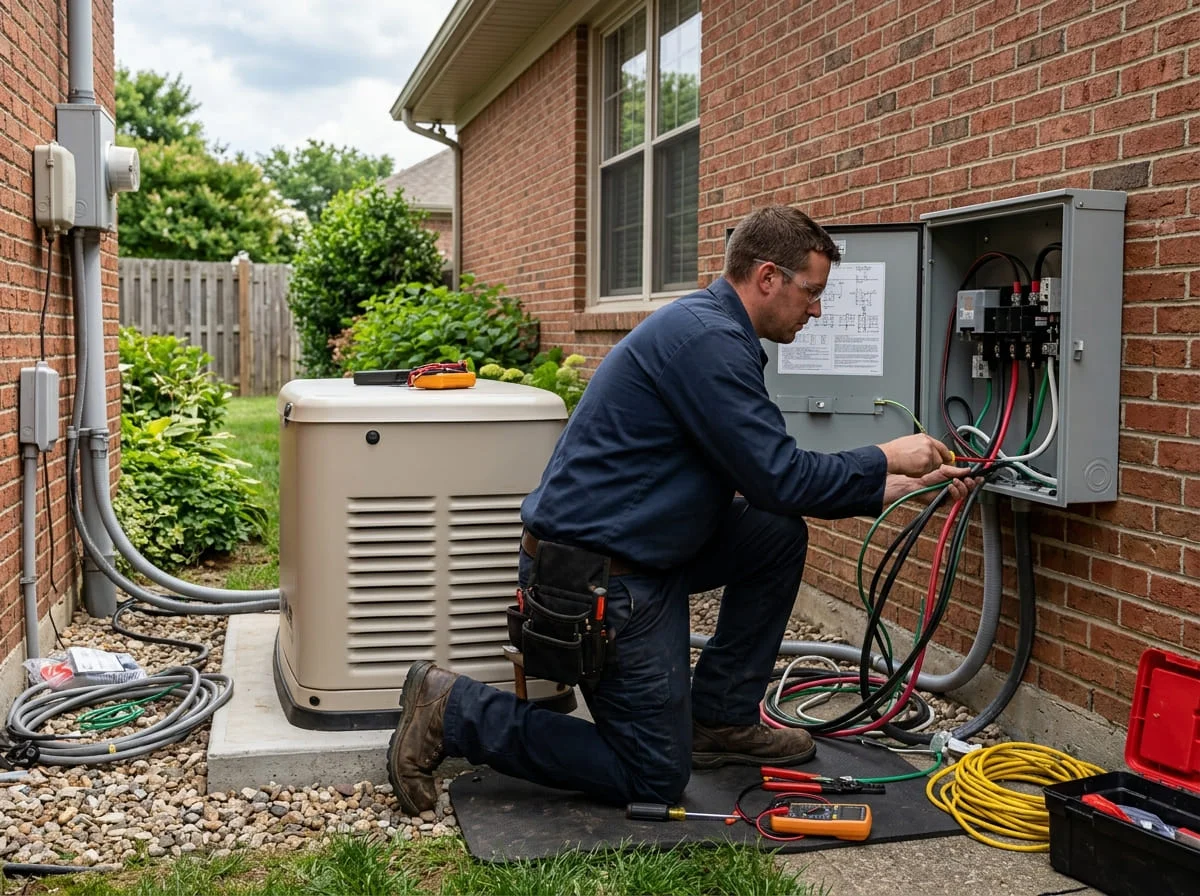
A generator hookup in Rockledge, FL runs $475 for a basic interlock kit up to $18,500 for a whole-home standby system on a large property, and the range here is wider than anywhere else in Brevard County for the same reason panel work is: distance and property layout matter as much as the generator itself. A riverfront estate on Rockledge Drive with a detached guest house and a dock asks different questions than a single-panel home in Viera three miles away.
Handyman Palm Bay FL assesses generator setups throughout Rockledge — the historic riverfront properties along Rockledge Drive, the mid-century neighborhoods off Barton Boulevard, the streets near Cocoa Village's southern edge, and the newer Viera-area developments to the west. Wiring a generator into the house, and any feeder work to a detached structure, is licensed electrical contractor work requiring a permit and inspection, and a standby system's fuel line adds a licensed gas contractor. On larger properties, getting the assessment right matters more than usual, because the wrong plan here is an expensive one.
Generator Hookup Services We Coordinate in Rockledge
- Whole-property panel mapping — identifying every panel and circuit before recommending where a transfer switch goes
- Interlock kit and transfer switch installation — sized and placed for the property's actual layout
- Detached structure standby feeds — guest houses, workshops, and dock structures wired for backup power under their own disconnect
- Voltage drop diagnosis — measuring conductor performance under load on long branch circuits before recommending a fix
- Whole-home standby packages — generator, transfer switch, pad, and fuel line for larger riverfront homes
- Marine-rated hardware installation — corrosion-resistant enclosures and connections for dock-adjacent equipment
- Load calculation for dual-panel and 320-amp services — sizing a standby unit correctly on the largest properties
- Post-storm safety check — verifying an existing multi-structure setup wasn't compromised by flooding or corrosion
Distance and the Voltage Drop Nobody Warns You About
Distance is the variable that changes a Rockledge generator hookup the most, the same way it changes panel work on this same street, covered on our electrical panel upgrade page. Voltage drop is a function of conductor length and size, and it applies just as much to the branch circuits a generator is backing up as it does to normal utility power. A circuit running 90 feet from the panel to the far wing of a large riverfront home will show more voltage drop under a generator than a 20-foot run to the kitchen.
This gets misread as a generator sizing problem when it's actually a distribution problem.
A homeowner notices dim lighting or a struggling window unit at the far end of the house during an outage and assumes the generator is too small, when the generator is delivering exactly what it should at the panel — the loss happens downstream on the wire itself. The fix is either upsizing the conductor on the affected run or placing a subpanel closer to that end of the house, not buying a larger generator that will show the identical symptom. This is worth diagnosing with an actual voltage measurement under load before assuming a bigger unit solves it.
Multi-Panel Properties — Which Panel Gets the Transfer Switch
Multi-panel properties are common enough on Rockledge Drive that deciding which panel gets the transfer switch is its own planning step, not an afterthought. A 1955 riverfront house with a 1978 addition, a 1991 detached garage feed, and a 2006 pool project can easily carry three or four panels installed across five decades by different electricians, none of whom mapped the whole system.
Getting this wrong means a partially useful transfer switch.
A transfer switch tied into the wrong panel keeps some circuits alive during an outage and leaves others dark, which defeats much of the point of installing one in the first place — especially when the dark circuits turn out to be the well pump or the refrigerator in the garage. Before quoting a hookup on a property like this, we map every panel, trace what each one feeds, and identify which one functions as the true main — usually, though not always, the oldest one, since it's the one everything else was built off of. That mapping is inexpensive relative to the property and routinely changes where the transfer switch ends up going.
Powering a Dock, Boathouse, or Guest House During an Outage
Powering a dock, boathouse, or guest house during an outage on a Rockledge riverfront property is a feeder job with its own code path, not an extension of the main house's transfer switch. Under the 2020 National Electrical Code, which Florida enforces today through the 8th Edition (2023) Florida Building Code, NEC 225.30(A)(5) specifically permits a second supply to a structure that already has one feeder, when that second supply is for an optional standby system — which is exactly the situation a detached guest house or boathouse with its own generator backup creates.
The Indian River adds its own layer of requirements on top of that.
Anything within reach of the water needs ground-fault protection, and equipment mounted outdoors near the river needs corrosion-rated enclosures and sealed connections the way standard indoor-grade hardware simply doesn't survive. Underground feeders to a detached structure need proper burial depth and conduit, which on a mature riverfront lot usually means trenching around live oak root systems — frequently the single largest cost variable on a project like this, and something an honest estimate walks the route to measure rather than guesses at. Florida moves to the 9th Edition Building Code on December 31, 2026, reviewed against the 2023 NEC.
Mid-Century Rockledge Drive vs. Viera
Mid-century Rockledge Drive homes and newer Viera houses need almost opposite generator planning, worth stating plainly since both fall under the same service. Homes built through the 1950s and 1960s off Barton Boulevard and along the older riverfront blocks often carry the multi-panel history and long feeder runs described above, which means more planning time before the generator itself gets specified.
Viera-area homes are the simpler case entirely.
Built largely from the late 1990s onward with a single modern 200-amp panel in good condition, these homes typically need nothing more than a straightforward load calculation and a standard interlock kit or transfer switch installation — the same job that takes a day in Viera can take considerably longer to plan correctly on a historic riverfront estate three miles away, and pricing reflects that difference rather than the generator equipment itself.
Generator Hookup Pricing in Rockledge, FL
Interlock kit installation: $475–$1,000.
Manual transfer switch, 6–10 circuits: $1,500–$2,700.
Whole-home standby system, sized to the property: $10,000–$18,500.
Detached structure feeder for standby power, including trenching: $1,400–$3,200.
Voltage drop diagnosis and load measurement: $165–$285.
Whole-property panel mapping, for properties with 3 or more panels: $285–$625.
Permit and inspection: $150–$400.
Trench length, live oak root systems, and marine-rated hardware are what move a detached-structure job within its range, so those get walked and measured before we quote rather than after. All pricing is confirmed in writing before any work begins, and the estimate is free. Call (877) 916-5930 or request a quote online to get scheduled.
We coordinate generator hookups throughout Brevard County — including interlock kits in Palm Bay and standby systems in Melbourne.