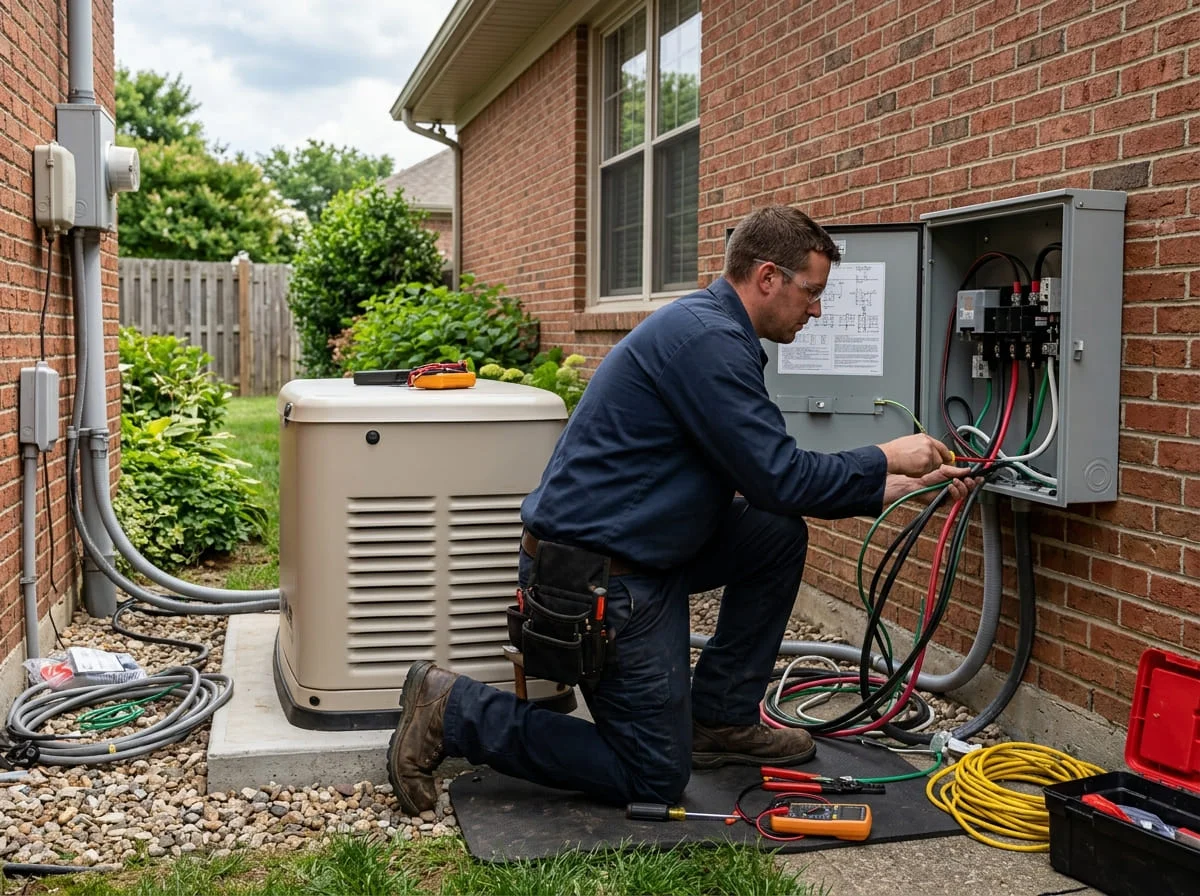
A generator hookup in Cocoa, FL costs $450–$17,000, and on a house built before 1955 the honest starting point is a question that has nothing to do with generators yet: what kind of electrical service does the house actually have. Cocoa Village holds some of the oldest continuously occupied housing stock in Brevard County, and a fair number of those homes are still on the original fuse service that predates the idea of a listed interlock kit by decades.
Handyman Palm Bay FL assesses generator setups throughout Cocoa — the historic Village blocks, the neighborhoods along Brevard Avenue and Delannoy, the mid-century streets west toward Clearlake Road, and the rental properties scattered through all of them. Wiring a generator into the house is licensed electrical contractor work requiring a City of Cocoa permit and inspection, and exterior equipment on a historic-district property may need additional design review. We give you the full picture — what your panel supports today, what it needs first, and what the honest options actually cost.
Generator Hookup Services We Coordinate in Cocoa
- Panel compatibility assessment — determining whether your service can take an interlock kit, needs a transfer switch, or needs replacing first
- 60-amp fuse service conversion — the prerequisite for any generator hookup on pre-1955 Village homes still on their original service
- Interlock kit and transfer switch installation — once a modern breaker panel is in place
- Historic district placement planning — routing visible equipment to a side or rear elevation where review applies
- Rental property backup power assessment — sized to tenant safety and landlord liability rather than maximum capability
- Power inlet box installation — mounted with care on lath-and-plaster or masonry historic exteriors
- Whole-home standby packages — generator, transfer switch, pad, and fuel line coordinated as one project
- Combination smoke and CO alarm pairing — added alongside a generator hookup on older homes most likely to be missing one
When the Panel Itself Is the Blocker
The panel itself is the first thing that blocks a generator hookup on many Cocoa Village homes, before an interlock kit or transfer switch is even part of the conversation. An interlock kit needs a breaker to physically lock out — a fuse box has none. A transfer switch is more flexible in general but still requires modern overcurrent protection on the load side, which a 60-amp fuse service in an eighty-year-old house typically can't provide alongside the demand a generator hookup adds.
This is the same fuse-service problem that drives most panel replacements in this city, covered in more depth on our electrical panel upgrade page, and it changes the sequence of the project rather than just the price.
A fuse service has to be converted to a modern breaker panel before a generator hookup can happen at all, not layered on as an add-on afterward. Homeowners already facing that conversion for insurance reasons should fold the generator hookup into the same project — running both at once saves a second mobilization and a second round of permits.
Historic District Review for a Visible Generator Installation
Historic district review comes into play on a Cocoa generator installation exactly where it comes into play on a panel service change: when the equipment is visible from the street. An interlock kit installed inside a garage changes nothing about the exterior and is generally unaffected. A whole-home standby unit with its pad, enclosure, and possibly a propane tank sitting in a front or side yard is a different matter on a property with a historic designation.
Planning placement before ordering equipment avoids the expensive version of this problem.
Routing a standby unit to a rear elevation, screening it from street view, or selecting a lower-profile enclosure are all options worth discussing with the City of Cocoa before scheduling installation, not after a pad has already been poured in the wrong spot. The practical approach is the same one that applies to a visible service change: confirm requirements first, and design around them rather than around the equipment's default placement.
Rental Properties and Backup Power Liability
Rental properties in Cocoa carry a different calculation for backup power than an owner-occupied home, and the Village has a substantial number of them. A landlord installing a generator hookup is making a decision about tenant safety and liability as much as convenience, and an expensive standby system a tenant doesn't understand how to operate safely is arguably a worse outcome than no generator at all.
The more common and more defensible answer for a rental is simpler.
An interlock kit or manual transfer switch paired with a portable generator, clear written instructions left at the property, and a working combination smoke and carbon monoxide alarm covers the realistic use case — someone keeping the refrigerator and a window unit running during a multi-day outage — without asking a tenant to manage equipment they weren't trained on. Landlord insurance policies in Brevard County increasingly ask about safety features directly, and a permitted, documented installation is the answer that satisfies that question cleanly.
Portable Generator Safety in an Older Village Home
Portable generator safety matters more in an older Cocoa Village home than almost anywhere else in the county, because these are exactly the houses most likely to be missing the safety equipment that catches a mistake. Florida Statute 553.885 requires a carbon monoxide alarm in homes with an attached garage or a fuel-burning appliance, and pre-1955 Village homes that have been added onto over the decades frequently fall into that category without ever having the alarm to show for it.
A generator running too close to the house is the scenario that statute exists to catch.
Pairing a generator hookup with the combination smoke and CO alarm work many of these homes are still missing costs little relative to the generator project itself and directly addresses the failure mode that causes real harm — carbon monoxide drawn back into the house through a window or vent during exactly the kind of extended outage a generator is meant to get you through safely.
What the Job Actually Involves
A generator hookup in Cocoa follows a sequence that starts with the panel question. First, the panel gets assessed against the interlock manufacturer's listed models, or, on a fuse service, the conversion to a modern breaker panel gets scoped first. Second, for a historic-district property, placement gets planned and, if needed, submitted for review before any equipment is ordered.
From there the installation proceeds by scope.
Third, the licensed electrician pulls the permit and installs the interlock kit, transfer switch, or automatic transfer switch, mounting a power inlet box with care on lath-and-plaster or masonry exteriors common to this city's older housing. Fourth, for a standby system, the pad is poured, the gas or propane line runs under its own permit, and the control wiring gets set. Finally, the inspector signs off and the generator is tested under an actual load before the job is complete.
Generator Hookup Pricing in Cocoa, FL
Interlock kit installation, once a modern panel is in place: $450–$950.
Manual transfer switch, 6–10 circuits: $1,450–$2,650.
Power inlet box, added to an existing interlock or switch: $250–$500.
Whole-home standby system, 20–24 kW with automatic transfer switch: $9,750–$17,000.
Reinforced concrete pad with hurricane tie-downs: $1,000–$1,900.
Permit and inspection: $150–$400.
A 60-amp fuse service conversion, required before a generator hookup on pre-1955 homes still on their original service, is priced on our electrical panel upgrade page. All pricing is confirmed in writing before any work begins, and the estimate is free. Call (877) 916-5930 or request a quote online to get scheduled.
We coordinate generator hookups throughout Brevard County — including standby systems in Rockledge and interlock kits in West Melbourne.