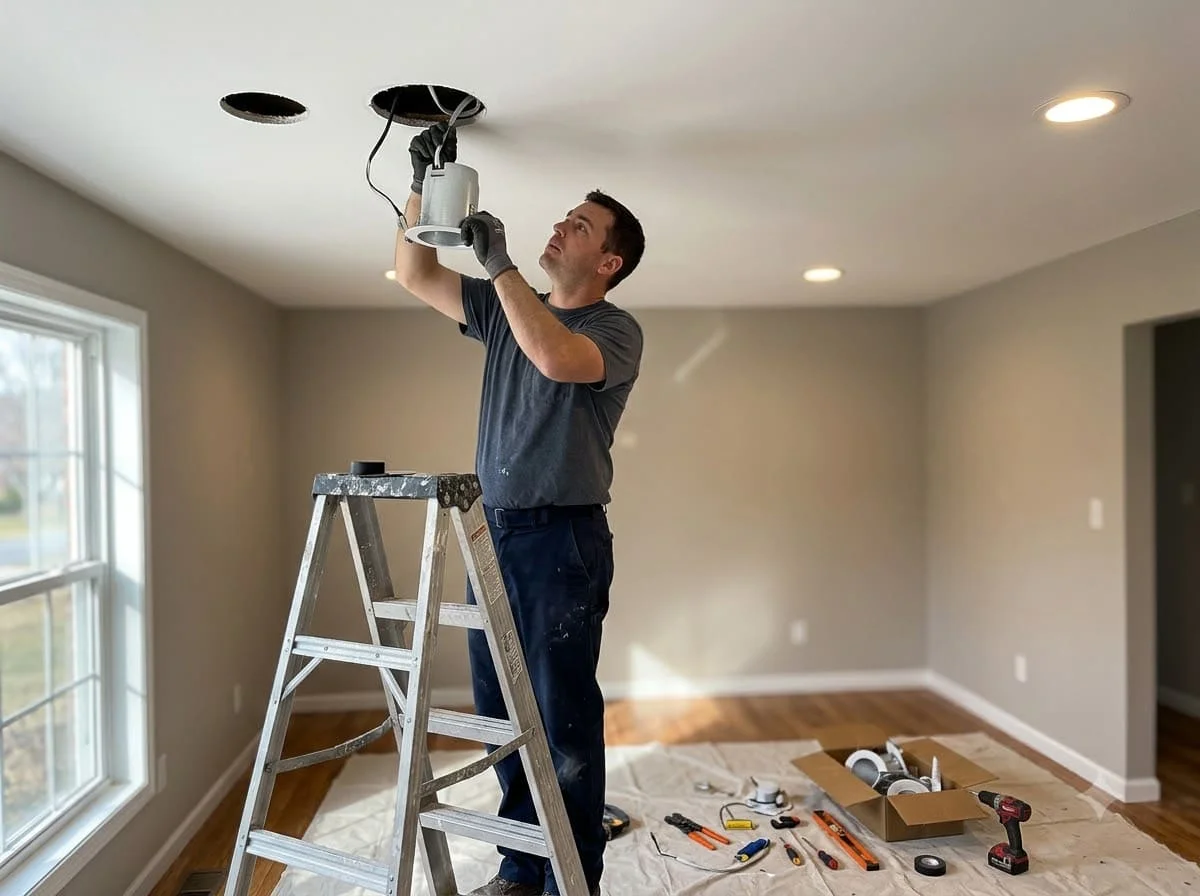
Recessed lighting installation in Cocoa, FL runs $125–$265 per fixture, and in a city whose oldest neighborhoods were built between the 1920s and the 1950s, more of that range is decided by what is above the ceiling than by the fixture you pick. Cocoa Village and the streets around it hold the kind of housing stock that rewards careful work and punishes assumptions — lath-and-plaster ceilings, framing that changed three times across a century of additions, rooms with no attic above them at all, and wiring that predates most of the rules now governing what we are about to connect to it.
Handyman Palm Bay FL installs LED downlighting throughout Cocoa — the historic Village core, the older residential streets off Brevard Avenue and Dixon Boulevard, and the mid-century and newer homes toward Cocoa North and the SR 520 corridor. We check the existing wiring before adding load to it, use correctly listed damp and wet-rated fixtures in bathrooms and covered exterior ceilings, and tell you plainly when a room is a poor candidate for recessed lighting instead of finding out mid-job. Where older circuits need attention first, we handle wiring and circuit corrections as part of the same visit.
Recessed Lighting Services We Provide in Cocoa
- Damp and wet-rated bathroom fixtures — correctly listed trims for tub and shower zones
- Canless LED wafer installation — shallow fixtures for rooms with no attic access above them
- Historic ceiling work — scored, slow-cut openings in lath-and-plaster Village homes
- Pre-install wiring inspection — existing conductors, grounds, and splices checked before load is added
- Covered porch and carport downlights — damp-rated fixtures for exterior ceilings
- Compact kitchen layouts — grids planned around the tight footprints in older Cocoa homes
- AFCI-compliant circuits — new lighting circuits protected as current code requires
- Honest alternatives — surface-mount and track options where recessed genuinely will not work
Damp-Rated and Wet-Rated Fixtures Around Tubs and Showers
Damp-rated and wet-rated fixtures are separate listings, and the difference matters most in exactly the room where people economize. NEC 410.10(D) governs luminaires in bathtub and shower areas. Fixtures within the outside dimensions of the tub or shower, up to 8 feet vertically from the top of the tub rim or the shower threshold, must be marked suitable for damp locations — and must be marked suitable for wet locations where they are subject to shower spray. The same section prohibits cord-connected fixtures, pendants, lighting track, and ceiling paddle fans with light kits within a zone extending 3 feet horizontally and 8 feet vertically from that same reference point.
The practical distinction comes down to whether water can reach the fixture directly.
A damp-rated fixture is built to handle humidity and condensation without corroding or admitting moisture into the housing. That covers a bathroom ceiling away from the shower, a covered porch, a carport, and the screened exterior ceilings common on older Cocoa homes. A wet-rated fixture is sealed against direct water using a gasket between the lens and the trim, and that is what belongs directly over a showerhead or a tub. Cocoa's year-round humidity makes the shortcut here expensive: a standard trim over a shower lets steam migrate into the housing every time someone bathes, and the driver electronics fail early with no dramatic warning. The rated part costs perhaps twenty dollars more. We also confirm the circuit feeding a bathroom carries the ground-fault protection current code requires, which pairs naturally with a GFCI outlet check while we are already in the room.
Rooms With No Attic Above Them
Rooms with no attic above them are common in Cocoa's older housing, and they determine what is physically possible. A century of additions produced back rooms under low-slope roofs, enclosed porches with framing built tight to the deck, and second stories laid directly over first-floor ceilings with no accessible cavity between. In a newer home you drop into the attic, run cable to each fixture location, and work top-down. In these rooms there is no top to work from.
Canless wafers solve part of this problem, and it is worth being precise about which part.
A wafer's remote junction box is small enough to pass through the fixture opening itself, get secured to the side of a joist by reach, and sit permanently in the cavity — so installing a fixture where there is no access above it is genuinely workable. What that technique does not solve is getting power to the room in the first place. Fishing a new cable across a sealed, insulated, or blocked cavity is a different problem, and in a house with irregular framing and fire blocking in unpredictable places it can turn into opening the ceiling in several spots to find a path. When we walk a Cocoa job and conclude the wire path does not exist, we say so. Surface-mounted LED fixtures and modern low-profile track have improved enormously and can light a room well while running in a raceway or off an existing box. Recommending that instead of recessed lighting costs us a larger invoice and saves you a ceiling, and it is the right call often enough in the Village that it is worth stating up front. Ceilings that do need patching afterward are covered by our drywall and plaster repair work.
Checking Older Cocoa Wiring Before Adding Load
Checking older Cocoa wiring before adding load is a step we do not skip, because new fixtures connect to whatever is already there. Homes from the 1920s through the 1950s in this part of Brevard County can still carry cloth-insulated conductors whose sheathing has gone brittle, ungrounded two-wire circuits, undersized conductors feeding circuits that have accumulated decades of additions, and splices sitting outside a box in a ceiling cavity where they were never permitted.
Three checks happen before we commit to a lighting plan.
First, we open the switch box and the nearest accessible junction and look at the actual conductors — insulation condition, wire gauge, and whether an equipment ground is present. Second, we establish what else is on the circuit, because a lighting circuit in a house of this age has often had a window unit, a kitchen counter, or a whole added room attached to it over the years. Third, we confirm what protection the circuit needs: NEC 210.12 requires AFCI protection for branch circuits supplying outlets in most dwelling rooms, and adding a new lighting circuit brings that requirement with it. The good news for LED downlights specifically is that they draw a fraction of what the incandescent fixtures these circuits were designed around consumed — twelve LED wafers can total less than a single old 100-watt bulb. Capacity is rarely the limiting factor. The condition of the conductors is. Florida currently enforces the 2020 NEC through the 8th Edition (2023) Florida Building Code, with the 9th Edition (2026) taking effect December 31, 2026 and reviewed against the 2023 NEC — and your local building department has the final word on how any provision applies to your permit. Where a job genuinely calls for a permitted licensed electrician rather than a handyman, we say so rather than taking work outside our scope.
Recessed Lighting Installation Pricing in Cocoa, FL
Canless LED wafer installed in an accessible ceiling: $125–$195 per light.
Damp-rated bathroom, porch, or carport fixture: $155–$225 per light.
Wet-rated sealed shower or tub fixture: $175–$265 per light.
Typical four-light kitchen layout in a compact Village home: $525–$850 installed.
Lath-and-plaster ceiling surcharge per opening: $25–$45.
Older wiring correction found during inspection: $145–$385 depending on scope.
New AFCI-protected lighting circuit with dimmer: $285–$495.
We quote the wiring inspection findings separately and in writing, so you are never surprised by a number that appeared after the ceiling was already open. All pricing is confirmed before work begins, and estimates are free. Call (877) 916-5930 or request a quote online. Our full local service list is on the Cocoa handyman services page.
We install the same downlighting across the county — including recessed lighting in Rockledge and LED downlights in Palm Bay.