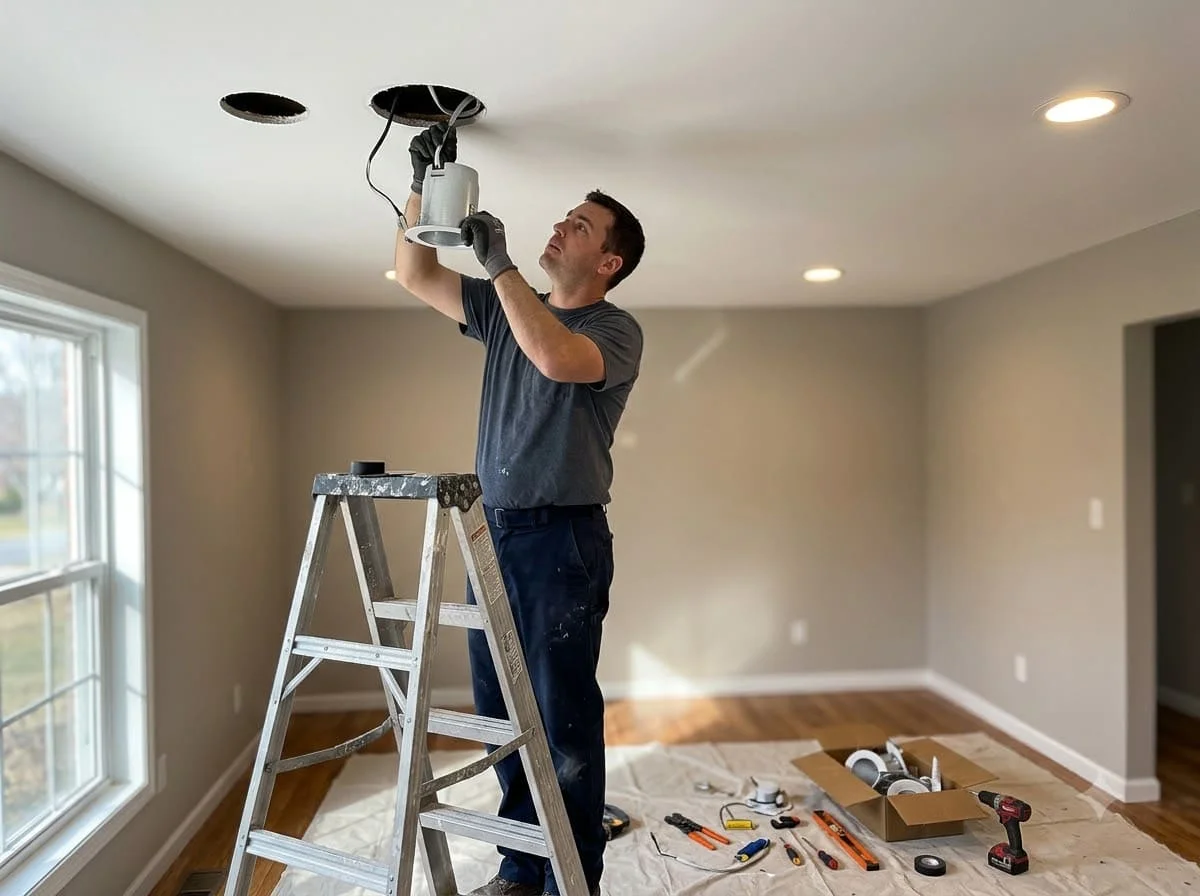
Recessed lighting installation in Melbourne, FL runs $125–$260 per fixture, and the complaint we get called out to fix most often is not a dead light — it is eight working lights that do not match each other. A homeowner adds four downlights to a kitchen that already had six, buys the same nominal 3000K bulb, and ends up with a ceiling that reads warm on one side and faintly green on the other. Nothing is broken. The fixtures came from different production bins, and once they are up on one ceiling the difference is impossible to unsee.
Handyman Palm Bay FL installs LED downlighting across Melbourne — the tech corridor neighborhoods near the L3Harris campuses, the older bungalows and mid-century homes in Eau Gallie and downtown, the waterfront streets along the Indian River Lagoon, and the postwar subdivisions off Babcock and Sarno. We source every fixture in a room from a single batch, set color temperature by room function rather than by whatever the box says, and match the dimmer to the driver so the run does not buzz or drop out at the low end. Where the switch leg lacks a neutral, we handle the dimmer and control wiring as part of the same job.
Recessed Lighting Services We Provide in Melbourne
- Color-matched fixture runs — single-batch sourcing and tight binning tolerance across every light in a room
- Canless LED wafer installation — shallow-depth downlights for joist bays and additions with no attic
- IC-rated airtight housings — sealed cans for insulated attics, gasketed to the ceiling
- Lath-and-plaster ceiling work — slow-cut openings in older Eau Gallie and downtown homes
- High-CRI fixtures — 90+ color rendering for kitchens, art walls, and workspaces
- Smart dimming and scene control — driver-matched smart dimmers and multi-zone switching
- Selectable CCT setup — color temperature dialed in on site after you see the room lit
- Old can retrofits — LED modules into existing housings without opening the ceiling
Choosing Color Temperature Room by Room
Choosing color temperature by room is the decision that determines whether the lighting feels right, and it is nearly free to get correct at install time. Kelvin measures the warmth or coolness of white light. Lower numbers are warmer and more yellow, higher numbers cooler and bluer. The number on the box is not a quality rating, and higher is not better — it is a match-to-purpose specification, and the right value depends entirely on what happens in the room.
Here is what we recommend for Melbourne homes, and why.
Living rooms, bedrooms, and dining rooms take 2700K, which reads close to the warm incandescent light most people associate with a comfortable evening. Kitchens and bathrooms take 3000K, slightly crisper for task work without tipping cold. Garages, workshops, and laundry areas can go to 3500K or 4000K where you genuinely need visual acuity over ambience. We do not put 5000K anywhere inside a house — it looks like a parking garage after dark and it is the single most common thing homeowners ask us to come back and change. The rule that overrides all of the above: any two spaces you can see into at the same time must match. An open-plan Suntree or Melbourne kitchen that sightlines into the living room needs one temperature across both, regardless of what the room-by-room guidance says in isolation. Many current fixtures include a selectable CCT switch, which lets us install first and set the temperature once you have seen it lit at night.
Why Two 3000K Lights Can Be Different Colors
Two 3000K lights can be different colors because of how LEDs are manufactured and sorted. LED chips come off a production line with unavoidable variation in the exact wavelength they emit. Manufacturers measure and sort the output into bins, then label a range of bins with one nominal color temperature. Two fixtures stamped 3000K can therefore sit meaningfully apart on the chromaticity chart while both being accurately labeled.
The tolerance you want to ask about is the MacAdam step rating.
A MacAdam step is a unit of just-noticeable color difference. Fixtures binned to a 3-step tolerance or tighter will look uniform to the eye across a ceiling; 5-step and looser will not, particularly on a white ceiling where the light reflects and the difference compounds. Budget fixtures frequently do not publish a step rating at all, which is itself informative. Two practical rules follow from this. First, buy every fixture for a continuous space at once, from one batch, so bin variation cannot creep in. Second, never plan to add two more lights to a run next year — the same model number from the same brand eighteen months later is not the same bin, and often not the same driver either. When homeowners in the tech corridor tell us they want the option to expand later, we lay out the full final count now and simply cap the circuit for the fixtures going in today. Alongside color, CRI is worth the small premium in a kitchen: a 90+ fixture renders food, wood tone, and skin accurately, where an 80-CRI light makes a well-designed kitchen look faintly flat.
Working With Eau Gallie and Downtown Melbourne Ceilings
Eau Gallie and downtown Melbourne ceilings need a different approach from the newer subdivisions west of the river. The housing stock in these older neighborhoods runs to bungalows, mid-century ranches, and homes that have been added onto more than once. Two conditions show up constantly. The ceilings are frequently lath and plaster rather than drywall, and the additions often have no attic access whatsoever — a flat or low-slope roof built tight over a back room with no way in.
Plaster is workable, but it does not forgive a fast cut.
A hole saw driven at speed through lath and plaster chips the surface and can crack the ceiling well past the opening, because plaster keys through the lath and wants to fracture along those keys. We cut slowly, support the plug so it does not drop and tear, and score the perimeter first on brittle ceilings. Where an addition has no attic access, canless wafers become the only realistic option — the remote junction box can be fed through the fixture opening itself and secured to the joist by reach, which no traditional housing allows. The 16-inch on-center dimensional joists in these homes also constrain the grid more than the 24-inch trusses in newer construction, so the layout has to be planned against the actual framing rather than a clean geometric spacing. We locate the joists first, mark the grid, and adjust before anything gets cut. Older ceilings sometimes need patching around a legacy fixture footprint too, which our drywall and ceiling repair work covers.
Recessed Lighting Installation Pricing in Melbourne, FL
Canless LED wafer installed in an accessible drywall ceiling: $125–$195 per light.
IC-rated airtight housing with separate trim: $165–$260 per light.
Typical six-light kitchen or living room layout: $750–$1,150 installed.
Lath-and-plaster ceiling surcharge for the slower cut and patching: $25–$45 per opening.
High-CRI 90+ fixture upgrade: $15–$30 per light.
New dedicated circuit with smart dimmer and neutral pull: $325–$525.
LED retrofit module into an existing can: $75–$135 per fixture.
Per-light pricing improves with fixture count, since the circuit and layout labor is fixed regardless of how many lights follow. All pricing is confirmed in writing before work begins, and estimates are free. Call (877) 916-5930 or request a quote online — most Melbourne jobs are scheduled same-week. Our full local service list is on the Melbourne handyman services page.
We fit the same downlighting across the county — including recessed lighting layouts in Rockledge and LED downlights in Cocoa.