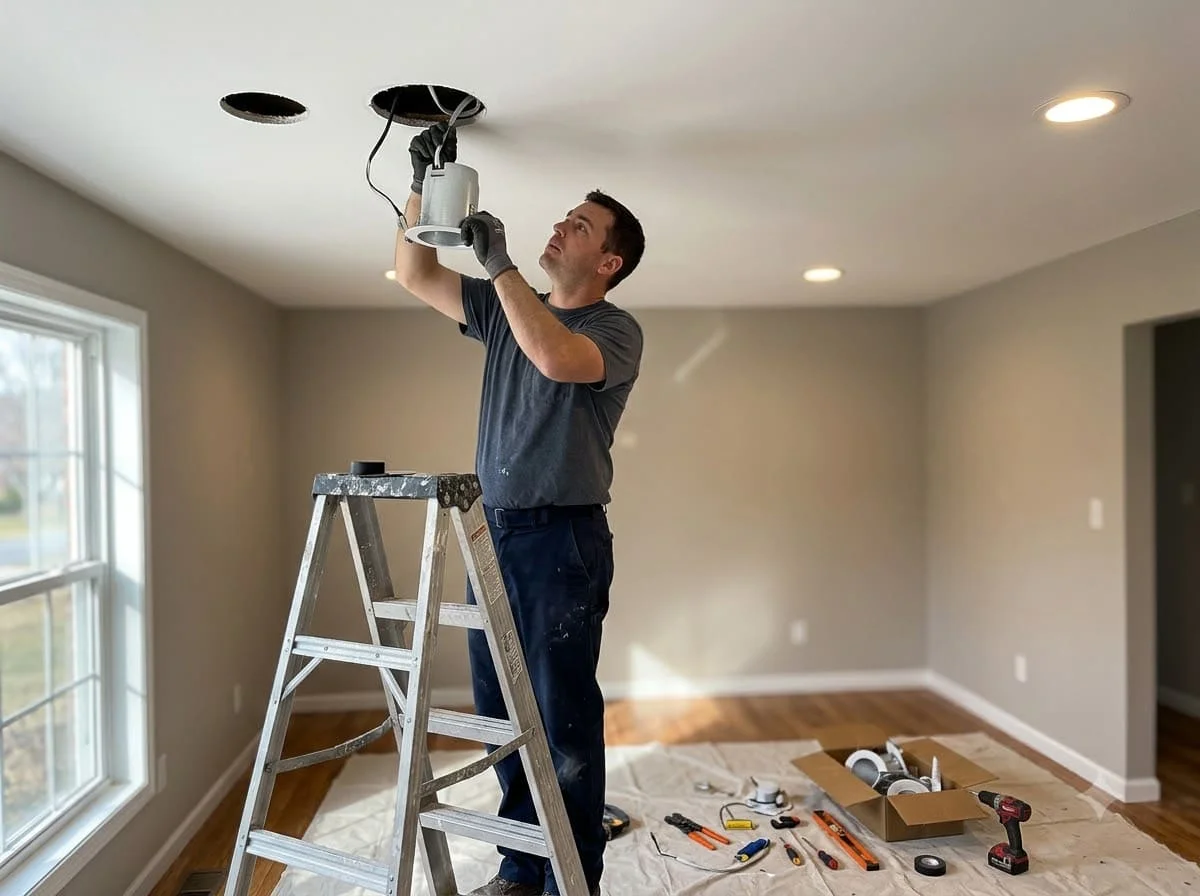
Recessed lighting work in West Melbourne, FL runs $75–$285 per fixture, and the reason for that wide spread is that most homes here are not starting from zero. The tract subdivisions built through the 2000s along Minton Road, Hollywood Boulevard, and out toward Heritage Oaks and Sawgrass came with recessed cans already in the ceiling. Those fixtures are now fifteen to twenty-five years old, they were specified for incandescent or early CFL lamps, and the question in front of most homeowners is not whether to add downlighting but what to do with the downlighting they already have.
Handyman Palm Bay FL handles both paths across West Melbourne — dropping LED retrofit modules into sound existing housings, and pulling and replacing the ones that are not worth keeping. We start by reading the label inside one of your cans, because that single piece of information determines which job you are actually buying. We also handle the fixtures the original builder skipped: vaulted great room ceilings, two-story foyers, and the lanai and covered-entry positions where exterior-rated parts are required. Where a new run needs its own circuit, we cover circuit and panel work in the same visit.
Recessed Lighting Services We Provide in West Melbourne
- LED retrofit modules — screw-in conversions for existing 5" and 6" IC-rated housings
- Full housing replacement — old non-IC or leaky cans pulled and replaced with sealed canless wafers
- Aperture downsizing — dated 6" openings converted to cleaner 4" trims
- Sloped and vaulted ceiling fixtures — slope-listed housings and adjustable gimbal trims for great rooms
- Two-story foyer lighting — high-reach installation with long-life sealed units
- New room layouts — bedrooms, offices, and bonus rooms the builder left on a single ceiling fixture
- Lanai and covered entry downlights — damp and wet-rated fixtures for exterior-visible positions
- Dimmer and driver matching — controls replaced alongside the fixtures so nothing buzzes or flickers
Reading the Label Inside Your Existing Cans
Reading the label inside your existing cans is the first thing we do on a West Melbourne quote, and it takes about two minutes. Pull the trim ring and the bulb, look up into the housing, and there is a printed label carrying the manufacturer, the maximum lamp wattage, and — critically — either "Type IC" or "Non-IC." That one word decides whether your house is a $600 job or a $1,800 job, and no amount of guessing from the outside will tell you which.
Three findings are common in homes of this vintage, and each points somewhere different.
First, an IC-rated housing in good condition. This is the best case, and the answer is a retrofit module — an LED unit that screws into the existing lamp socket and clips into the housing, converting the fixture in minutes for $75–$135 with no ceiling work at all. Second, a non-IC housing. Under the 2020 National Electrical Code, which Florida's 8th Edition (2023) Building Code adopts, 410.116(A)(2) requires insulation to stay 3 inches clear of these, which in a blown-insulation attic means someone must maintain a permanent dam around every can forever. Replacement is usually cheaper over any real time horizon than managing that. Third, an IC-rated housing that is intact but not airtight. These were common before air-sealing requirements tightened, and they pass the safety rule while still leaking conditioned air. Whether that is worth replacing depends on how many you have and whether the room already has a humidity complaint.
Why the 2000s Fixtures Were Built for a Different Lamp
The 2000s fixtures in these homes were built for a different lamp, and that explains almost every complaint we hear about them. A 6-inch can designed around a 65-watt BR30 incandescent needed volume — the housing had to dissipate real heat, so it was deep and wide, and the aperture was sized to the bulb rather than to the light. LED changed the thermal problem completely. A modern downlight producing the same output runs at a fraction of the wattage and needs a fraction of the space.
That shift is why an aperture change is often the upgrade people actually want.
Six-inch openings across a ceiling read as distinctly dated now, in the same way that brass fixtures and oak cabinets date a kitchen. A 4-inch aperture delivers comparable light with a visually quieter ceiling, and on the 9- and 10-foot ceilings common in West Melbourne great rooms the smaller opening looks considerably more deliberate. Going the other direction, the current Florida energy code has tightened around efficacy: the 8th Edition (2023) Florida Building Code, Energy Conservation now requires permanently installed luminaires — with an exception for those in kitchen appliances — to hit at least 45 lumens per watt, or to use lamps of at least 65 lumens per watt. The previous 7th Edition set that bar at 90 percent of lamps rather than all luminaires. Any LED downlight clears this comfortably while the original incandescent lamps these housings were built for do not, which is worth knowing if you are pulling a permit on a larger remodel. The 9th Edition takes effect December 31, 2026, so a permit pulled after that date falls under a newer edition than the figures above. Your local building department has final say on how the provision applies to your specific scope of work.
Vaulted Great Rooms and Two-Story Foyers
Vaulted great rooms and two-story foyers are the two spaces West Melbourne builders most often under-lit, and both need parts that a flat-ceiling job does not. A standard recessed housing aims its beam straight down, perpendicular to the housing. Mount that in a ceiling pitched at 6:12 and the light lands on the far wall at an angle, producing a bright wash where you did not want one and a dim floor where you did. The fix is either a housing specifically listed for sloped ceilings, which sets the lamp back to vertical, or an adjustable gimbal trim that lets us aim each fixture independently after installation.
Two-story foyers add a maintenance problem that should shape the fixture choice up front.
A light eighteen to twenty feet up is not something you will be changing casually. That argues strongly for sealed, long-life LED units rated well beyond a replaceable-lamp fixture, so the install decision is made once. It also argues for getting the dimming right on the first visit, because coming back to swap a buzzing dimmer is trivial while coming back to swap a fixture means renting a lift again. In great rooms we typically layer rather than flood — a perimeter of downlights on their own zone, a separate zone over the seating area, and the existing central fixture or fan kept on its own control. Three zones on separate dimmer controls gives a room that can be bright for cleaning and low for a movie without rewiring anything later. If a ceiling fan is going into the same vault, the box has to be fan-rated, which we handle under ceiling fan installation.
Recessed Lighting Installation Pricing in West Melbourne, FL
LED retrofit module into an existing IC-rated can: $75–$135 per fixture.
Old housing removed and replaced with a canless LED wafer: $145–$215 per light.
New fixture in a ceiling with no existing recessed lighting: $125–$195 per light.
Aperture downsize from 6" to 4" including drywall patching: $165–$245 per light.
Sloped-ceiling housing or adjustable gimbal trim: $185–$285 per light.
Two-story foyer or high-reach access surcharge: $95–$185 per visit.
Damp or wet-rated lanai and covered-entry fixture: $155–$245 per light.
A whole-house retrofit of twelve to sixteen existing cans typically lands between $1,100 and $1,900, and is one of the better value-per-dollar improvements available on a home of this age. All pricing is confirmed in writing before work starts, and estimates are free. Call (877) 916-5930 or request a quote online. Our full local service list is on the West Melbourne handyman services page.
We do the same work across Brevard County — including recessed lighting in Palm Bay and downlight layouts in Rockledge.