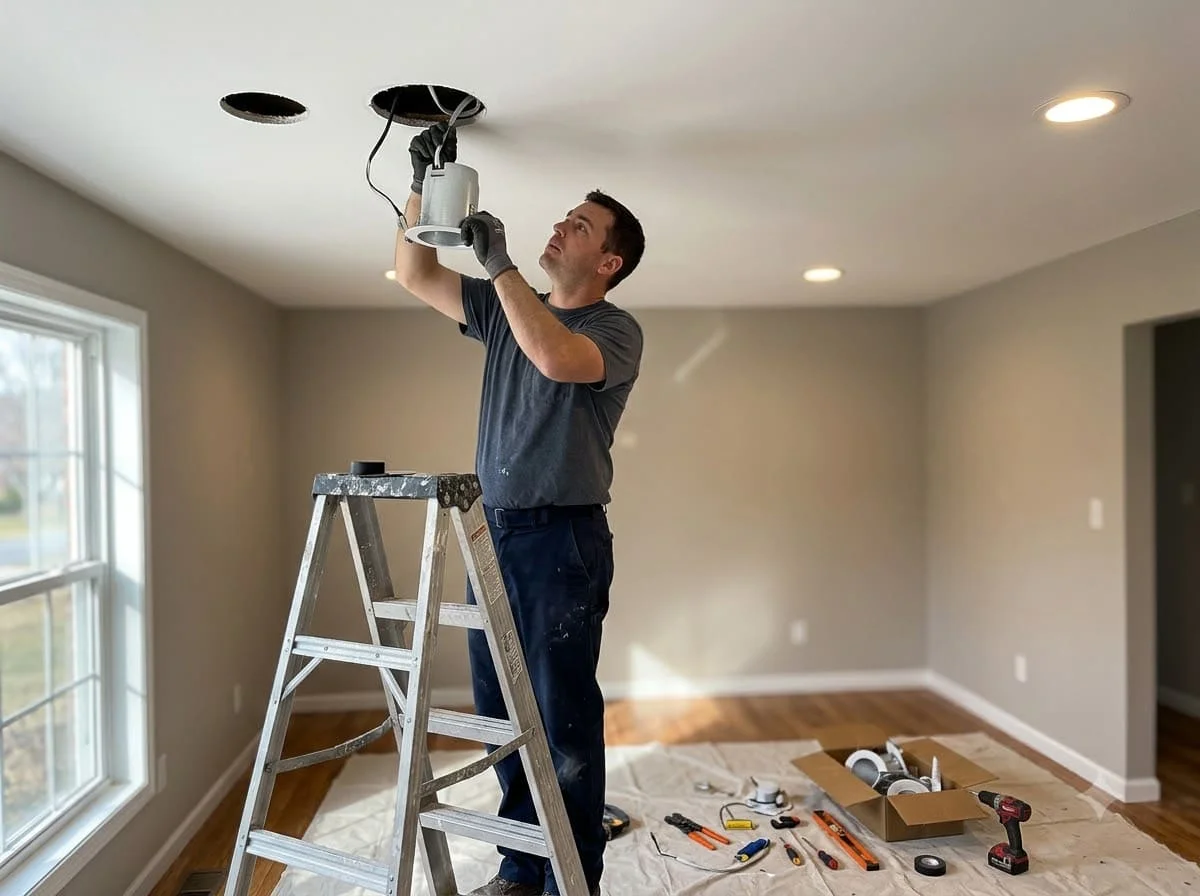
Recessed lighting installation in Palm Bay, FL runs $125–$260 per fixture, and the single decision that determines whether the job helps or hurts your power bill happens above the ceiling, not below it. A Palm Bay attic sits above blown-in insulation and routinely passes 130°F in August. Every downlight you add is a penetration through the boundary between that attic and your air-conditioned living space. Get the housing right and the room transforms. Get it wrong and you have installed six small chimneys into the hottest part of your house.
Handyman Palm Bay FL installs LED downlights throughout the city — the Port Malabar street grid, Bayside Lakes, Palm Bay Point, Palm Bay Village, the newer subdivisions off Emerson Drive and Malabar Road, and the canal-front homes on the southeast side. We use IC-rated, airtight-listed housings and canless LED wafers exclusively, seal every fixture to the drywall the way Florida energy code requires, lay the grid out to the room instead of eyeballing it, and pair the circuit with a dimmer that actually matches the driver. Where a bank of new fixtures needs its own circuit, we look at panel and circuit capacity in the same visit.
Recessed Lighting Services We Provide in Palm Bay
- Canless LED wafer installation — thin-profile downlights for shallow ceiling cavities and tight truss bays
- IC-rated airtight housing installation — sealed can systems for insulated attics, gasketed to the ceiling
- Old can retrofits — LED modules dropped into existing 5" and 6" housings without touching the ceiling
- Full room layouts — kitchens, living rooms, lanais, hallways, and bedrooms spaced and laser-marked before cutting
- Kitchen and island lighting — downlights layered with under-cabinet and pendant fixtures
- Damp and wet-rated trims — bathrooms, showers, and screened lanais with correctly listed fixtures
- New circuits and dimmer control — dedicated runs, driver-matched dimmers, and multi-zone switching
- Popcorn ceiling assessment — pre-1980s texture tested before any hole is cut
What Is Actually Above Your Palm Bay Ceiling
Above your Palm Bay ceiling is a vented attic that behaves nothing like an attic in the states most residents moved here from. Port Malabar homes are slab-on-grade concrete block with a wood truss roof, drywall hung on the bottom chord, and blown-in fiberglass or cellulose laid over it. There is no basement, no crawl space, and typically no conditioned attic. Summer temperatures in that space routinely run 130°F to 150°F under a dark shingle roof, and the humidity up there tracks outdoor humidity almost exactly.
That environment inverts the logic behind most recessed lighting advice written for northern climates.
In a cold climate, an unsealed can leaks warm indoor air upward and the penalty is heating cost. In Palm Bay the pressure runs the other way for most of the year. A running air handler holds the house at slight negative pressure, so a leaky fixture pulls superheated, moisture-laden attic air down into your living room. The result is an AC system working against an unnecessary load and a measurable rise in indoor humidity — which is the actual mechanism behind the musty smell some homeowners notice after a lighting job. This is why R402.4.5 of the Florida Building Code, Energy Conservation — 8th Edition (2023), the version in force today — requires recessed luminaires in the thermal envelope to be IC-rated, labeled at no more than 2.0 cfm of air leakage tested to ASTM E283 at 75 Pa, and sealed with a gasket or caulk between the housing and the ceiling. We treat that sealing step as part of the installation, not an upgrade.
Why IC Rating Is Not Optional in an Insulated Attic
IC rating is not optional here because Palm Bay attics are insulated by default. Under the 2020 National Electrical Code, which that same edition of the Florida Building Code adopts, 410.116(A)(2) prohibits thermal insulation from being installed within 3 inches of a non-IC recessed luminaire's enclosure, wiring compartment, ballast, driver, or power supply, and prohibits it above the fixture entirely. Non-IC housings also require at least a half-inch of clearance from combustible material. Meeting that with blown-in insulation means constructing a permanent dam around every single can and trusting that nobody ever tops up the attic insulation and buries it. Florida moves to the 9th Edition Building Code on December 31, 2026, reviewed against the 2023 NEC, so work permitted after that date follows a newer edition than this one.
Type IC fixtures are listed for direct insulation contact and eliminate the problem at the source.
The failure mode when this is ignored is not immediate, which is what makes it dangerous. A non-IC housing buried in cellulose does not spark on day one. It overheats slowly, the thermal cutout starts cycling the light off and back on as the fixture heats and cools, and the homeowner assumes a bulb is going bad. That cycling is the safety device doing its job and telling you the installation is wrong. If your existing downlights blink off after twenty minutes and come back later, that is the diagnosis, and swapping the lamp will not change it. We also see this on jobs where someone installed correctly rated fixtures and a later insulation contractor blew new material over non-IC cans nobody flagged.
Eight-Foot Ceilings, 24-Inch Trusses, and Why Wafers Won
Eight-foot ceilings and 24-inch truss spacing define what will physically fit in a Port Malabar house. The engineered roof trusses in these homes sit at 24 inches on center with diagonal webs running down toward the bottom chord, and those webs land in unhelpful places. A traditional 6-inch can housing needs real vertical clearance and a clear bay. On a low-slope roof near the eaves, the space between the ceiling drywall and the underside of the roof deck can drop under six inches, and a conventional housing simply will not go in.
Canless LED wafers changed the arithmetic on retrofit work in older Palm Bay homes.
A wafer is a thin LED disc with a small remote junction box. It needs roughly two inches of depth instead of eight, clips into the drywall with spring arms, and fits between truss webs where a can never would. The junction box tucks alongside the framing. Most quality wafers are listed IC and airtight in a single product, which satisfies both the NEC clearance rule and the energy code sealing rule without a separate air-sealing step. On an 8-foot ceiling the shallower profile also matters visually — a deep can in a low room creates a harsh cone of light directly underneath it, while a wafer with a diffused lens spreads more evenly and makes the ceiling feel higher. We still use full IC-rated housings where a room calls for adjustable gimbals or a specific beam angle, but for a standard Port Malabar living room the wafer is the better tool. If your existing switches buzz once the LEDs go in, that is a driver-and-control mismatch and we handle it with the right dimmer switch rather than leaving you to live with it.
Popcorn Ceilings and What We Check Before Cutting
Popcorn ceilings are common across the older Palm Bay housing stock, and they change the order of operations. Spray-applied acoustic texture was widely used through the 1970s and into the 1980s. Regulators restricted asbestos in these products in the late 1970s, but existing inventory was never pulled from warehouses, and contractors kept spraying what they already had well into the early-to-mid 1980s. A large share of the Port Malabar grid was built squarely inside that window.
The sequence we follow on any textured ceiling built before roughly 1985 is straightforward.
First, we look at the permit year and the texture itself. Second, if the home falls in the risk window, we recommend a lab test on a scraped sample before any hole is cut — it is inexpensive, takes a few days, and is the only way to get a real answer. Third, if the result is negative, we proceed normally and cut clean holes with a dust shroud. Finally, if the result is positive, cutting six fixture openings is asbestos abatement and belongs to a licensed abatement contractor, not to us. We will say so plainly and stop there. Nobody benefits from a handyman putting a hole saw through a positive ceiling, and a homeowner who finds out afterward has a far more expensive problem than the one they called about. Ceilings that need patching or smoothing after older fixtures come out are handled through our drywall repair and texture matching work.
Recessed Lighting Installation Pricing in Palm Bay, FL
Canless LED wafer installed in an existing accessible ceiling: $125–$195 per light.
IC-rated airtight housing with separate trim: $165–$260 per light.
Typical six-light living room or kitchen layout: $750–$1,150 installed.
LED retrofit module dropped into an existing can: $75–$135 per fixture.
New dedicated circuit with driver-matched dimmer: $285–$475.
Damp or wet-rated trim for bathrooms, showers, and lanais: $155–$245 per light.
Sloped-ceiling or adjustable gimbal fixture: $185–$285 per light.
Per-light pricing drops as the fixture count rises, because most of the labor sits in the first light — the circuit, the layout, and the attic access. All pricing is confirmed in writing before any work begins, and the estimate is free. Call (877) 916-5930 or request a quote online and we'll get you scheduled — most Palm Bay jobs go out same-day. You can see the full range of what we handle locally on our Bayside Lakes handyman services page.
We install the same downlighting across Brevard County — including LED downlights in West Melbourne and recessed can lighting in Melbourne.