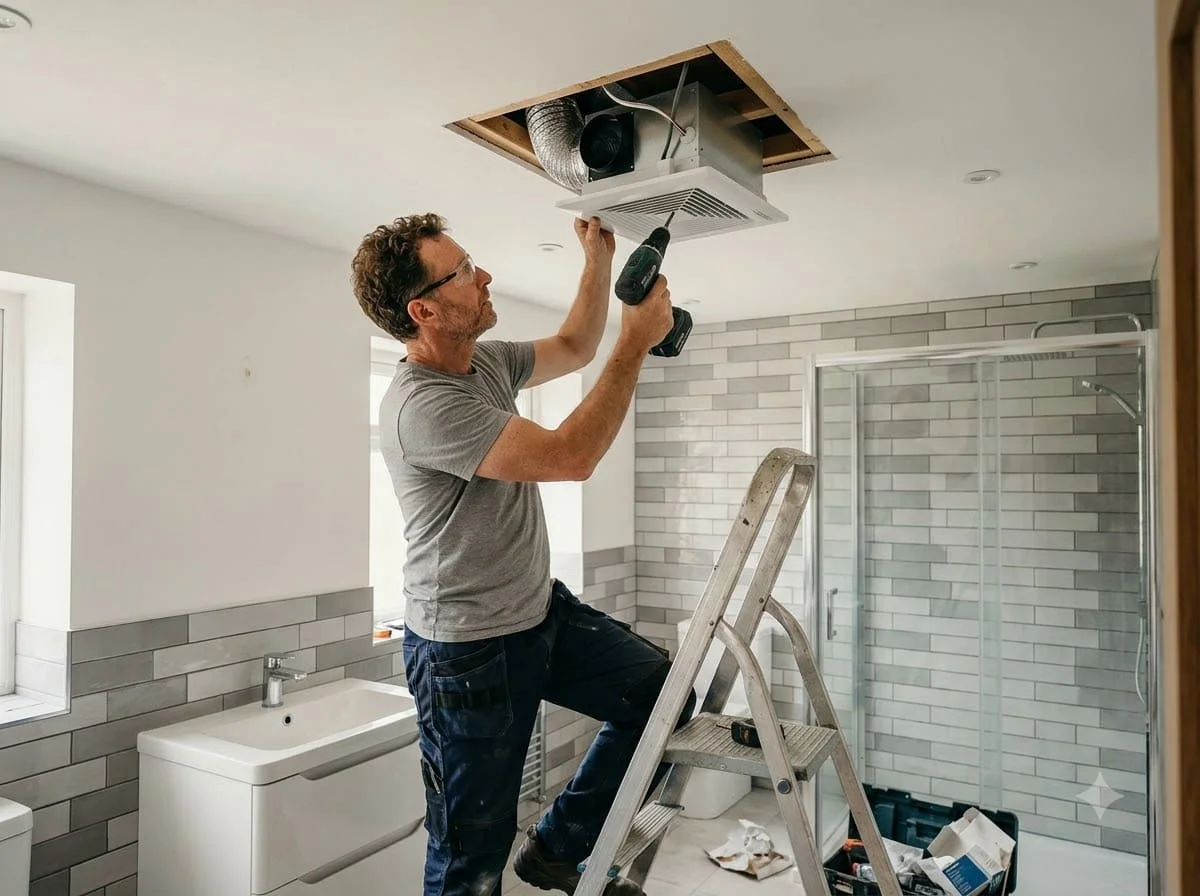
Bathroom exhaust fan installation in Palm Bay, FL costs $195–$1,100, and the number that matters most before price is where the duct actually goes, because in this city a fan that runs perfectly well can still be doing nothing useful at all. A large share of the Port Malabar and Bayside Lakes homes we get called to have a bathroom fan ducted a few feet into the attic instead of all the way to a roof or wall termination — a shortcut that was common for decades and is invisible until someone finds the damage it caused.
Handyman Palm Bay FL installs and replaces bathroom exhaust fans across Port Malabar, Bayside Lakes, Palm Bay Point, Palm Bay Village, and the canal-front streets on the southeast side. This is work we perform directly, not licensed-electrician-only scope — we run the wiring, hang the fan, and route the duct to a real exterior termination ourselves. The one exception is a first-time install that requires cutting a brand-new roof penetration, where we coordinate with a licensed roofer to keep the cap properly flashed and the roof's wind rating intact.
Bathroom Exhaust Fan Services We Provide in Palm Bay
- Fan replacement on existing ductwork — swapping a failed, noisy, or undersized fan where the vent path already works
- Fan installation with new duct routing — connecting to an existing roof or soffit vent point that the old fan never reached
- First-time installation — new fan, new duct, and a new roof or wall termination for bathrooms that have never had one
- Attic duct inspection — checking for crushed, disconnected, or attic-terminated ducts before quoting a simple swap
- Humidity-sensing fan upgrades — units that switch on automatically when moisture rises and shut off on their own
- Fan/light/heater combo units — for primary bathrooms wanting one fixture instead of three
- Timer and wall control installation — countdown timers and humidity-sensor controls for existing fans
- Duct insulation in the attic run — reducing condensation risk where the duct crosses unconditioned attic space
Why So Many Palm Bay Fans Vent Into the Attic
Why so many Palm Bay fans vent into the attic comes down to how easy the shortcut is compared to doing it correctly. Running a duct a short distance to the nearest attic space and simply letting it discharge there takes far less time than routing it all the way to a roof cap or a soffit vent, and for decades that difference wasn't consistently caught. The fan still moves air, the bathroom still clears in the moment, and the homeowner has no reason to suspect anything is wrong.
Florida Building Code, Residential (8th Edition, 2023), Section M1507.2 requires bathroom exhaust air to discharge directly to the outdoors and specifically prohibits discharge into an attic, soffit, or crawl space — a rule that exists precisely because of what happens when it's ignored.
Warm, moist bathroom air pumped into a vented Palm Bay attic day after day doesn't just disappear. It condenses on the underside of the roof decking, especially overnight when attic temperatures drop, and over years that produces the dark staining and soft decking that turns up during a re-roof inspection or when a homeowner finally climbs into the attic for an unrelated reason. Florida moves to the 9th Edition Building Code on December 31, 2026, so a section number cited today is worth reconfirming after that date.
Fan Sizing for Florida's Year-Round Humidity
Fan sizing for Florida's year-round humidity matters more here than it does in a climate with a genuine dry season. The 50 CFM code minimum is built around clearing a standard single-fixture bathroom in a reasonable time, and it does that job adequately in most Palm Bay guest baths. It's a different story in a primary bathroom with a separate tub, a walk-in shower, and a water closet, all sharing one small fan sized for a room a third that size.
The visible result of undersizing is a bathroom that never quite feels dry.
Mirrors stay fogged longer, grout lines darken faster, and a musty smell develops that no amount of cleaning fully resolves, because the fan is running the whole time and still isn't moving enough air to actually clear the humidity load. Sizing a fan to the room — factoring square footage and fixture count rather than defaulting to the cheapest code-minimum unit — is a five-minute conversation at the estimate that prevents a recurring complaint for years afterward.
Salt Air and the Roof or Wall Cap
Salt air affects a bathroom fan's exterior termination the same way it affects every other piece of exterior hardware on a Palm Bay home. The roof or wall cap sits outside, exposed, with a spring-loaded backdraft damper made of thin metal or plastic, and on canal-front and southeast-side homes near the Indian River Lagoon, that damper corrodes and stiffens faster than it would further inland.
A stuck damper fails in one of two directions, and neither is good.
Stuck open, it lets attic heat, insects, and the occasional lizard travel back down the duct into the bathroom. Stuck closed, it blocks the fan's exhaust entirely, and the fan ends up straining against a shut damper while accomplishing almost nothing. Checking the cap and damper is part of any fan replacement on a home in this part of the city, and choosing a corrosion-resistant cap at install time saves the second service call a few years later.
What the Job Actually Involves
A bathroom exhaust fan installation in Palm Bay follows a straightforward sequence in most homes. First, we check what's already there — whether a duct exists, where it terminates, and whether the existing wiring can carry the new fan's draw, especially on a fan/light/heater combo that draws considerably more than a bare fan. Second, we size the replacement fan to the room rather than defaulting to a like-for-like swap if the old unit was clearly undersized.
From there installation moves quickly on most jobs.
Third, the old fan comes out, the new housing goes in, and the duct gets connected, insulated where it crosses the attic, and routed to a real exterior termination. Fourth, on the rare first-time install with no existing duct path at all, a new route gets planned through the attic to the nearest roof or gable termination, and if that requires cutting new roof decking, a licensed roofer sets the cap and flashing to keep the roof warranty and wind rating intact. Finally, the fan gets tested for actual airflow at the grille, not just power-on confirmation.
Bathroom Exhaust Fan Installation Pricing in Palm Bay, FL
Fan replacement, existing duct reused: $195–$350.
New fan with new duct run to an existing exterior vent point: $350–$600.
First-time install, new roof or wall penetration: $650–$1,100.
Humidity-sensing fan upgrade: add $85–$150.
Fan/light/heater combo unit, installed: $450–$750.
New dedicated circuit, where none exists: add $250–$450.
Timer or humidity-sensor wall control: $95–$175.
Attic duct condition and whether a new roof penetration is needed are what move a job within its range, so we check both before quoting rather than after. All pricing is confirmed in writing before any work begins, and the estimate is free. Call (877) 916-5930 or request a quote online to get scheduled.
We install bathroom exhaust fans throughout Brevard County — including first-time installs in historic Cocoa homes.