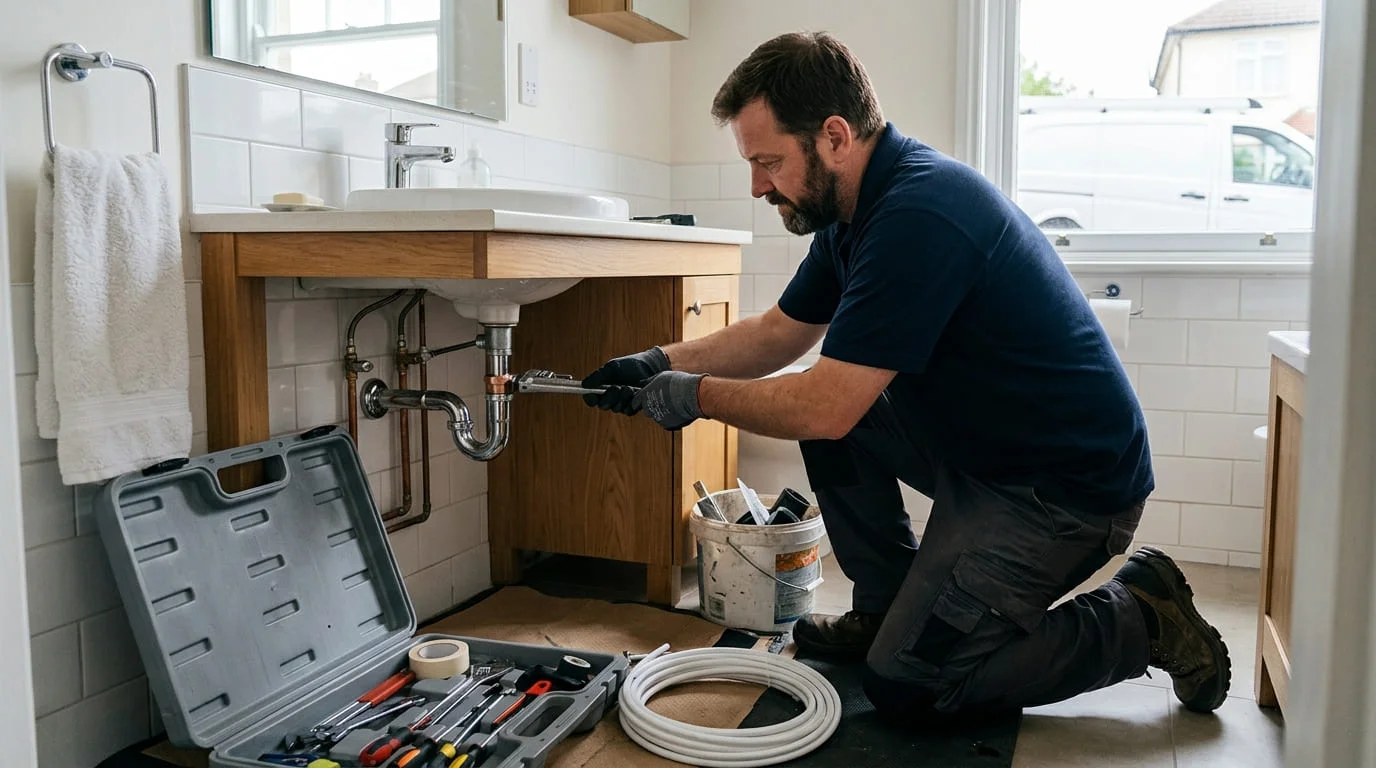
Melbourne, FL homeowners face a specific set of plumbing challenges that don't appear in national home maintenance guides. Three factors combine to make Brevard County plumbing problems different from what you'd encounter in most of the country: the Floridan Aquifer's hard water that accelerates pipe corrosion and scale buildup on a schedule faster than manufacturers' ratings assume; an aging housing stock with original 1970s–90s plumbing systems that are now at or past their service life; and soil and construction conditions that make slab leaks more common here than in most markets. These are failure patterns Handyman Palm Bay FL encounters in Brevard County homes week after week. This guide covers what Melbourne homeowners need to know before a small problem becomes a large one.
Hard Water in Melbourne: What the Floridan Aquifer Does to Your Plumbing
Melbourne's municipal water supply comes from the Floridan Aquifer System — one of the most productive freshwater aquifers in North America and one of the hardest. Water hardness in Brevard County typically measures 150–250 mg/L as calcium carbonate, which falls in the moderately hard to very hard range. For context: the EPA's secondary standard for drinking water recommends below 120 mg/L for appliance protection. Melbourne's water routinely exceeds that threshold by 25–100%.
The effects show up on a predictable timeline. Within a year: white mineral deposits on faucet aerators and showerheads. By two to three years: visible scale inside the dishwasher and on glass shower doors. By five years: reduced water pressure from scale narrowing the interior pipe diameter, and water heater heating elements coated in calcium scale that reduces both efficiency and total capacity. By ten to fifteen years: water heaters operating at significantly reduced capacity, pipe corrosion accelerated by the interaction of mineral-laden water with metal surfaces, and aerators requiring routine replacement rather than periodic cleaning.
The practical responses Melbourne homeowners take include: annual water heater flushing to remove settled calcium and magnesium before it hardens at the tank bottom; whole-house water softeners for homes where scale effects are severe; and descaling tankless units on the manufacturer's recommended schedule. For Melbourne's oldest homes with galvanized supply lines, hard water isn't just an inconvenience — it's the primary accelerant of pipe failure.
Galvanized Pipe Failures in Melbourne's Older Homes
Melbourne's residential construction began expanding in the 1960s and accelerated through the 1980s. Homes built before approximately 1985 — particularly the older blocks of Eau Gallie, the Port Malabar-adjacent areas, and the earliest Downtown Melbourne residential development — were plumbed with galvanized steel supply lines. These pipes have a rated service life of 40–70 years, and Brevard County's hard water pushes that toward the lower end of the range.
Galvanized steel corrodes from the inside outward in hard water environments. The interior pipe wall develops a progressive layer of rust and mineral scale that narrows the pipe's interior diameter and restricts flow throughout the house. By the time whole-house water pressure is noticeably reduced, the pipe interiors in an older Melbourne home may have calcified to a small fraction of their original diameter. Eventually, corrosion works through the pipe wall entirely, producing pinhole leaks inside walls and ceilings — visible as a wet spot or discolored ceiling panel.
If your Melbourne home was built before 1980 and the original supply lines have never been replaced, it's worth having a licensed plumber assess the current condition. Handyman Palm Bay FL regularly handles the drywall and flooring repair that follows galvanized pipe replacement — the drywall opened during pipe access, the ceiling patches, and the paint and finish restoration once the new lines are in place.
CPVC Plumbing: What Melbourne's 1990s and 2000s Homes Need to Know
Homes built in Melbourne and West Melbourne between approximately 1988 and 2005 were commonly plumbed with CPVC — chlorinated polyvinyl chloride. CPVC replaced galvanized steel as the budget-friendly alternative to copper and became the standard in Florida's tract home construction during the major growth cycles of the 1990s and early 2000s. West Melbourne subdivisions along Minton Road, Henry Avenue, and Fell Road, and the Melbourne subdivisions developed during that era, are likely to have CPVC supply lines.
CPVC in normal conditions has a rated service life of 50–75 years. Florida's conditions, however, are not normal. The combination of high chlorine levels in Brevard County's municipal water and Florida's temperature extremes — hot water lines running near 140°F, attic temperatures exceeding 160°F in summer — accelerates aging in CPVC. Aged CPVC becomes brittle. It doesn't fail under normal operating pressure, but it can crack or snap from minor physical disturbance during renovation work. This is a practical concern for anyone in a West Melbourne home from this era who is opening walls for a kitchen or bathroom renovation: disturbing a brittle CPVC elbow or fitting during work can cause failure that wasn't there before the project started.
Slab Leaks in Melbourne CBS Homes
Slab leaks are among the most disruptive — and most expensive — plumbing failures a Melbourne homeowner can face. A slab leak is a failure in a water supply or drain line that runs through or beneath the concrete slab foundation that CBS construction is built on. Detecting and repairing a slab leak requires specialized electronic detection equipment and, for the repair itself, typically involves accessing the pipe through the slab — meaning flooring, tile, or concrete removal as part of the work.
Slab leaks are more common in Melbourne than most homeowners expect, for two reasons that are specific to this area. First, Brevard County's hard water is corrosive to copper pipe from the inside through a process called internal pitting corrosion. This differs from galvanized pipe corrosion — with copper, hard water chemistry (specifically low pH combined with high dissolved oxygen) creates electrochemical pitting that works through the pipe wall over 20–30 years. Many of Melbourne's 1980s homes were plumbed in copper that is now 40+ years old and entering the window when slab line failures become more frequent. Second, Florida's soil conditions — sandy layers over limestone karst — allow minor slab movement over decades that stresses buried pipe joints and bends.
The early signs of a slab leak in a Melbourne home: a persistent sound of running water when all fixtures are off; a warm or hot spot on the floor, particularly on a tile floor (supply line leak, usually hot water); unexplained water bill increases without a visible source; or new cracks in floor tile, baseboards, or drywall at floor level as the slab is undermined by water erosion beneath it. If you're seeing any combination of these signs, call a licensed plumber immediately for leak detection. The cost of detection and repair is significantly lower than the cost of a slab failure.
Once a licensed plumber has resolved the slab leak, Handyman Palm Bay FL handles the restoration work: drywall repair where water migrated up interior walls, flooring removal and reinstallation, tile and grout restoration after the slab work opened up the floor, and paint and finish work throughout the affected area. We work directly with homeowners and their insurance carriers to provide the itemized written documentation that supports insurance claims for slab leak damage.
Water Heater Maintenance for Melbourne's Hard Water Conditions
Water heaters in Brevard County's hard water fail faster than manufacturers' ratings suggest. Tank water heaters rated for 12–15 years typically perform closer to 8–12 years in Melbourne's conditions without maintenance. The mechanism is scale accumulation on the heating element and at the tank bottom — as scale builds up, the element has to work harder and run longer to reach setpoint temperature, which increases energy consumption and shortens element life.
Annual water heater maintenance steps that matter in Melbourne: flushing the tank to remove settled sediment before it hardens; testing the temperature and pressure relief (T&P) valve annually (these fail from scale buildup and a failed T&P valve is a safety hazard); and inspecting or replacing the sacrificial anode rod every 3–5 years. The anode rod is a magnesium or aluminum rod that attracts corrosive elements and corrodes in place of the tank itself — in Brevard County's hard water, it depletes faster than in soft-water areas.
Tankless (on-demand) water heaters are increasingly popular in Melbourne for their energy efficiency and compact footprint. They require periodic descaling in hard water environments — flushing the heat exchanger with a descaling solution on the manufacturer's recommended schedule (typically annually in Brevard County's conditions). Skipping this maintenance causes scale to build up on the heat exchanger, reducing flow rate and efficiency, eventually causing failure that most manufacturers will not cover under warranty if maintenance records show the descaling was skipped.
When to Call a Handyman vs. a Licensed Plumber in Melbourne
Florida state law defines what work requires a licensed plumber and what a handyman can legally perform. The line matters for both safety and insurance validity.
Handyman Palm Bay FL handles: faucet and fixture replacement, toilet fill valve and flapper replacement, supply line replacement under sinks and behind toilets, shut-off valve replacement, water heater maintenance (flushing, anode rod inspection, element visual assessment), and the drywall, flooring, and finish restoration that follows plumbing repairs. We also handle the follow-on restoration work after a slab leak repair, pipe replacement, or water heater replacement is completed by a licensed plumber.
A licensed plumber is required for: new water line installation, sewer line work, water heater replacement, any work on the main supply line from the meter, gas line work, and slab leak detection and repair. Brevard County also requires permits for most of this licensed work.
If your Melbourne home has a plumbing problem you're unsure how to classify, call (877) 916-5930 and describe what you're seeing — we'll tell you honestly whether it's handyman scope or licensed plumber scope, and refer you to a qualified plumber if it's the latter. See our Melbourne leak repair page and Melbourne handyman service page for more on what we handle throughout the Melbourne area.