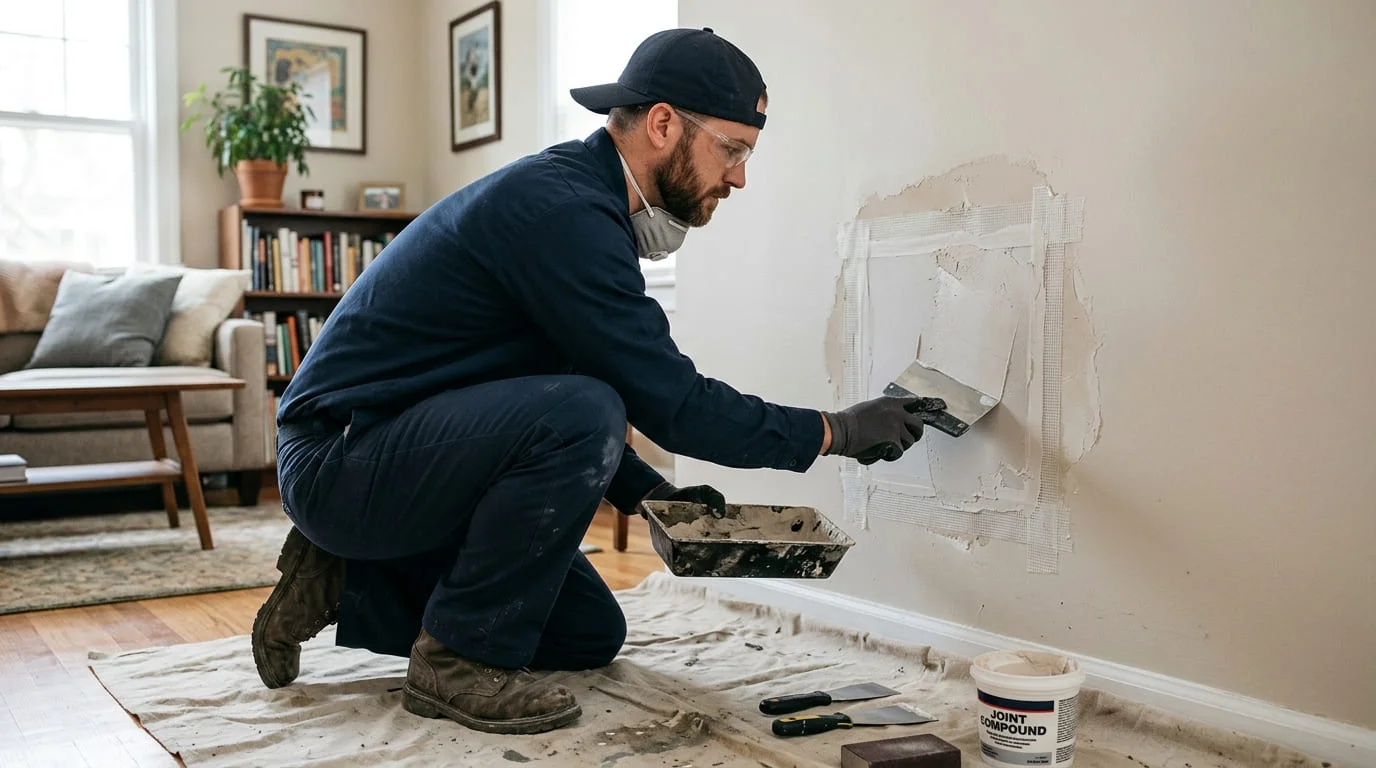
Drywall repair is one of the most common home maintenance tasks — and one of the most commonly done inadequately. A patch that looks good for the first few months and then develops cracks, a repair that's visible under raking light because the texture doesn't match, or a fix that doesn't include any structural backing and collapses under the first coat of compound. Understanding the right approach for different repair sizes produces results that actually hold up.
Small Holes (Under 4 Inches): Self-Adhesive Patch Method
Door handle impacts, picture hooks, and wall anchors removed during a move all produce small holes that don't require complex repairs. For holes under 4 inches in diameter, a self-adhesive fiberglass mesh patch applied over the hole provides the backing that keeps the compound from cracking as it dries over the unsupported opening.
Apply the patch, then apply lightweight joint compound over it with a 6" knife, feathering it 3–4 inches beyond the patch edges. The compound will shrink slightly as it dries. Apply a second coat once the first is fully dry (the compound turns uniformly white — no gray wet areas), feathering wider. A third thin skim coat levels the surface. Sand with 120 grit, followed by 220 grit for a smooth finish. Apply texture to match the wall surface, prime, and paint.
Medium Holes (4–8 Inches): California Patch Method
The California patch (also called the clip method) is the cleanest approach for medium-sized holes. Cut the hole into a clean square or rectangle using a drywall saw. Cut a piece of new drywall slightly larger than the hole — the patch piece should be 2 inches larger than the hole on each side. Score the back of the patch piece, snap it, and peel away the gypsum from a 1-inch perimeter on each side, leaving a paper border.
Apply joint compound around the hole perimeter, press the patch piece in place so the paper borders overlap the existing wall surface, and embed with compound. The paper border bonds to the existing drywall and provides a continuous surface for the compound to adhere to. This method creates a structurally sound patch without requiring separate backing boards.
Large Holes (Over 8 Inches): Full Panel Backing Method
Large holes require backing — wood strips or metal backing plates attached to the inside of the wall to support the new drywall patch. Cut the damaged area back to the nearest studs on each side, or install 2x4 backer pieces inside the wall cavity at the edges of the cut-out. Cut a piece of new 1/2" drywall to fit, secure it to the backing with drywall screws, tape all seams with paper tape embedded in compound, and build up with additional thin coats of compound. Sand, texture, prime, and paint.
The Keys to Invisible Repairs: Thin Coats and Patience
The two variables that separate professional-quality drywall repairs from visible patches are coat thickness and drying time. Joint compound applied more than 1/4 inch thick in a single coat will crack as it dries — the outer surface dries and skins over while the interior is still shrinking. Apply thin coats, let each dry completely, and build the repair to level gradually. In Palm Bay's summer humidity, drying can take 24–48 hours per coat rather than the 4–6 hours a product label assumes in a dry climate.
Texture Matching: The Make-or-Break Step
A perfectly leveled patch that doesn't match the surrounding texture will be visible every time the light hits the wall at an angle. Orange peel — the most common texture in Palm Bay homes — is applied with a hopper gun or aerosol texture can. Knockdown requires spraying and then flattening with a knife at the right moment. Sand texture is typically mixed into the final coat of compound before application.
Aerosol texture cans work adequately for small repairs and are the right DIY tool for occasional patch work. For large repairs or repairs in prominent locations, professional texture matching with a hopper gun produces better results because the pattern and density can be dialed in to match the existing wall more precisely.
For drywall repair and texture matching in Palm Bay, call (877) 916-5930 or visit our drywall repair service page. We match textures correctly and leave repairs that blend.