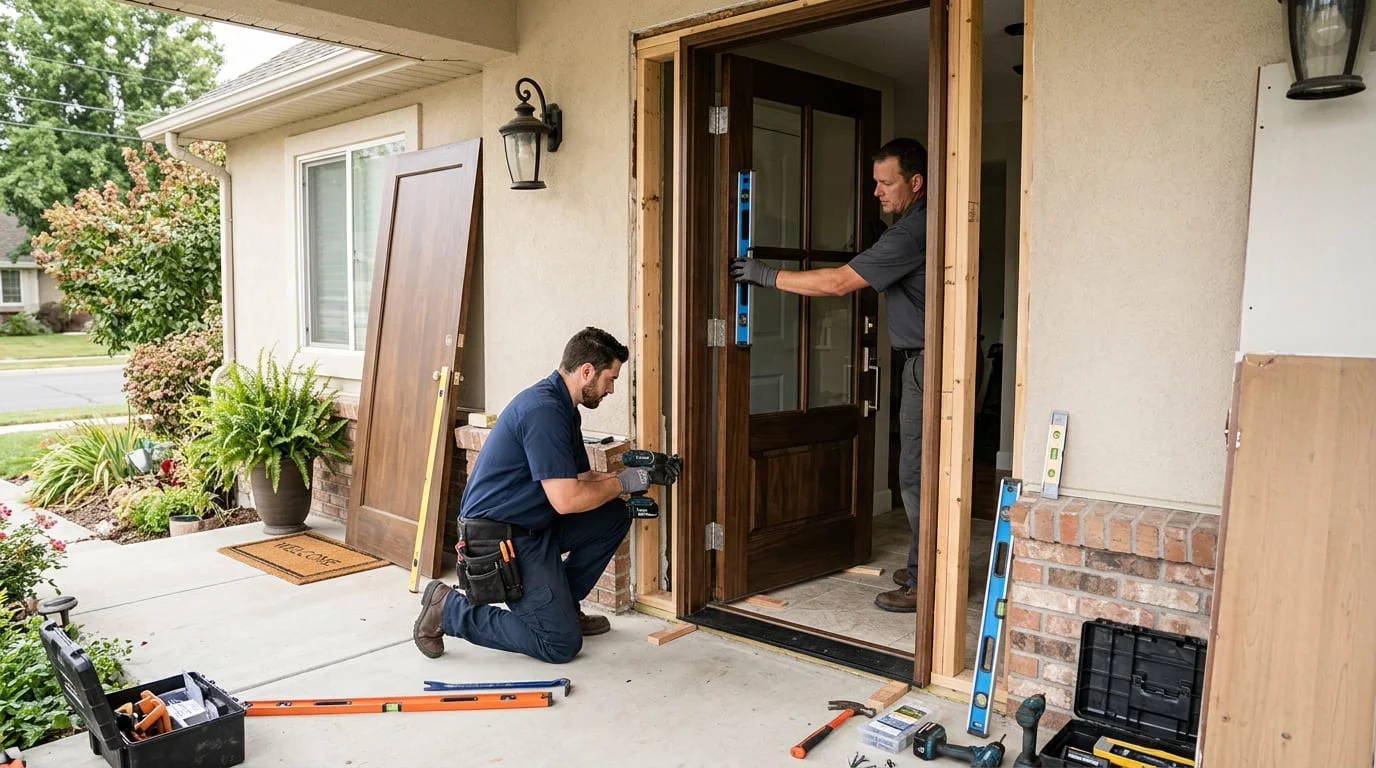
A door that sags, a cabinet that won't stay closed, a hinge that squeaks or wobbles — all roads lead to the hinge. Hinge adjustment and replacement in Palm Bay covers everything from cabinet door European hinges that have drifted out of alignment to exterior door butt hinges corroded by salt air. Most hinge problems look worse than they are and can be resolved quickly with the right diagnosis.
Hinge Services in Palm Bay
- Cabinet hinge adjustment — dialing in European concealed hinges so doors hang flush, close fully, and stay shut
- Cabinet hinge replacement — swapping failed or broken concealed hinges with matching soft-close or standard replacements
- Door hinge adjustment — correcting a sagging door by adjusting hinge position on frame or door
- Door hinge replacement — installing new butt hinges to replace corroded or worn originals, matched to your existing finish
- Stripped screw hole repair — filling and re-drilling stripped hinge screw holes in door frames and cabinet boxes
- Soft-close hinge upgrade — replacing standard cabinet hinges with soft-close versions for a quieter, more refined feel
Common Hinge Problems in Palm Bay Homes
Kitchen and bathroom cabinet hinges in Palm Bay take a beating from the humidity. European concealed hinges have multiple adjustment points — height, depth, and lateral — all of which can drift as the cabinet box moves slightly with humidity cycling. The result is cabinet doors that hang crooked, gap at the top or bottom, or fail to stay closed. These adjustments take a few minutes per door and require no new hardware.
Exterior door hinges face a different challenge: corrosion. Palm Bay's proximity to the Indian River and the Atlantic means salt air reaches even inland neighborhoods. Steel hinges on exterior doors, particularly those on the east or south exposure, corrode and pit within a few years without maintenance. Once corrosion reaches the hinge barrel and pin, the door begins to sag noticeably and the hinge needs replacement, not lubrication.
Is It the Hinge, the Door, or the Cabinet?
Before replacing a door, a cabinet box, or an entire piece of hardware, it's worth ruling out the hinge first — because in our experience, the hinge is the actual problem more often than homeowners expect. A door that has started dragging on the floor on the latch side, a cabinet door that hangs slightly lower on one corner than the other, or a door that swings open or closed on its own without being touched are all classic hinge symptoms that get misdiagnosed as "the door is warped" or "the cabinet is out of square."
- Door drags only on the latch side — almost always a worn or loose hinge on that side, not a warped door
- One cabinet door corner sits lower than the other — a European hinge that's drifted out of vertical adjustment
- Door swings open or shut on its own — the hinge pin or barrel is worn enough that the door is no longer held in a neutral position
- Squeaking that doesn't go away with lubrication — the hinge pin and barrel have worn enough that lubricant can't fill the gap; the hinge needs replacement
- Cabinet door slams shut hard or won't latch softly — the hinge's built-in closing tension has degraded, common on older soft-close hinges
A two-minute hinge check before assuming a bigger problem saves money — and in most cases, it is the hinge.
Our Hinge Adjustment and Replacement Process
Hinge work is precise, low-drama work when done methodically. We follow the same sequence whether it's a single cabinet door or a full set of exterior door hinges.
- Step 1 — Test the door or cabinet through its full range of motion: we open and close slowly, noting exactly where it binds, drags, or fails to seat
- Step 2 — Inspect each hinge: checking for loose screws, worn barrels, bent leaves, corrosion, and — on European hinges — whether the adjustment screws are at the limit of their travel
- Step 3 — Adjust first, replace only if needed: most issues resolve with adjustment alone; we only recommend replacement when a hinge is physically worn, corroded, or its adjustment range has been maxed out
- Step 4 — Repair stripped screw holes: if screws spin freely without gripping, we fill the hole with wood filler or glued wooden plugs, let it cure, and re-drill a clean pilot hole
- Step 5 — Final test under normal use: every door and cabinet is opened and closed multiple times, including a "slam test" for cabinet doors to confirm soft-close function works as intended
Adjusting European Concealed Hinges: What Each Screw Does
Most kitchen and bathroom cabinets installed in Palm Bay over the last 20 years use European-style concealed hinges (commonly Blum, Salice, or Hettich), which have three independent adjustment screws — and most homeowners have never touched any of them. The depth screw controls how far the door sits from the cabinet face, fixing doors that stick out too far or sit too far in. The height screw raises or lowers the door, fixing doors that sit unevenly relative to the door next to it. The side (lateral) screw shifts the door left or right, closing uneven gaps between adjacent doors. A door that "won't stay closed" is usually a side adjustment that's drifted too far open, preventing the hinge's spring mechanism from pulling the door fully shut. Dialing in all three screws on each hinge — typically two hinges per door — usually takes under five minutes per door once the right screw is identified.
Hinge Materials for Palm Bay's Salt Air
Hinge material matters most on exterior doors and on any cabinet near a window or door that's frequently opened to the outside. Standard zinc-plated steel hinges — the most common builder-grade option — corrode visibly within two to four years on east- and south-facing exterior doors in Palm Bay, especially in neighborhoods closer to the Indian River Lagoon and Turkey Creek. Stainless steel hinges cost more upfront but resist this corrosion almost entirely and are worth the upgrade on any exterior door. For interior cabinet hinges, finish is more about appearance than durability — brushed nickel, oil-rubbed bronze, and matte black all hold up well indoors, and we stock common finishes to match existing hardware so a single replaced hinge doesn't stand out against the others.
Hinge Repair Pricing in Palm Bay
Cabinet hinge adjustment: $65–$95 per door. Cabinet hinge replacement: $85–$150 per door. Door hinge adjustment: $75–$125. Door hinge replacement: $95–$175 per door. Soft-close upgrade: $25–$45 per door plus hardware. Bundle multiple doors or cabinets for the best per-unit rate.