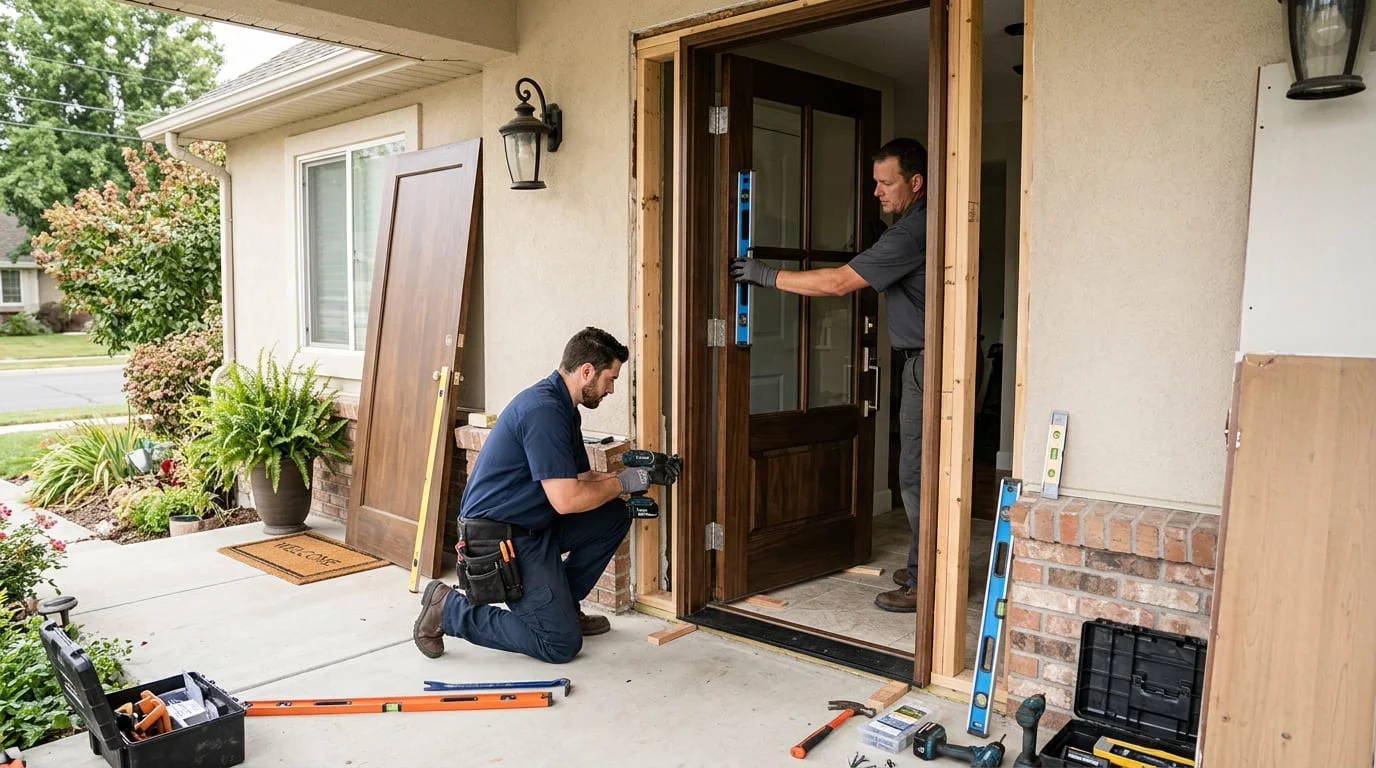
A door that sticks, binds, drags on the floor, or won't latch properly is one of the most common repair calls in Palm Bay — and one of the most misunderstood. Most homeowners assume it means the door or frame needs replacing. In reality, the vast majority of door alignment problems in Palm Bay are caused by humidity-driven wood swelling or minor foundation settling, both of which can be corrected without replacing anything.
Door Alignment Services in Palm Bay
- Hinge adjustment and tightening — loose or misaligned hinges are the most common cause of a sagging door that won't latch
- Strike plate repositioning — moving the strike plate to match where the latch actually lands after frame movement
- Door planing — trimming the sticking edge so the door swings and closes freely
- Frame squaring — adjusting a racked door frame caused by foundation settling
- Door edge sealing — sealing all door edges to slow moisture absorption and reduce seasonal swelling
- Threshold and sweep adjustment — correcting doors that drag on the floor or leave gaps at the bottom
Why Palm Bay Doors Go Out of Alignment
Palm Bay's humidity swings between 60% in winter and 90%+ during summer. Wood door frames absorb this moisture and expand, then contract as humidity drops — often unevenly. Over several cycles, doors that fit perfectly when installed begin to bind on the latch side in summer and rattle in their frames in winter. This is especially pronounced in older Port Malabar homes with original wood frames and doors that have been through 30–50 humidity cycles.
Foundation movement is the second major cause. Palm Bay's clay soil expands when wet and contracts during dry periods, causing slight but measurable foundation movement that racks door frames out of square. The telltale sign is a gap around the door that's wider on one diagonal than the other — the frame has shifted rather than the door swelled.
Signs Your Door Needs Alignment Work
Door problems rarely appear overnight — they build gradually until the door becomes hard to live with. The earliest sign is usually a faint scrape sound as the door swings, often along the bottom corner on the latch side. Next comes difficulty latching: the door appears closed but the latch bolt isn't fully seated in the strike plate, so the door can be pushed open with a light touch or swings open on its own overnight as the house settles slightly. Some homeowners respond by slamming the door harder, which only accelerates wear on the hinge screws and strike plate.
- Visible daylight gaps — uneven gaps around the door frame, especially a wedge-shaped gap that's wider at the top or bottom on one side
- Dragging on the floor or carpet — the bottom corner of the door scuffs the flooring, leaving a worn arc mark on carpet or a scratch line on tile and vinyl
- Door won't stay open or closed on its own — a door that swings shut by itself or drifts open indicates the frame is no longer plumb
- Deadbolt won't throw smoothly — if the key turns hard or the bolt has to be lined up by lifting or pushing the door, the frame has shifted relative to the door
- Cracking paint or drywall near the frame — small diagonal cracks at the corners of the door casing often accompany frame movement and are an early indicator worth addressing before the door itself starts binding
Catching these signs early — particularly before peak hurricane season when exterior doors need to seal and latch properly — keeps a simple hinge adjustment from turning into a full frame repair down the road.
Our Door Alignment Process
Every door alignment call starts with a diagnostic walk-through rather than jumping straight to a fix. We open and close the door slowly, watching where it contacts the frame and listening for where it binds. We check the gap around all four sides of the door with a tape measure or feeler gauge — a consistent 1/8" reveal on all sides is the target for most interior doors, while exterior doors are set slightly tighter against the weatherstripping for a proper seal.
- Step 1 — Hinge inspection: we check each hinge for loose screws, worn barrels, and bent leaves. Tightening hinge screws, or replacing them with longer 3" screws that bite into the framing stud behind the jamb, resolves a large share of sagging-door complaints on its own
- Step 2 — Strike plate check: we verify the latch bolt lines up with the strike plate opening. If the frame has shifted even 1/8", the latch can miss the strike entirely. We re-position the strike plate or file the opening slightly to restore a solid catch
- Step 3 — Door edge evaluation: if the door itself is binding against the frame (not a hinge or frame issue), we mark the contact points with carpenter's chalk, remove the door, and plane the high spots with a sharp hand plane — taking off thin, even passes rather than one heavy cut that can leave the edge wavy
- Step 4 — Frame squaring: for racked frames caused by foundation movement, we use shims behind the hinge-side jamb to bring it back into plumb, checking with a 4-foot level and a framing square at each hinge location
- Step 5 — Final test and sealing: once the door swings freely and latches solidly, we re-seal any planed or exposed wood edges with primer and paint, or exterior-grade sealant on outward-facing doors, to slow future moisture absorption
Tools and Materials We Use for Door Alignment
Door alignment work is precision carpentry, and the tools matter. We carry a sharp block plane and a larger jack plane for trimming door edges — a dull plane tears wood fibers instead of slicing them, leaving a rough edge that catches moisture and swells faster. For hinge work, we use a self-centering drill bit (sometimes called a Vix bit) to drill perfectly centered pilot holes for hinge screws, which is the difference between a hinge that sits flush and one that's slightly cocked.
- Cedar or composite shims — used behind hinges and at the strike side to fine-tune frame position; composite shims resist moisture absorption better than wood shims in humid closets and bathrooms
- 3" exterior-grade hinge screws — replace short factory screws to anchor hinges into the structural framing, not just the thin jamb material
- Wood filler and two-part epoxy filler — epoxy filler is used for stripped or rotted screw holes in exterior door jambs where standard wood filler won't hold a screw long-term
- Exterior-grade primer and paint, or polyurethane sealant — applied to any freshly planed or exposed door edges to seal out humidity
- Adjustable strike plates — for doors that need ongoing seasonal fine-tuning, an adjustable strike plate lets the latch position be tweaked slightly without removing the door
Door Alignment Across Palm Bay's Neighborhoods
Door alignment issues show up differently depending on the age and construction of the home. In older sections of Port Malabar, where many homes were built on shallow slab foundations in the 1960s and 70s, decades of clay soil expansion and contraction have left interior door frames slightly out of square — often just enough that doors that once closed easily now need a firm push. These homes typically need both hinge adjustment and minor frame squaring at the same visit.
In newer construction in Bayside Lakes and San Filippo, slab settling is less of a factor, but humidity-driven wood movement is still very real — especially on exterior doors facing south or west, which take the most direct sun and heat exposure. We see a lot of summer-only sticking on these doors as the wood door slab absorbs ambient moisture during Florida's wet season. Coastal-adjacent homes near Turkey Creek often show faster hinge corrosion on exterior doors due to the combination of salt-laden air and frequent exposure to sprinkler overspray, which keeps hinge hardware damp longer than homes set further from irrigation lines.
Door Alignment Pricing in Palm Bay
Hinge adjustment and strike plate repositioning: $95–$175. Door planing: $150–$250. Frame adjustment for settling: $200–$400. Most jobs completed same-day in a single visit.