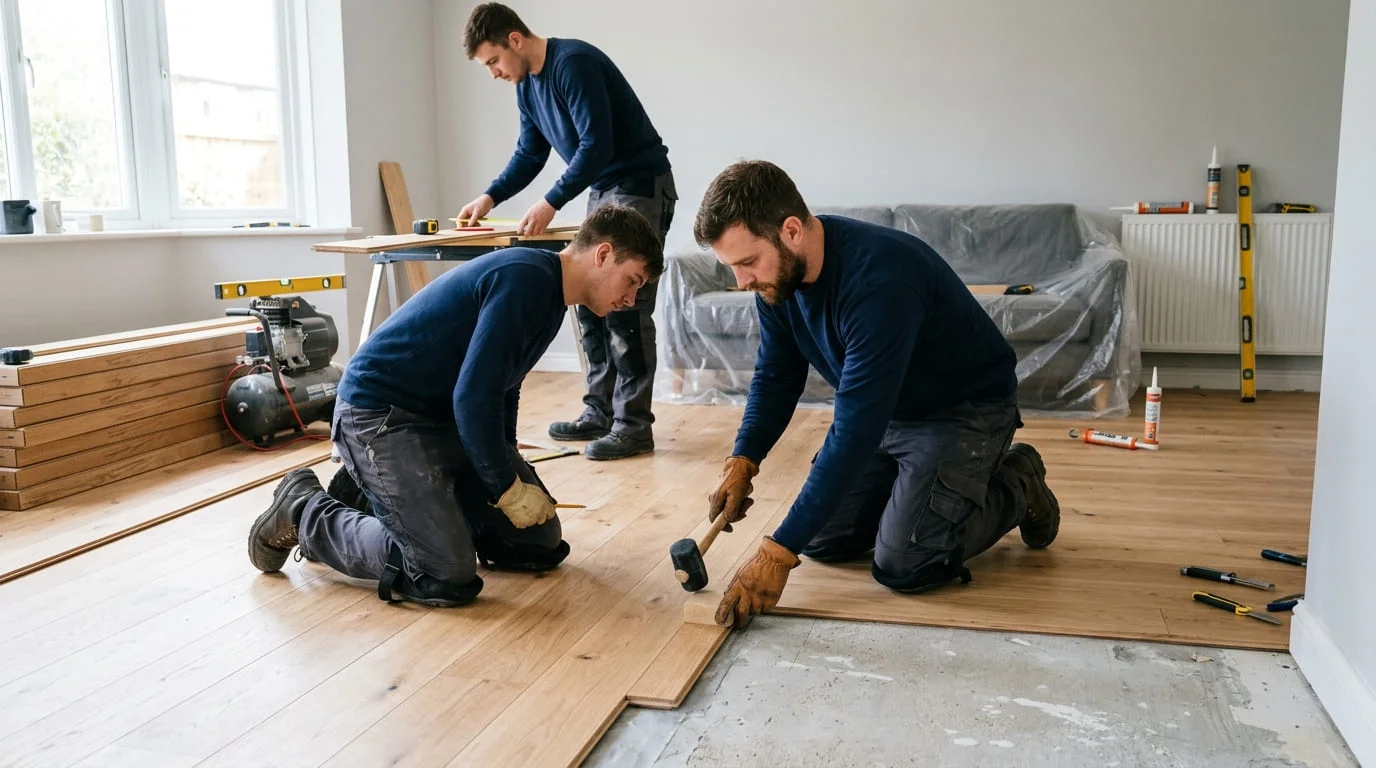
Squeaky floors, bouncy subfloors, and water-damaged boards are among the most common structural complaints in Palm Bay homes. Florida's humidity affects every layer of your floor system — from the subfloor panels that flex as they lose their fastening, to the finished hardwood boards that expand, contract, and gap as the seasons change. Floorboard repair in Palm Bay covers the full range, and the majority of squeak repairs can be completed without touching your finished floor surface.
Floorboard Repair Services in Palm Bay
- Squeak elimination from below — securing subfloor to joists from crawl space for a non-invasive permanent fix
- Squeak repair from above — specialty screws driven from the finished floor surface, countersunk and filled
- Bouncy subfloor repair — adding blocking or sister joists to eliminate subfloor flex in over-spanned sections
- Hardwood board replacement — removing and replacing damaged, cracked, or water-damaged boards with matched species and stain
- Subfloor panel replacement — removing and replacing delaminated or water-damaged subfloor panels before finished floor reinstallation
- Water damage assessment — identifying the source of moisture damage before repair to prevent recurrence
Why Floors Fail in Palm Bay Homes
The subfloor in most Palm Bay homes is OSB or plywood — both of which respond to humidity. As Brevard County's summer humidity causes the panels to expand, the original nails and screws that secure them to the joists are stressed. Over years of cycling, the fastener holes enlarge slightly and the panels begin to move independently of the joists beneath them. The result is the characteristic squeak that occurs every time someone walks over that spot — the panel flexes down, rubs against the fastener, and squeaks.
Water damage is the more serious scenario. Palm Bay's plumbing leaks, roof intrusion, and the occasional appliance overflow can saturate subfloor sections, causing delamination in plywood and complete breakdown in OSB. Soft spots underfoot — especially near bathrooms, kitchens, and washing machine areas — indicate water-damaged subfloor that needs replacement. Ignoring it risks the finished floor failing and, in severe cases, structural joist damage below.
Signs You Need Floorboard Repair
Most floor problems give warning signs long before they become structural concerns. A squeak that appears in one spot and stays confined to that spot is usually a single loose fastener — easy to fix. A squeak that's spreading across a hallway or bedroom over a period of months suggests the subfloor panel itself is working loose along its full length, which takes more time to address but is still a straightforward repair from below if there's crawl space access.
- Visible deflection — you can see the floor flex slightly when someone walks across it, especially noticeable with a glass of water on a side table
- A "spongy" feel underfoot — particularly near tubs, toilets, water heaters, or exterior doors, almost always points to subfloor moisture damage
- Cracking tile or grout lines — tile floors don't flex, so subfloor movement underneath shows up as cracked grout joints or loose tiles long before the tile itself breaks
- Doors that stick or no longer latch in a room with floor problems — can indicate the floor structure has settled or shifted slightly
- A musty smell near a specific section of floor — often the first sign of moisture trapped under vinyl, laminate, or carpet before any visual damage appears
- Nail or screw "pops" — small bumps under carpet or vinyl where a fastener has backed partway out of the subfloor and is pressing against the flooring above
Catching these early matters. A squeak addressed when it's a single loose panel is a 30-minute fix. The same panel left to flex for two more years can crack the subfloor itself, requiring replacement of the panel rather than just re-fastening it.
How We Diagnose and Repair Floorboards
The first step on any floorboard call is figuring out why the floor is doing what it's doing — not just where. We walk the affected area slowly, marking exact squeak locations with painter's tape, and check for a pattern: is it one joist bay, a seam between two subfloor panels, or scattered across the room? The pattern tells us whether we're dealing with a fastener problem, a panel seam problem, or a joist-level issue.
If the home has a crawl space or accessible area below the affected floor — common in many Palm Bay homes built on pier-and-beam or with accessible crawl spaces — that's almost always the preferred repair route. We work from below with a flashlight and a helper walking the floor above to pinpoint exact movement, then install construction adhesive along the joist top plus 1⅝" or 2" coarse-thread screws driven up through the subfloor into the joist. This pulls the panel down tight against the joist permanently, with zero impact on your finished floor above.
For slab-on-grade homes — the majority of newer construction in Bayside Lakes, San Filippo, and other Palm Bay developments — there's no access from below, since the subfloor sits directly on a concrete slab or the home has engineered floor trusses with a finished ceiling underneath. In these cases, repairs happen from above using squeak-elimination kits like the O'Berry Enterprises Squeeeeek No More system: a depth-controlled screw is driven through a breakaway plastic guide that snaps off below the surface, leaving a clean, barely visible hole that gets filled and touched up to match the floor finish.
For hardwood specifically, we use trim screws driven at an angle through the tongue of the board into the subfloor, countersunk and filled with color-matched wood putty — a technique that's invisible once the floor is refinished or even just buffed with matching wax.
Materials and Tools for Floorboard Repair
- Subfloor panels — ¾" tongue-and-groove OSB or CDX plywood, matched to the existing subfloor thickness so the finished floor sits flush after repair
- Construction adhesive — polyurethane-based subfloor adhesive (such as PL Premium) applied to joist tops before re-fastening, which bonds the panel to the joist and resists the humidity cycling that loosens nails over time
- Fasteners — coarse-thread deck screws (1⅝"–2½" depending on subfloor thickness) rather than nails; screws hold through repeated expansion and contraction far better than smooth-shank nails
- Squeak-elimination kits — breakaway-head screw systems for finished floors with no underside access
- Moisture meter — pin-type meter used to check subfloor moisture content before any repair; we don't fasten down a panel that's still wet, since trapping moisture leads to mold and a repeat failure
- Sister joist material — pressure-treated 2x lumber sized to match existing joists, used when a joist itself has sagged or cracked and needs reinforcement rather than the subfloor alone
- Wood filler and matching stain — for finishing screw holes and small board repairs on hardwood so the repair blends with the surrounding finish
We carry a range of subfloor screw lengths and squeak kits on the truck because matching the fastener to the actual subfloor thickness — which varies between ½", ⅝", and ¾" depending on when the home was built — is what determines whether the repair holds.
Crawl Space Access and Humidity Control in Palm Bay
For homes where we're working from below, the condition of the crawl space itself matters as much as the repair. Palm Bay's high water table and frequent heavy rain mean crawl spaces can stay damp for days after a storm, and a damp crawl space keeps subfloor moisture content elevated even after a repair is completed. If we find standing water, missing or torn vapor barrier, or visible mold on joists during a floorboard call, we'll point it out — addressing that moisture source is often what prevents the same squeak (or a worse subfloor failure) from coming back in a year.
Vapor barrier — 6-mil polyethylene sheeting laid across the crawl space floor — is inexpensive and dramatically reduces the moisture reaching the subfloor from below. Homes in low-lying areas near Turkey Creek or closer to the Indian River Lagoon tend to have higher ambient crawl space humidity than homes on higher ground further from the water, and benefit most from a properly installed vapor barrier as part of any floor repair work.
Floorboard Repair Pricing in Palm Bay
Squeak repair from below: $150–$300. Squeak repair from above: $175–$350. Hardwood board replacement: $250–$600 for small sections. Subfloor panel replacement: $300–$800 per section. Water damage repair (combined subfloor and finish): $400–$1,200.