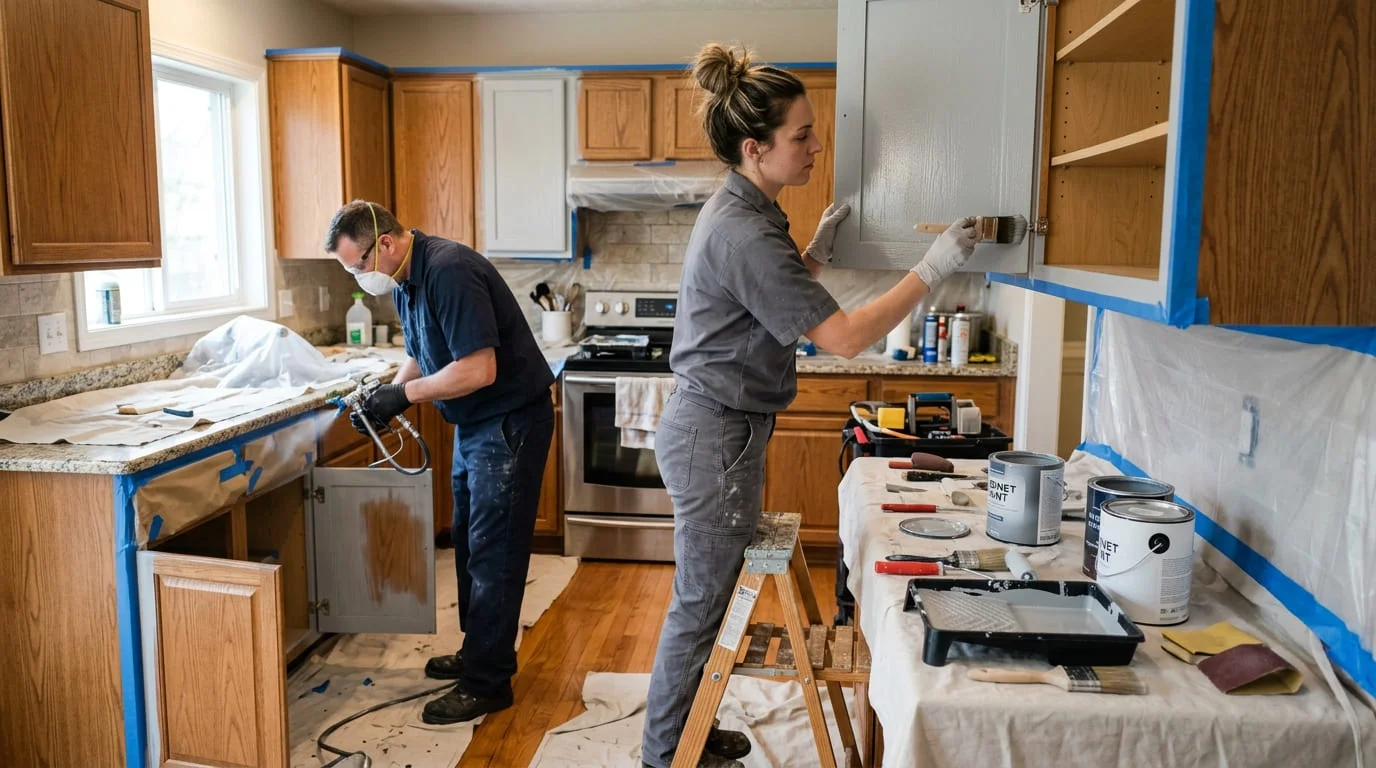
Most Palm Bay kitchens don't need new cabinets — they need the right upgrades. The oak cabinet kitchens that were standard in Brevard County's 1990s construction have solid plywood boxes that will outlast most replacement options. What they have is dated door profiles, worn hardware, and decades of accumulated paint and grease that make them look far worse than they are. Cabinet upgrades in Palm Bay — painting, door replacement, soft-close hardware, and functional improvements — deliver 80% of the visual impact of new cabinets at 20–30% of the cost.
Cabinet Upgrade Services in Palm Bay
- Cabinet painting and refinishing — professional preparation, priming, and finish coating in the color of your choice
- Cabinet door replacement — new Shaker, flat-panel, or custom doors on existing solid boxes
- Drawer front replacement — new fronts to match new doors for a consistent updated look
- Soft-close hinge upgrade — replacing standard hinges with European soft-close concealed hinges throughout the kitchen
- Full-extension drawer slide installation — replacing cheap partial-extension slides with full-extension ball-bearing hardware
- Hardware replacement — pulls, knobs, and handles installed consistently across all doors and drawers
- Interior cabinet organizer installation — pull-out shelves, lazy Susans, and tray dividers added to existing cabinets
- Under-cabinet lighting installation — LED strip or puck lighting under upper cabinets for task lighting
Cabinet Painting in Palm Bay's Climate
Cabinet painting in Florida requires a different approach than in drier climates. The combination of humidity during application and the UV exposure that interior painted surfaces receive through Florida's large windows means that proper primer selection and finish product matters significantly. We use alkyd or waterborne enamel formulations that cure to a hard, washable film — not standard wall paint, which stays soft and picks up fingerprints and chips easily on cabinet surfaces.
Surface preparation is where most cabinet painting jobs succeed or fail. Grease contamination on kitchen cabinets is extensive even when they look clean — it needs to be removed with a degreaser before any sanding or priming, or the finish will peel within months. We clean, degloss, fill imperfections, prime, and apply multiple finish coats. The result is a factory-smooth finish that holds up to daily kitchen use in Palm Bay's humid environment.
Signs Your Cabinets Are Candidates for Upgrades
The question we get asked most often is whether a kitchen needs new cabinets or just an upgrade — and for most Palm Bay kitchens built from the 1990s onward, the answer is upgrade. The key test is the condition of the cabinet boxes themselves, not the doors or finish. Solid wood and plywood cabinet boxes that are square, with drawers that slide smoothly (even if slowly) and doors that close flush, are good candidates for painting, new doors, or hardware upgrades regardless of how dated they look. The warning sign that points toward replacement instead is swollen or delaminating particle board — most commonly seen at the cabinet base under the sink (from years of minor drips) or around the dishwasher (from heat and moisture exposure) — because particle board that's absorbed water doesn't return to its original shape or strength even once dry, and paint won't fix swollen, crumbling material. Sagging doors, hinges that won't hold position, and drawers that bind or fall off their tracks are all upgrade-friendly problems — these are hardware issues, not box issues, and are some of the most cost-effective fixes available.
Our Cabinet Upgrade Process
Cabinet upgrades succeed or fail based on preparation — more than half the work on a cabinet painting project happens before any paint is applied.
- Step 1 — Assess the boxes: every cabinet box is checked for square, solid material, and structural soundness before committing to a painting or refacing scope
- Step 2 — Define the scope: based on the assessment and your goals, we recommend painting only, painting plus new doors, full door replacement with existing boxes, or a combination — with cost and impact tradeoffs explained for each
- Step 3 — Remove doors, drawers, and hardware: everything is labeled and removed to a work area, and all surfaces are cleaned with a degreaser to remove the kitchen grease film that's invisible but present on every cabinet surface
- Step 4 — Prep surfaces: light sanding to degloss factory finishes, filling any dents or holes from old hardware, and spot-priming bare or repaired areas
- Step 5 — Prime and finish: a bonding primer is applied first, followed by multiple finish coats with appropriate dry time between each — rushing this step is the most common cause of premature peeling
- Step 6 — Reassemble and upgrade hardware: doors and drawers are reinstalled, often with new soft-close hinges and slides, and new hardware is installed in a consistent pattern across the kitchen
Cabinet Materials and Finishes for Florida Kitchens
Material and finish choices for cabinet upgrades in Palm Bay should account for the kitchen's combination of humidity, cooking heat, and daily handling. For cabinet doors, solid wood holds paint exceptionally well and can be sanded and repainted multiple times over its life, while MDF (medium-density fiberboard) doors — common on more affordable cabinet lines — paint to a smoother, more factory-like finish but are vulnerable to swelling if the edges are ever exposed to standing water, such as around a sink cabinet. For paint sheen, satin or semi-gloss finishes are the practical choice for kitchen cabinets — they clean easily and resist the humidity-related dulling that flat or matte finishes can develop over time in Florida kitchens, even though matte finishes are currently popular in design trends. Hardware finish matters more in Florida than homeowners often expect: polished brass and unlacquered finishes can develop tarnish or fingerprint marks faster in humid kitchens, while brushed nickel, matte black, and stainless steel finishes hold up to daily handling and humidity without requiring the periodic polishing that brighter finishes need to look their best.
Cabinet Upgrades and Kitchen Resale Value in Palm Bay
Kitchens are consistently one of the top areas buyers focus on when touring a home, and cabinet condition is one of the first things noticed — even before buyers consciously register countertops or appliances. For Palm Bay homes where the existing cabinet boxes are solid (which describes most homes from the 1990s and 2000s), a cabinet painting and hardware upgrade delivers a kitchen that photographs and shows like a much more recently renovated space, at a fraction of what a full cabinet replacement would cost — money that can instead go toward countertops, backsplash, or other visible upgrades that buyers also notice. For resale specifically, neutral cabinet colors — whites, light grays, and warm off-whites — have the broadest appeal and are the safest choice if the home may be listed within the next few years, while bolder colors are better reserved for kitchens the homeowner plans to enjoy long-term. Soft-close hardware is a small detail that buyers notice during a showing — opening a drawer or door that closes quietly and smoothly creates an impression of quality that carries through to how they perceive the rest of the home.
Cabinet Upgrade Pricing in Palm Bay
Cabinet painting (full kitchen): $1,500–$3,500. Door replacement only: $2,000–$5,000. Soft-close hinge upgrade: $400–$800. Drawer slide upgrade: $75–$150 per drawer. Hardware: $5–$10 per piece installed.