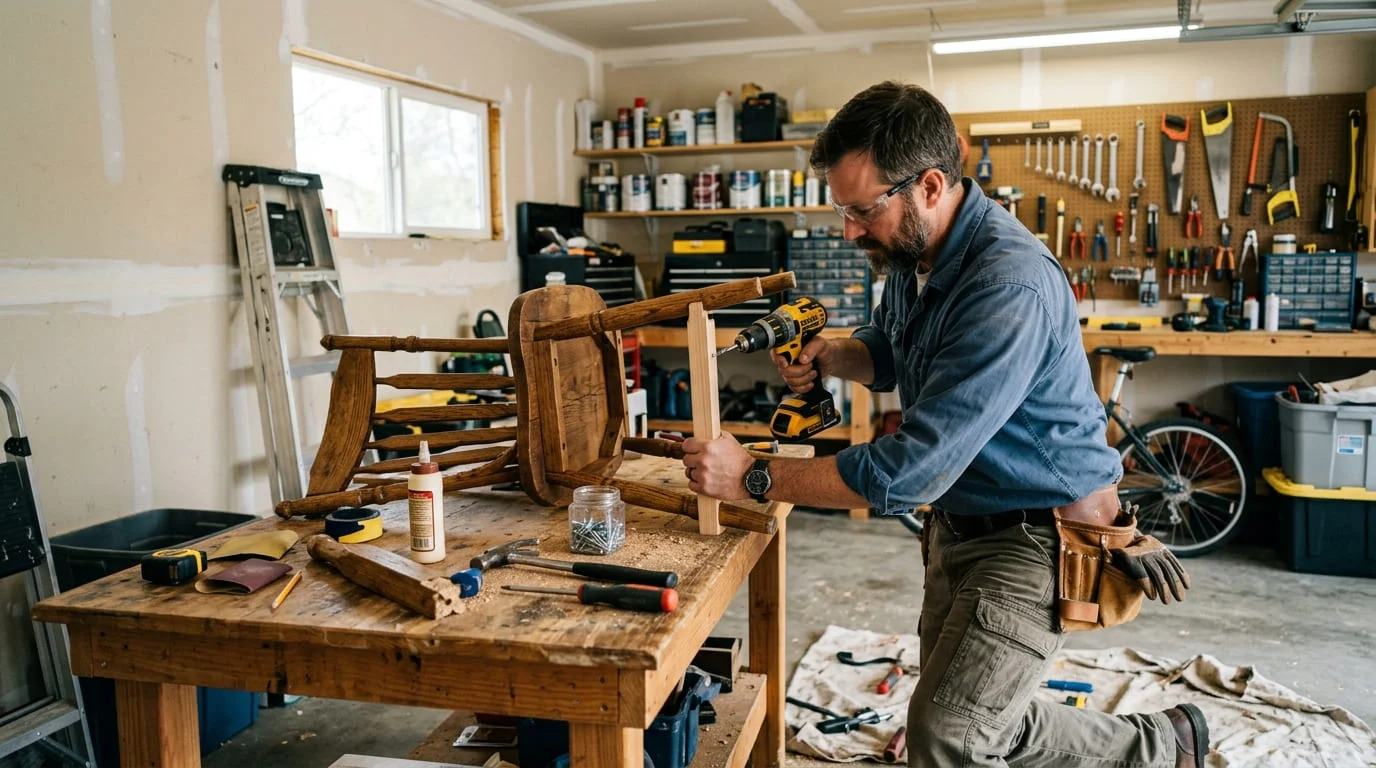
Palm Bay's humidity is hard on furniture. The year-round moisture cycle that makes Brevard County's summers so oppressive does the same thing to wood joints, veneer adhesive, drawer slides, and engineered wood panels — slowly and invisibly, until something breaks, loosens, or falls apart. Furniture repair in Palm Bay is one of the more underutilized services we offer, largely because homeowners assume broken furniture means buying new furniture. In most cases, it doesn't.
Furniture Repair Services in Palm Bay
- Joint re-gluing and structural repair — loose chair legs, wobbly table bases, separating cabinet frames
- Broken leg replacement — sourcing or fabricating replacement legs to match existing furniture
- Drawer slide replacement — replacing failed metal or plastic drawer slides for smooth, reliable operation
- Hinge replacement and adjustment — cabinet and furniture hinges that are bent, stripped, or broken
- Hardware replacement — handles, knobs, pulls, and catches that are broken or missing
- Veneer repair — re-adhering lifted or bubbled veneer on tabletops and cabinet faces
- Water damage repair — swollen panels, warped drawer bottoms, moisture-damaged finishes
- Flat-pack furniture assembly and repair — fixing IKEA and similar furniture that has failed at joints or cam locks
How Palm Bay's Climate Damages Furniture
Solid wood furniture in Palm Bay undergoes constant moisture cycling. During summer, high humidity causes wood fibers to swell, stressing glued joints. During the drier winter months, wood contracts. Over years, this cycling loosens even well-made joints, particularly in chairs and tables that also carry load stress. The fix — disassembly, cleaning of old adhesive, re-gluing with appropriate wood glue, and proper clamping — is straightforward and returns the piece to full strength.
Engineered wood and particle board products are less forgiving. These materials absorb humidity readily and swell, losing their structural integrity once the resin binder is compromised. Drawer bottoms are the first to go in Palm Bay's humid conditions. We replace these with exterior-grade plywood that handles humidity significantly better.
Signs Your Furniture Needs Repair
Furniture problems rarely start as a complete failure — they start small and get worse with use. A dining chair that creaks when someone sits down has a joint that's begun to separate; left alone, normal use eventually pulls it apart entirely. A drawer that's started sticking partway through its travel usually means the slide track has warped slightly or the drawer box itself has swelled with humidity. Cabinet doors that no longer sit flush, or that swing open on their own, often point to worn or stripped hinge screws rather than a problem with the door itself.
- Creaking or shifting when weight is applied — an early sign of a loosening glue joint, most common on chairs, tables, and bed frames
- Drawers that stick, bind, or won't close fully — usually a slide, track, or swelling issue rather than a sizing problem
- Doors or drawer fronts that sag or sit unevenly — typically worn hinge screws or a hinge mortise that's enlarged over time
- Visible gaps at glued joints — a sign the original adhesive has failed and the joint is held together mostly by friction
- Cloudy, bubbled, or peeling finish — often moisture intrusion that, left untreated, can spread to the wood underneath
Catching these signs early keeps a simple re-glue or hardware swap from becoming a full structural rebuild. We can usually assess and repair issues like these during a single visit.
Our Furniture Repair Process
Furniture repair is methodical work — rushing a glue-up or skipping surface prep is why so many DIY furniture repairs fail again within months. Our process depends on what's wrong, but most structural repairs follow the same general path.
- Step 1 — Diagnose the failure: we identify whether the problem is a glue joint, a hardware failure, a material issue (swollen MDF, split solid wood), or a combination
- Step 2 — Disassemble as needed: for joint repairs, we carefully separate the joint, which often requires gently working it apart without damaging surrounding wood
- Step 3 — Clean old adhesive: dried glue residue prevents new glue from bonding properly, so all old adhesive is scraped or sanded from both mating surfaces
- Step 4 — Re-glue and clamp: we use wood glue appropriate to the joint and material — often a PVA wood glue for solid wood, or a stronger epoxy for engineered wood that's lost integrity — and clamp with even pressure for the full cure time
- Step 5 — Reinforce if needed: for joints under repeated stress, such as chair legs and stretchers, we add corner blocks, dowels, or screws for extra holding power beyond the glue alone
- Step 6 — Hardware and finish: drawer slides, hinges, and hardware are replaced or adjusted, and any exposed repair areas are touched up to blend with the existing finish
Repair vs. Replace: Making the Right Call
Deciding whether a piece is worth repairing comes down to three things: the quality of the original construction, the extent of the damage, and what the piece means to you. Solid wood furniture — dining tables, dressers, and bed frames built with mortise-and-tenon or dovetail joinery — is almost always worth repairing. These pieces were built to be repaired; the joinery methods that hold them together are the same methods furniture makers have used for centuries precisely because they can be taken apart and reassembled.
Flat-pack and particle-board furniture is a different calculation. A $150 nightstand with a broken cam-lock joint might cost $80–$120 to repair properly — at that point, replacement may make more sense unless the piece has sentimental value or matches a set you want to keep intact. We'll always tell you honestly where a piece falls on that spectrum rather than charging for a repair that doesn't make financial sense.
Outdoor and Lanai Furniture Repair in Palm Bay
Lanai and patio furniture takes a different kind of beating in Palm Bay. Aluminum-framed furniture is popular because it doesn't rust, but the welds and joint connectors can still fail from years of expansion and contraction in direct Florida sun. Wicker and rattan furniture — whether natural or synthetic resin — dries out and becomes brittle under constant UV exposure, and individual woven strands break loose at stress points like arm joints and seat edges. We repair and re-weave damaged sections rather than replacing the whole piece where possible.
Teak furniture, common on screened lanais throughout Bayside Lakes and Port Malabar, is naturally weather-resistant but its hardware isn't always — stainless steel fasteners are essential for any teak repair near the coast, since standard steel hardware rusts and stains the wood within a season. Sling and strap replacement on patio chairs is another common Palm Bay repair: the polyester webbing degrades from UV exposure long before the aluminum frame does, and replacing it restores the chair to full use at a fraction of the cost of a new set.
Furniture Repair Pricing in Palm Bay
Joint re-gluing: $75–$150 per joint area. Broken leg repair or replacement: $95–$200. Drawer slide replacement: $75–$150 per drawer. Hardware replacement: $50–$150. Veneer and water damage repair: $150–$400 depending on extent.