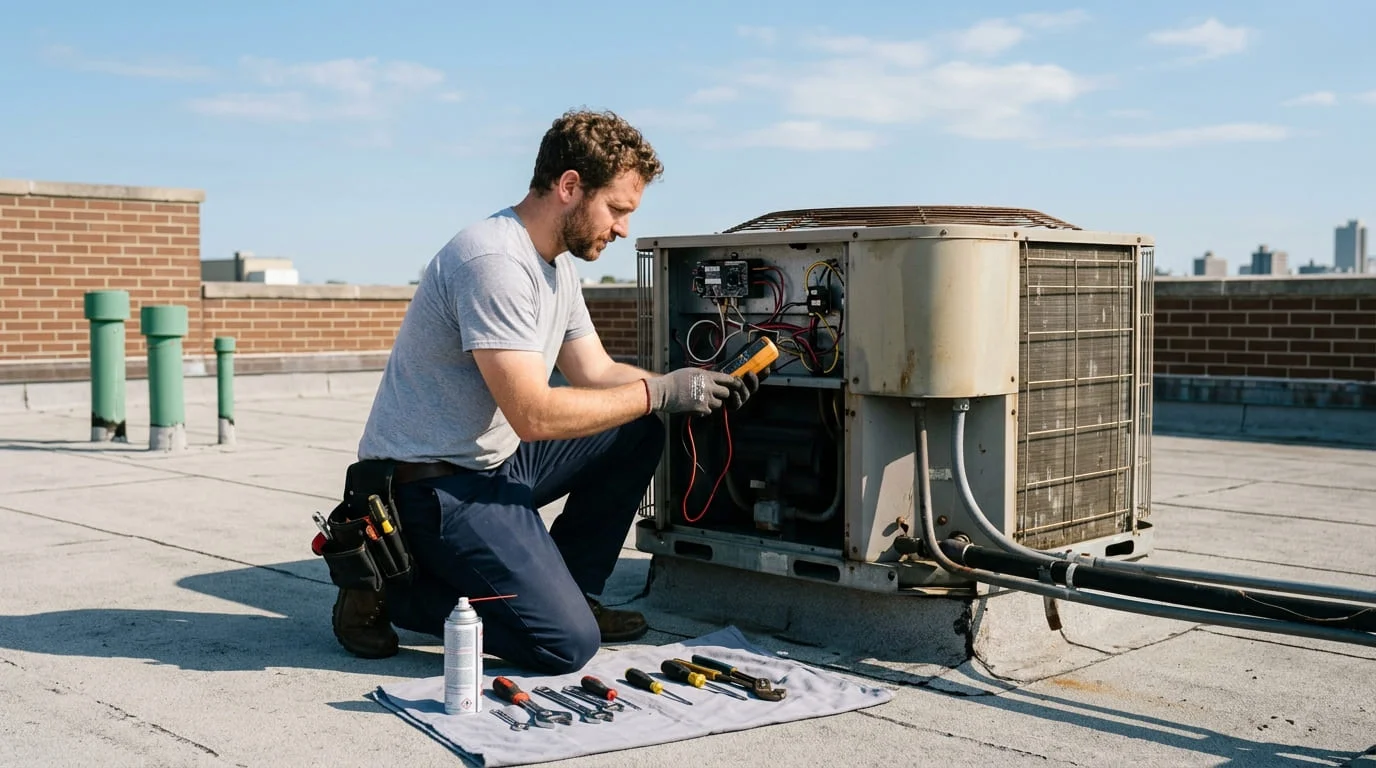
In Palm Bay, your air conditioner isn't a luxury — it's infrastructure. An AC system that runs 10–11 months a year accumulates wear, coil fouling, and condensate drain buildup far faster than systems in northern climates. HVAC maintenance in Palm Bay means addressing the specific failure modes that Florida's heat, humidity, and salt air create — not just running through a generic national checklist.
HVAC Maintenance Services in Palm Bay
- Evaporator and condenser coil cleaning — dirty coils reduce efficiency dramatically; in Palm Bay's dusty, humid environment they foul faster than anywhere else
- Condensate drain line flushing and treatment — algae growth in Palm Bay drain lines is the leading cause of AC shutoffs and water damage
- Air filter replacement — we use the appropriate MERV rating for your system and Palm Bay's pollen and dust levels
- Refrigerant level inspection — low refrigerant reduces cooling capacity and stresses the compressor
- Electrical connection tightening and inspection — loose connections cause component failures and are a fire risk
- Blower motor and belt inspection — worn belts and failing motors are caught early before they cause a full system shutdown
- Thermostat calibration — miscalibrated thermostats cause short cycling and uneven cooling across your Palm Bay home
- Mold inspection in air handler — high humidity makes Palm Bay air handlers prone to mold growth that circulates through your home
Why Palm Bay AC Systems Need More Attention
A Palm Bay air conditioner runs roughly 2,500–3,000 hours per year. A comparable system in the Midwest might run 800–1,000 hours. That's three times the wear in the same calendar year. Condenser coils exposed to Brevard County's salt-laden air corrode faster than inland systems. Condensate drain lines in Palm Bay's humidity develop algae growth that, left untreated, causes the drain pan to overflow — often the first sign is a water stain on the ceiling below the air handler.
The twice-yearly maintenance schedule that HVAC manufacturers recommend is the minimum for Florida. Pre-season service in spring catches problems before your system faces its heaviest load months. Fall service addresses the damage accumulated over summer and prepares the system for winter heat pump use.
Warning Signs Your AC Needs Service Now
Most AC failures don't happen without warning — the system gives signs for days or weeks before it stops cooling completely, but the signs are easy to dismiss as "it'll be fine" until it isn't. Warm air blowing intermittently, especially during the hottest part of the afternoon, often means the system is struggling to keep up with the load and is a step away from not keeping up at all. Ice forming on the refrigerant lines or the indoor coil — visible as frost on the copper line running to the outdoor unit — indicates a refrigerant or airflow problem that gets worse the longer the system runs in that condition. Water pooling around the indoor air handler is one of the most urgent signs in Palm Bay: it usually means the condensate drain line is clogged with algae and the overflow safety switch either hasn't tripped yet or has failed.
- Warm air during peak afternoon heat — system is losing capacity under load
- Ice on refrigerant lines or indoor coil — refrigerant or airflow issue that worsens with continued operation
- Water around the air handler — likely a clogged condensate drain, address immediately to avoid ceiling damage
- Rising electric bills with no usage change — declining efficiency, often from dirty coils or low refrigerant
- Musty odor from vents — mold or algae growth in the drain pan or ductwork
- System short-cycling — turning on and off in quick bursts rather than running full cooling cycles
Our HVAC Maintenance Visit, Step by Step
A thorough maintenance visit takes time because each step addresses a specific Florida-climate failure mode — rushing through it defeats the purpose.
- Step 1 — Safety shutdown: power is shut off at the disconnect before any panels are removed or coils are accessed
- Step 2 — Condenser coil cleaning: the outdoor unit's coil fins are cleaned with an appropriate coil cleaner and rinsed, removing the dirt, pollen, and salt residue that restrict airflow over the coil
- Step 3 — Evaporator coil check: the indoor coil is inspected for dirt buildup and cleaned if accessible — a dirty evaporator coil is one of the biggest hidden efficiency killers
- Step 4 — Condensate drain flush and treatment: the drain line is flushed clear with a wet/dry vacuum from the outside termination point, and an algaecide tablet is added to the drain pan to slow regrowth until the next visit
- Step 5 — Refrigerant pressure check: pressures are measured against the manufacturer's specification for the outdoor temperature, identifying low refrigerant from a slow leak before it affects cooling
- Step 6 — Electrical and capacitor inspection: connections are tightened, and the run/start capacitors are tested — capacitors are a leading cause of AC failure in Florida's heat and often fail without warning once they're outside their tolerance range
- Step 7 — Filter replacement and final test: a fresh filter is installed, the thermostat is calibrated, and the system is run through a full cooling cycle to confirm proper operation
Salt Air and Coastal AC Units Near Turkey Creek and the Lagoon
AC condensers within a mile or two of Turkey Creek, the Indian River Lagoon, or the Atlantic coast face accelerated coil corrosion from salt-laden air. The aluminum fins on a standard condenser coil can show visible white corrosion within just a few years in these areas, and once corrosion penetrates the fins, the coil loses both efficiency and structural integrity — eventually leading to refrigerant leaks at the corroded points. For homes in this zone, we recommend more frequent coil rinsing between full maintenance visits — a simple garden hose rinse of the outdoor unit every month or two removes salt deposits before they cause lasting corrosion. Factory-applied coastal coil coatings are available on new units and as an aftermarket service for existing coils, and significantly extend coil life in these higher-exposure areas. If your system is in a coastal-adjacent neighborhood, mention it when scheduling — it changes what we check and recommend.
One-Time Tune-Up vs. Twice-Yearly Maintenance Plans
A single annual tune-up is better than nothing, but it leaves a six-to-eight month gap during Florida's heaviest run-time months where condensate drains can re-clog and coils can re-foul before the next scheduled visit. Twice-yearly maintenance — spring and fall — keeps the system ahead of these issues year-round and is also a requirement many manufacturers specify, in writing, in the warranty documentation, for compressor and parts warranty coverage to remain valid. If your system is still under manufacturer warranty, skipping documented annual maintenance can be grounds for a warranty claim denial on a failed compressor — a detail that's easy to overlook and expensive to discover after the fact. We can set up a recurring schedule so you don't have to remember to call.
HVAC Maintenance Pricing in Palm Bay
Full preventive maintenance visit: $150–$250 including coil cleaning, drain treatment, filter replacement, and inspection. Add-on refrigerant recharge: $100–$200 depending on refrigerant type. Condensate drain clearing (emergency): $100–$175. Twice-yearly maintenance plans available — ask when you call.