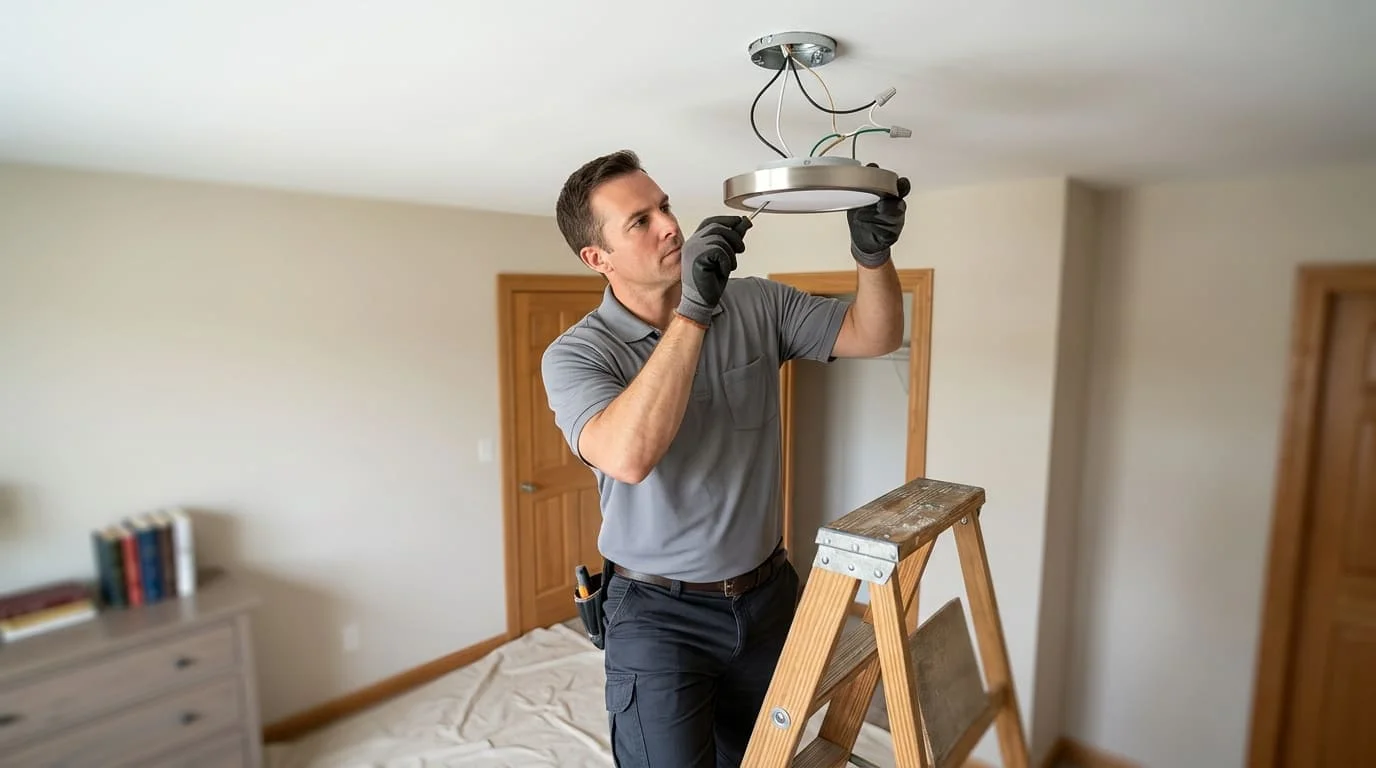
Replacing an existing light fixture is one of the more approachable home improvement tasks — the wiring is usually straightforward, the tools required are basic, and the visible result is immediate. Done correctly with the power properly shut off, it's a safe job. Done incorrectly — or on wiring that has issues you didn't know about — it can create a shock hazard or a fire. This guide walks through the process correctly and clearly flags where the job crosses from DIY territory into licensed electrician territory.
When to DIY and When to Call an Electrician
DIY-appropriate: Replacing an existing fixture with a new fixture of similar type (pendant for pendant, flush mount for flush mount) in a home with standard wiring where the circuit is properly de-energized. Straightforward wire connections — black to black, white to white, bare copper to bare copper or green — with no signs of burning, melting, or overheating at the existing fixture.
Call a licensed electrician:
- Installing a fixture where there was none (requires running new circuit wiring)
- Replacing a standard fixture with a ceiling fan (box must be fan-rated; circuit may need evaluation)
- Any wiring that looks burned, discolored, melted, or has an unusual smell
- Homes built before 1980 with aluminum branch circuit wiring (requires special connectors)
- Older homes with knob-and-tube or cloth-insulated wiring
- Any situation where you're not sure what you're looking at
Tools and Materials
- Non-contact voltage tester (essential — do not skip this)
- Flathead and Phillips screwdrivers
- Wire strippers
- Needle-nose pliers
- Wire nuts (the new fixture usually includes these)
- Electrical tape
- Ladder appropriate for the ceiling height
Step 1: Shut Off the Circuit — and Verify It
Go to the breaker panel and turn off the breaker for the circuit the fixture is on. If you're not sure which breaker controls it, turn on the fixture, then flip breakers one at a time until the light goes off. Label the breaker if it isn't already.
After shutting off the breaker, use a non-contact voltage tester at the switch and at the fixture location to verify power is off before touching any wires. This is not optional. A non-contact tester costs $15 and confirms with certainty that the circuit is de-energized. Never assume the breaker label is correct.
Step 2: Remove the Existing Fixture
Remove the globe, shade, or cover to expose the mounting screws. Unscrew the fixture base from the ceiling box. The fixture will hang by its wires — have someone help you hold it or set it on a step ladder while you work on the connections, so you're not holding the fixture and disconnecting wires at the same time.
Note or photograph how the wires are connected before disconnecting anything. Unscrew the wire nuts and separate the connections. The fixture should now be free.
Step 3: Inspect the Electrical Box
Look at the ceiling box that the fixture was attached to. It should be firmly anchored — no movement when you push it. Check its weight rating (usually printed on the side): standard fixture boxes are rated 35 lbs; fan-rated boxes are rated 50 lbs with additional bracing for dynamic loads.
If you're installing a ceiling fan and the box isn't fan-rated, the box must be replaced before installation. A ceiling fan on a non-fan-rated box is a safety hazard — the motor vibration and dynamic loading will eventually pull the box free of its anchor, and that's a significant risk.
Step 4: Install the New Mounting Bracket
New fixtures include a mounting bracket (crossbar) that attaches to the electrical box. Match the screw pattern on the bracket to the holes in your box — most boxes use a universal 3-1/8" or 4" stud pattern. Thread the mounting screws or attach the bracket per the new fixture's instructions. The bracket is what the fixture hangs from.
Step 5: Connect the Wires
Thread the fixture wires through the canopy (the part that covers the ceiling box). Connect black fixture wire to black house wire, white to white, and bare copper or green to the ground wire in the box. Twist the pairs clockwise and secure each with a wire nut — give each connection a firm tug to confirm it won't pull apart. Wrap the base of each wire nut with a half-wrap of electrical tape for extra security, particularly if the fixture is heavy or in a vibration-prone location.
Tuck all wires carefully into the ceiling box — pinched or kinked wires create long-term issues. Attach the fixture canopy to the mounting bracket per the manufacturer's instructions, install the bulbs within the fixture's rated wattage, restore power at the breaker, and test.
If Anything Looks Wrong, Stop
If you open the ceiling box and find burned insulation, wires that are melted together, or connections that look improvised, stop and call a licensed electrician. A fixture that failed due to a wiring problem isn't fixed by installing a new fixture over the same wiring.
For light fixture installation, ceiling fan mounting, or any electrical work in Palm Bay, call (877) 916-5930 or visit our lighting installation service page. We handle the job correctly, safely, and on your schedule.